Minnesota (with Colette Routel)
and New Mexico (with Fletcher)
and Michigan (with Fort)
NPR (with Marcia Zug and Mary Jo Hunter)
Minnesota (with Colette Routel)
and New Mexico (with Fletcher)
and Michigan (with Fort)
NPR (with Marcia Zug and Mary Jo Hunter)
Ugh, the suspense . . . .
SCOTUS will be releasing more opinions on Thursday.
Previous coverage here.
Here.
We thought it would be helpful to make available a few useful law review articles that parse through the issues raised in the Baby Veronica case.
Indian Child Welfare Act: generally and legislative history
B.J. Jones, The Indian Child Welfare Act: In Search of a Federal Forum to Vindicate the Rights of Indian Tribes and Children against the Vagaries of State Courts, 73 N.D. L. Rev. 395 (1997) (PDF)
Patrice Kunesh-Hartman, The Indian Child Welfare Act of 1978: Protecting Essential Tribal Interests, 60 U. Colo. L. Rev. 131 (1989) (PDF)
Existing Indian Family Exception
Barbara Atwood, Flashpoints Under the Indian Child Welfare Act: Toward a New Understanding of State Court Resistance, 51 Emory L.J. 587 (2002) (PDF)
Christine Metteer, The Existing Indian Family Exception: An Impediment to the Trust Responsibility to Preserve Tribal Existence and Culture as Manifested in the Indian Child Welfare Act, 30 Loy. L. A. L. Rev. 647 (1997) (PDF)
ICWA Constitutionality
Matthew L.M. Fletcher, ICWA and the Commerce Clause, in The Indian Child Welfare Act at 30: Facing to the Future (2009) (PDF)
Here. Judge Allie Maldonado, Judge Tim Connors, and our own Kate Fort are interviewed. [Everyone’s name is spelled wrong, but there’s no spelling on radio….]
An excerpt:
The state law is called the Michigan Indian Family Preservation Act. People in the know shorten it to MIFPA.
As State Court Judge Tim Connors sees it, the law could be a model for the whole state. He get’s really passionate about the law, going so far as to call it “salvation” and “a tremendous gift.” Connors sees MIFPA’s approach as an alternative to breaking apart families when the state takes children away from their parents. Connors is not afraid to say what he thinks about that approach. “The truth of the matter is that what we do in our state courts and (sic) family courts is very destructive to families, to individuals, to children,” he says.
The tribes want families kept out of this system. Their history and a ton of statistics tell them it takes kids a long time to get out, and it can be pretty damaging.
Tribes would rather parents get the help they need to be better parents and keep a family together.
Of course that isn’t always possible. Abusive and neglectful parents should not get to keep their kids under MIFPA or any other law.
But for many other families who have problems, MIFPA says the state needs to work a little harder to connect Indian families to the resources that can make a difference for them and their children. It’s called an “active efforts” requirement. Judge Connors explains it to himself as “following through” and “walking the talk.” Connors also says he thinks the active efforts requirement should be the law for all kids in the state.
Judge Connors highlights something that always gets lost in discussions about the Indian Child Welfare Act — ICWA and MIFPA really are best practices statutes, and when someone asks why Indians should get a “special” statute, the answer is that every child should have these legal rights.
Here.
Lots of internet traffic on this case:
Faculty Lounge (Kate Fort’s Posting)
Constitutional Law Prof Blog (context relating to Indian boarding schools)
SCOTUSblog (argument preview, concluding with a note that the plain language favors tribal interests but Indians fare worse in SCT than prisoners)
Tulalip News (Q&A with Cherokee counsel)
A powerful read. Update — We’ll keep this on the front page of Turtle Talk for a few days.
Here.
An excerpt:
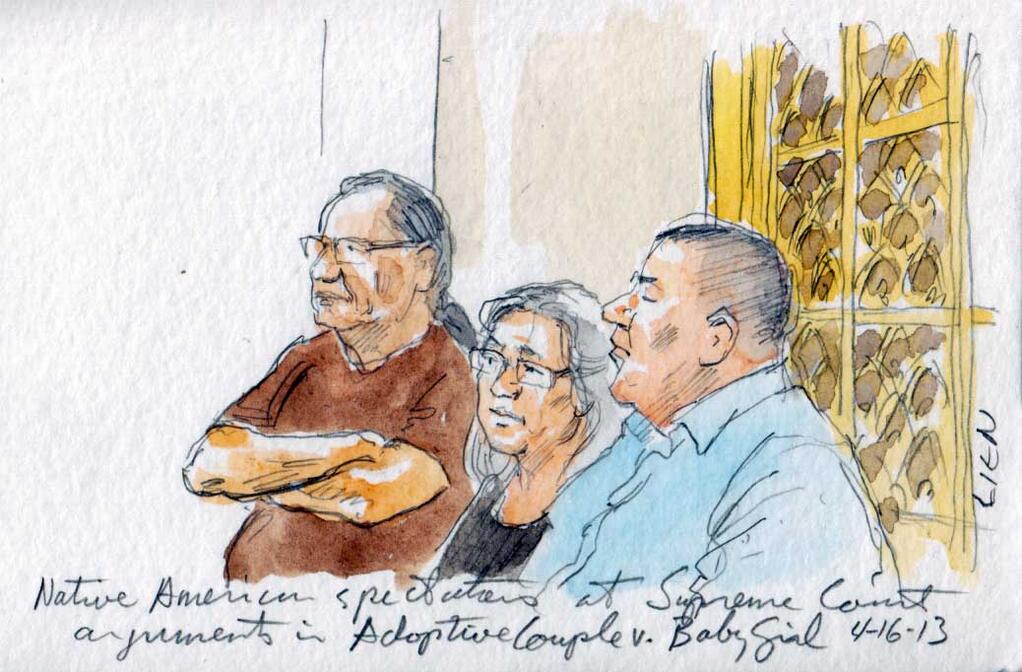
The United States Supreme Court next Tuesday hears argument in a head-spinning case that blends the rank bigotry of the nation’s past with the glib sophistry of the country’s present. The case is about a little girl and a Nation, a family and a People. The question at the center of it has been asked (and answered) over and over again on this blessed continent for the past 400 years: Is the law of the land going to preclude or permit yet another attempt to take something precious away from an Indian?
Update: Kate Fort’s post on the case here on the Faculty Lounge.
Indian tribes, individuals, law clinics, bar associations, and other entities inundated the Supreme Court with amicus briefs in the Baby Veronica case. Here is our guide to the amici (we’ve highlighted the must-read briefs in red):
The United States:
Here.
As always, the most important brief.
The State AGs Brief:
The AGs’ brief may also be the most important amicus brief, in that 18 state attorneys general signed on to a brief drafted and distributed by the Arizona AG. No state AG filed an amicus brief supporting petitioners. While the contents of the brief are important (they attack the existing Indian family exception (EIF) and provide a defense against the federalism attack on ICWA), the mere fact of the brief is very powerful. The Minnesota DHS brief is along the same lines.
The Strategic Briefs:
12-399 bsac Association on American Indian Affairs (aka the NCAI brief)
12-399 Professors of Indian Law Amicus (the legal history brief)
12-399 bsac Seminole Tribe of Florida et al (the constitutionality brief)
These three briefs form the cornerstone of the amicus strategy. As usual, the NCAI brief offers greater national context for the dispute in issue, offering legislative history and even some sociological history. The law profs brief, IMHO the best law profs brief ever filed in the Indian cases before the Supreme Court, is the legal history of ICWA, written by one of the very best legal historians out there, Stuart Banner, former SOC clerk. The constitutionality brief defends against the farthest-reaching attacks of some of the petitioners, that ICWA is unconstitutional. It focuses on the doctrine we call the political status doctrine, first articulated by the Supreme Court in Morton v. Mancari.
Briefs Authored by Supreme Court Specialists:
12-399 bsac CaseyFamilyPrograms (Patricia Millett)
12-399 bsac CurrentandFormerMembersofCongress (Kathleen Sullivan)
12-399 bsac Adult Pre-ICWA Indian Adoptees (Ed DuMont)
It’s unfair to characterize these briefs solely as briefs authored by Supreme Court specialists, but names mean a great deal to clerks when slogging through a very large pile of amicus briefs. The Millett brief may be critically important, given that so many adoption and children’s organizations signed on, responding in force to the petitioners’ adoption policy positions.
Social Science Brief:
12-399 bsac Nat’l Lat Psych Assoc
I guess the closest thing we have to a Brandeis brief in this case. Could be critical, especially since the social science that persuaded Congress to adopt ICWA in 1978 has not aged all that well. Also, it responds directly to the junk science on attachment theory Mark Fiddler keeps pitching. Continue reading
 Turtle Talk
You must be logged in to post a comment.