Here is the opinion in the Matter of the Welfare of the Children of L.K. and A.S.:
Available briefs:
Here is the opinion in the Matter of the Welfare of the Children of L.K. and A.S.:
Available briefs:
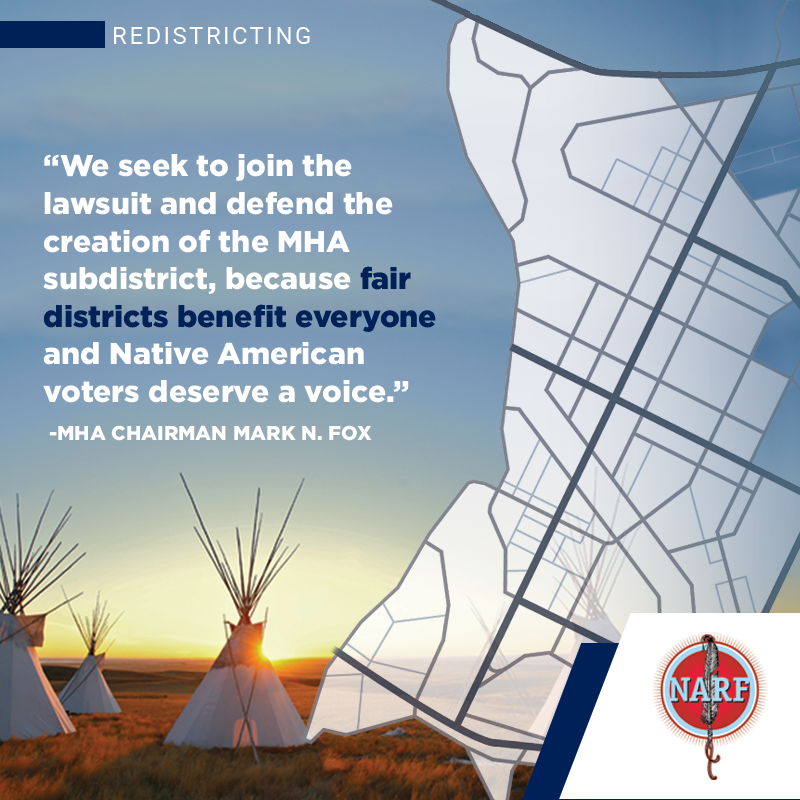
To defend a challenge to a North Dakota State House subdistrict that the North Dakota Legislature approved in 2021, the the Mandan, Hidatsa, and Arikara (“MHA”) Nation intervened as a defendant to support North Dakota. After MHA Nation and the state successfully won summary judgment in the district court, North Dakota is now asking the Supreme Court to vacate the state’s (and the MHA Nation’s) win in the lower court.
Here is the jurisdictional statement from the Plaintiffs.
Here is MHA Nation’s Motion to Dismiss or Affirm.
And here is North Dakota’s Response.
Media coverage:
More here.
Hosted by the Arizona State Bar and the Tribal In-House Counsel Association:
Equal Protection and Indian Law
Co-Sponsored by the State Bar of Arizona and the State Bar’s Indian Law Section
January 17, 2024, 12:00-1:00 (Arizona)
1.0 Total CLE Unit
Join Professor Matthew Fletcher as he discusses recent updates and cases relating to equal protection and Indian Law.
Faculty:
Matthew Fletcher, Harry Burns Hutchins Collegiate Professor of Law, Michigan Law
Chairpersons:
Doreen McPaul, Immediate Past-President, Tribal In-House Counsel Association
Virjinya Torrez, President, Tribal In-House Counsel Association
Register: https://azbar.ce21.com/item/equal-protection-indian-law-601423

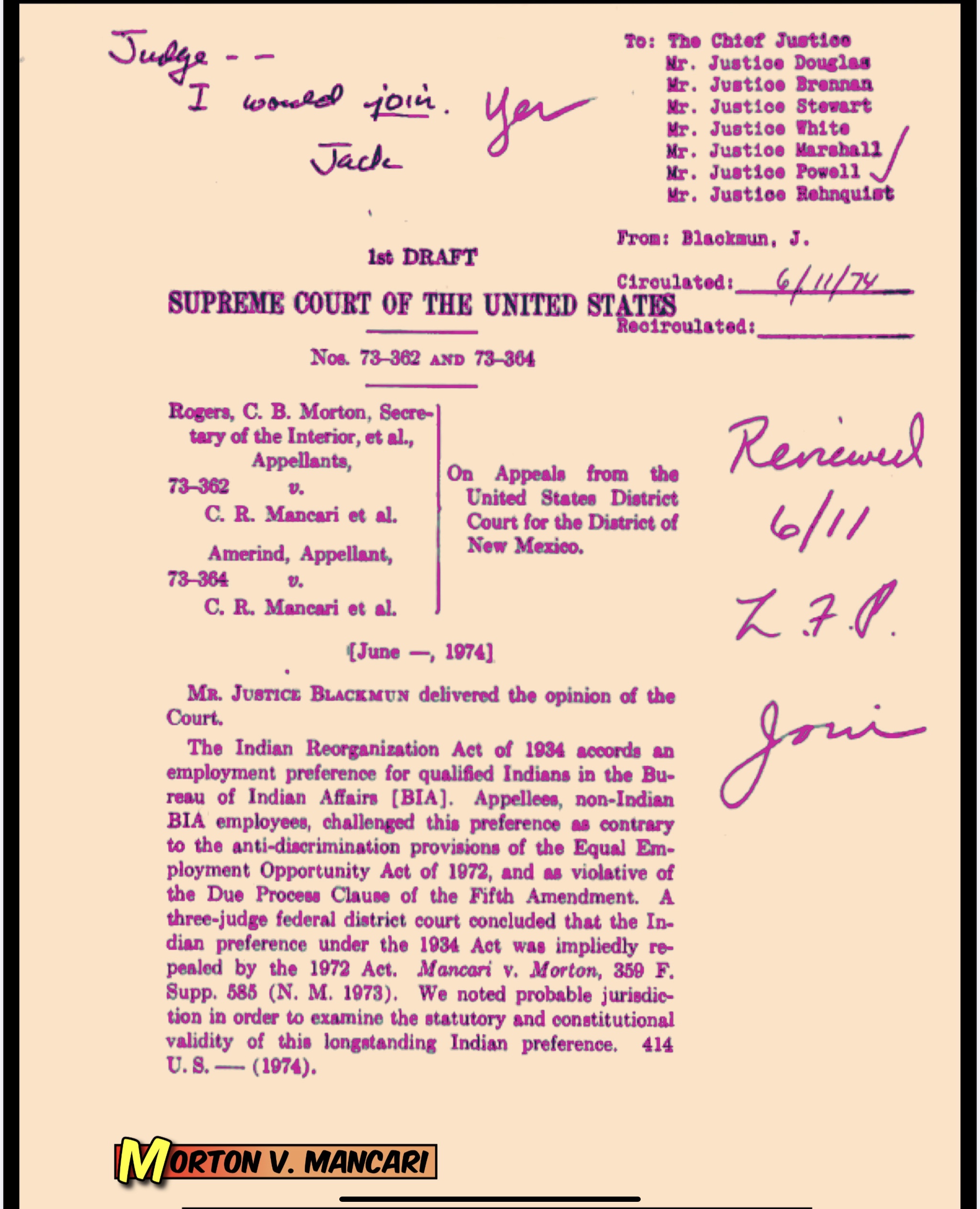
Yes, it’s gonna be at least partially about equal protection matters post-Brackeen, so perhaps it should be called “Shitting On Our Parade.” [comic book here]


This case is also unreported, and not notable for any ICWA holding except for footnote 4, which highlights how ICWA is USUALLY challenged:
4 Again, DCS alleges Parents have waived this issue for failure to raise it below. Parents did argue to the juvenile court during closing argument that the standard of proof should be beyond a reasonable doubt. See Tr., Vol. 2 at 95. They did not, however, offer any basis for that assertion, least of all a state or federal constitutional basis. As DCS points out, in order to properly preserve an issue for appeal, “[a]t a minimum, a party must show that it gave the trial court a bona fide opportunity to pass upon the merits of the claim before seeking an opinion on appeal.” Endres v. Ind. State Police, 809 N.E.2d 320, 322 (Ind. 2004). The juvenile court did not have that opportunity below.
Although we consider Parents’ state due process claim notwithstanding waiver for the same reason we exercised our discretion to decide the jury trial issue, supra n.2, we decline to consider the waived federal equal protection claim. Parents’ equal protection argument is based on the fact that the Indian Child Welfare Act provides that parental rights of Native Americans may be terminated only upon evidence beyond a reasonable doubt. See 25 U.S.C. § 1912(f). The right to a jury in juvenile proceedings and the scope of the state due process clause are matters of settled law in Indiana. But Indiana courts have not had occasion to consider whether the differing state and federal standards violate equal protection, and we will not undertake that analysis when it was not developed at all in the juvenile court and is raised for the first time on appeal.
Waiver notwithstanding, we note that the United States Supreme Court has routinely rejected claims that laws that treat Native Americans as a distinct class violate the equal protection rights of non-Native Americans, see, e.g., United States v. Antelope, 430 U.S. 641, 646 (1977) (concluding “federal regulation of Indian affairs is not based upon impermissible classifications”), and states that have had occasion to consider whether their clear and convincing standard violates the equal protection clause have found no violation, see, e.g., Matter of M.K., 964 P.2d 241, 244 (Okla. Civ. App. 1998) (holding heightened burden of proof required for termination of Native American parental rights is “rationally tied to Congress’ responsibility for policy toward [Native American] families” and lower state standard did not violate non-Native American father’s right to equal protection).
In other words, the Non-Native parents would like to have the same protections ICWA provides Native families.
From JOTWELL, here.
Here are the materials in Fontenot v. Hunter (W.D. Okla.):
33 Ps Motion for Summary Judgment
35 Oklahoma Motion for Summary Judgment
An excerpt:
Although the Court rejects Plaintiff’s challenges under the Due Process and Equal Protection Clauses of the Fourteenth Amendment, as well as those under the dormant Commerce Clause and the First Amendment, the Court finds for the foregoing reasons that Plaintiff has shown that Oklahoma’s American Indian Arts and Crafts Sales Act of 1974, as amended, Okla. Stat. tit. 78, §§ 71-75, violates the United States Constitution’s Supremacy Clause and is therefore unconstitutional, both facially and as applied to her.
Here, on SSRN.
The abstract:
The question whether Congress may create legal classifications based on Indian status under the Fifth Amendment’s Due Process Clause is now reaching a critical point. Critics claim the Constitution allows no room to create race or ancestry based legal classifications. The critics are wrong.
When it comes to Indian affairs, the Constitution is not colorblind. Textually, I argue, the Indian Commerce Clause and Indians Not Taxed Clause serve as express authorization for Congress to create legal classifications based on Indian race and ancestry, so long as those classifications are not arbitrary, as the Supreme Court stated a century ago in United States v. Sandoval and more recently in Morton v. Mancari.
Should the Supreme Court reconsider those holdings, I suggest there are significant structural reasons why the judiciary should refrain from applying strict scrutiny review of Congressional legal classifications. The reasons are rooted in the political question doctrine and the institutional incapacity of the judiciary. Who is an Indian is a deeply fraught question to which judges have no special institutional capacity to assess.
Here is the opinion in Brackeen v. Zinke (N.D. Tex.):
Case page with briefs here.
A federal court has held that ICWA violates the equal protection component of the Fifth Amendment’s Due Process Clause, rejecting the Morton v. Mancari argument and applying strict scrutiny. The court further held that ICWA violated the Tenth Amendment’s prohibition on commandeering state legislative functions. The court more or less summarily rejected the argument that the Indian Commerce Clause authorized Congress to enact ICWA. Finally, the court struck down the ICWA regulations.
Still, there will certainly be an appeal. The case is limited only to the parties involved.
Downloads(PDF): 12.29.2016 – Comment Letter re Emergency Petition – Misc Attorneys an Firms across country, APB Co Comment Letter North Dakota Supreme Court December 2016
Link: “Debate generated by petition for expanded legal representation” by Caroline Grueskin from the Bismarck Tribune,
Previous posts: N.D. Supreme Court Accepting Comments Until December 30th on Proposed Temporary Rule to Allow Out of State Lawyers Practice, Petitioners Request Out-of-State Lawyers Be Allowed to Represent Protesters
 Turtle Talk
You must be logged in to post a comment.