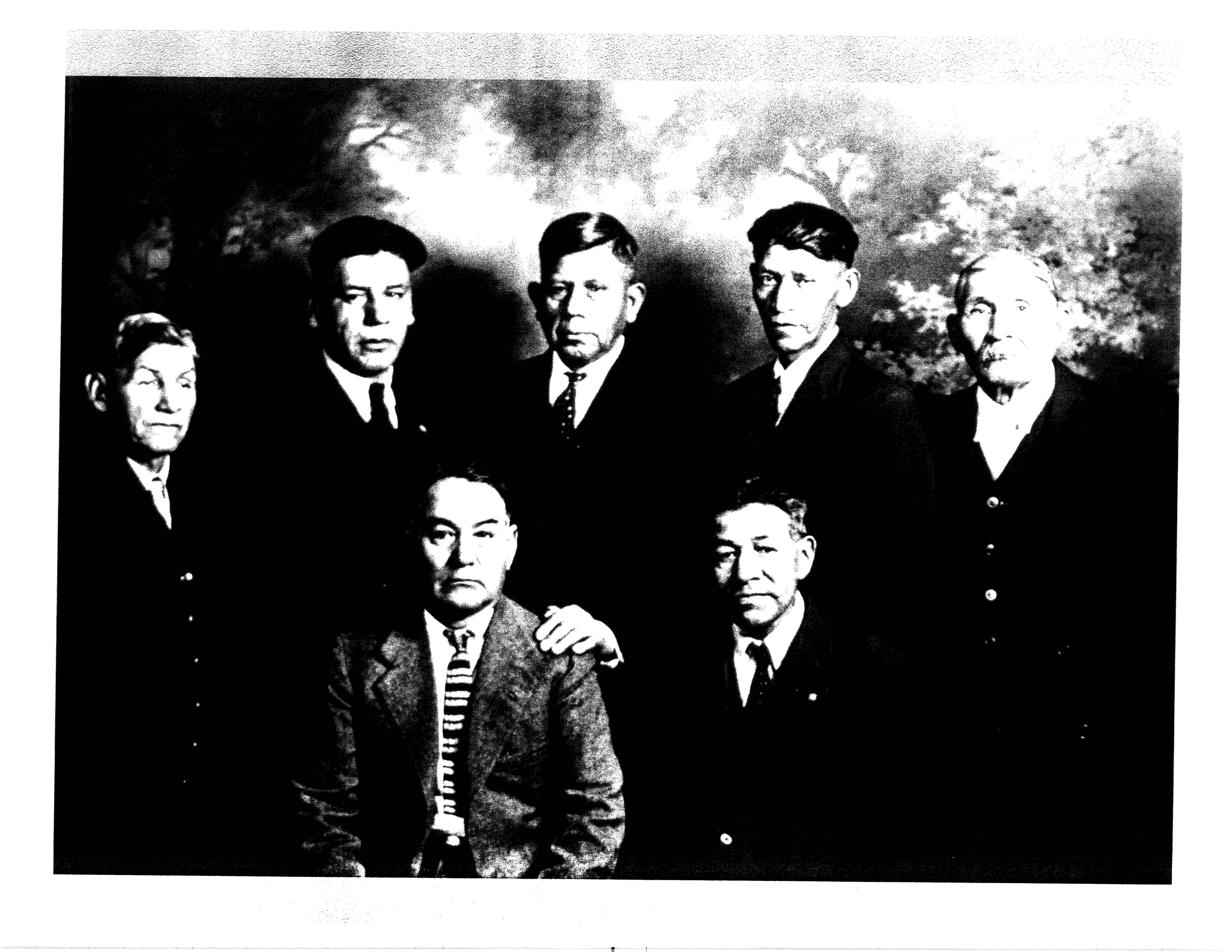
Here’s a pic of the Michigan Indian Defense Association headed by Ben Peshawbe:
And the government offices in Peshawbestown:

Here’s a pic of the Michigan Indian Defense Association headed by Ben Peshawbe:
And the government offices in Peshawbestown:
Here: STNCertPetitionandAppendixMay242010
Lower court materials here.
Cross-posted from First Peoples Blog:
Historian and First Peoples author Malinda Maynor Lowery (Lumbee) writes for us about her tribe’s federal recognition struggle and how recent moves by the Lumbee Tribal Council highlight the fact that every tribe, recognized or not, is still a political entity.

I’m a big fan of the Godfather (there are a lot of metaphors that explain Indian politics in those movies) and so recent events with Lumbee recognition have reminded me that someone else is always pulling the strings.
My book Lumbee Indians in the Jim Crow South (University of North Carolina Press 2010) explores federal recognition and identity formation between the 1870s and the 1950s, a critical period when the Lumbees’ formal political organization developed in the presence of brutal pressure from white supremacists at both local and federal levels. My community responded to this pressure by dividing into strategic factions, and each party developed its own way of dealing with the capricious and subjective identity definitions that Congress and the BIA articulated. These identity definitions revolved in part around stereotypes of Indians, but they also involved comparisons to African Americans. We had to convince outsiders that we were not black, and therefore worthy of separate recognition.
During this period, our political system developed essentially two tiers—a formal, elected leadership, and an informal, unelected leadership. The unelected leaders were the puppeteers, pulling the strings behind the scenes. They were often the most literate members of the community, the ones with the closest personal and political ties to whites, and they believed that they understood the “system” and could make it work for us. To a degree, walking this tightrope between black and white forced these brokers into political compromises that worked against our interests. But the brokers also had their own reasons for making these compromises; often they wanted to shore up their own power and authority within the Indian community by delivering on a promise, and they wanted to increase their clout with the white elites, locally and nationally, who were giving lip service to our recognition efforts.
What these leaders never grasped was that the more you squeeze out of the system, the more autonomy it squeezes out of you, and we are left with compromises that ultimately get us nowhere (the two previous instances of recognition, in 1938 and 1956, are cases in point). So how will it turn out this time?
From Indianz:
The Mackinac Bands of Chippewa and Ottawa Indians of Michigan are asking the Bureau of Indian Affairs to be treated as a federally recognized tribe.
The Mackinac Bands are considered a part of the federally recognized Sault Ste. Marie Tribe of Chippewa Indians. But the bands say they are a distinct and self-governing tribe.
The bands wrote a new constitution to reflect their status.
Get the Story:
New Anishinabe Constitution presented (The Cheboygan Daily Tribune 2/12)
Pathetic. Rank hypocrisy, at the very least.
From the NYTs:
More than 200 years late — 31 if you count from the tribe’s petition — the federal government has acknowledged that the Shinnecocks of Southampton, Long Island, are an Indian tribe. Settling that question raises new ones. The Shinnecocks will almost certainly try to build a casino — they have been lobbying as hard for one as they have for recognition — but how big, and where?
The “where” is an especially interesting question. Casinos are usually built on reservation land. The Shinnecocks live on the East End of Long Island, a national depository of wealth, privilege and privacy. When the tribe jumped the gun a few years back and bulldozed part of its property for a bingo hall, the not-in-my-backyard opposition erupting from the dunes and privet hedges was ferocious. And that was just a skirmish.
That is probably why the Shinnecocks are exploring other sites in Suffolk County, at two New York racetracks and in the Catskills. But building an off-reservation casino is itself fraught with uncertainty and regulatory hurdles. The tribe could end up spending many years and lots of money chasing something that is a guaranteed winner only for lobbyists and consultants.
Casinos are also a magnet for tainted money and a handmaiden to addiction, crime and other social ills. That is why we would urge the tribe to spend its energy on finding other ways to leverage its valuable real estate.
A casino is, after all, only a means to an end — to economic vitality, greater respect, a better future for the tribe’s 1,000 members. The Shinnecocks are now in a much better position to pursue that dream. Lack of federal status did more than hamper the tribe’s quest for gambling riches. It also denied it access to federal programs for housing, health care and education.
The Shinnecocks have a long, proud history of self- governance, and advantages that poorer, more remote tribes can only dream of: geography, bargaining power and the support of state officials including Gov. David Paterson, who endorsed their quest for recognition. The good news on recognition would be even better if the tribe could foresee a future apart from slots and dice.
From the Faculty Lounge:
The Shinnecock Indian Nation ended its 30 year battle for federal recognition yesterday, with the Bureau of Indian Affairs approving the Long Island tribe’s petition. The small tribe of 1,066 people is located in Southampton, in the midst of wealthy beach communities.
This comes as a great victory for the Shinnecocks, who are one of the very few tribes who have emerged successful from the recognition process. Currently, there are 564 federally recognized tribes, and only 8 percent of these tribes have ever been individually recognized since 1960. Poor tribes with limited resources have trouble hiring lawyers, lobbyists, and consultants to guide them successfully through the process. The Shinnecocks paid at least $1.74 million since 2005 in their recognition effort.
The process is incredibly rigorous, with recognition standards often tautologically excluding groups whose conception of “tribe” differs from the federal governments. Many tribes, often Northeastern ones, do not fulfill requirements of “significant rates of marriage within the group” and relative isolation from nontribal members. Tribes historically situated near urban areas and those who have incorporated others as family have not been approved, most notably the Mashpee of Cape Cod.
Recognition criteria, as stated in 25 CFR 83.7, can be found here.
(Picture: Shinnecock oyster farming taken by Gordon Grant for the NYT.)
From the Nation’s counsel:
Here is the most recent opinion in Gristede’s Foods v. Poospatuck (Unkechauge) Nation — DCT Order Granting Stay until August 2010
Here is the latest opinion in Samish Indian Nation v. United States (Fed. Cl.) — Samish Ct Cl Order
An excerpt:
It is readily apparent that the federal government’s failure to treat plaintiff as a recognized Indian tribe between 1969 and 1996 deprived plaintiff of many of the federal benefits enjoyed by other federally recognized Indian tribes during that time period. However, the relief plaintiff seeks is not available in the Court of Federal Claims. Indeed, if plaintiff is lagging behind some of its sister tribes as a result of the deprivation of federal benefits, its avenue for relief is with Congress.
Here — STNRehearingPetition091125
 Turtle Talk
You must be logged in to post a comment.