Judge Richard Blake Honored as Justice Innovator of the Year

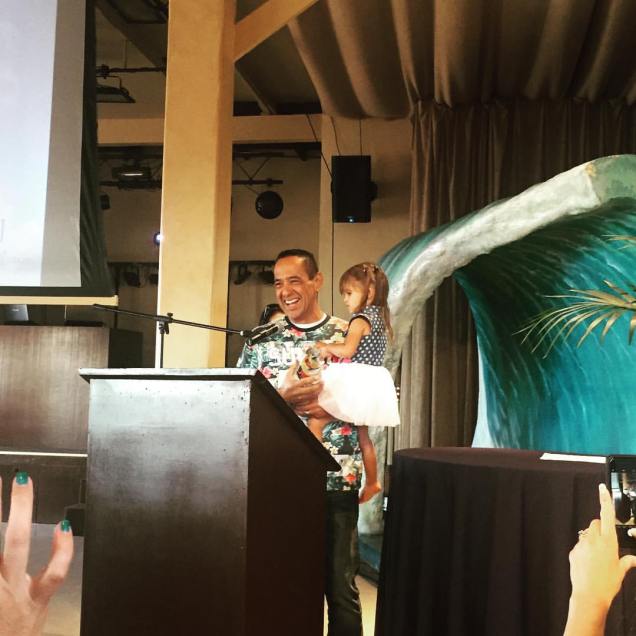
Judge Richard Blake, Chief Judge of Hoopa Valley Tribal Court and Board of Directors President of the National American Indian Court Judges Association, was honored at the NCJFCJ Annual Conference as Justice Innovator of the Year.

The Innovator of the Year Award honors someone who has inspired, sponsored, promoted, or led an innovation or accomplishment of national significance in juvenile justice, child abuse and neglect, family law, and/or domestic violence.

Judge Blake has been a tireless advocate for tribal court judges and has been involved in amazing work in his own Tribe, leading the way in innovative practices in all areas of the law. The work he has done and the sacrifices he has made have been inspirational to many. It is great to see him being recognized on a national level for his efforts.

Congratulations Judge Blake (and his gorgeous daughter who stole the show).

H/T to Nikki Campbell for the picture.

13701142_10106498427336421_6836082684401349210_o

NAICJA Expresses Concern over Alleged Nooksack Attacks on Judicial Independence

Here:

NAICJA Press Release – Judicial Independence

An excerpt:

The Board of Directors of the National American Indian Court Judges Association (NAICJA)—the only membership association of tribal court judges and tribal court personnel in the nation—is concerned by the recent reports that the Nooksack Tribe terminated a tribal court judge because of a decision she rendered in an on-going disenrollment dispute. Although the NAICJA Board takes no position on the underlying controversy, the media coverage suggests that the judge was terminated for ruling against the tribal council. If that proves correct, the action represents a clear threat to judicial independence.

Former Nooksack Judge Susan Alexander released this letter/memorandum to the media a few weeks back:

AlexanderMemo

Northeast Regional Peacemaking Training

The National American Indian Court Judges Association, the Native American Rights Fund, and Columbia Law School offer this training that reviews foundational principles of peacemaking, peace circles, and traditional dispute resolution. While justice practitioners have been focusing on how indigenous peacemaking can help state and federal courts, this training brings the focus back to indigenous and tribal principles of peacemaking and how tribes are using and can use these methods in their own communities. One full day will be devoted to experiential training with peacemakers and notable faculty from across Indian Country.
Registration and more information available here

NAICJA Board of Directors Unanimously Support AG and ILOC Reports

Resolution No. 2015-01
Resolution No. 2015-02

The National American Indian Court Judges Association are supporting the Indian Law and Order Commission’s November 2013 report entitled “A Roadmap for Making Native America Safer,” which “advocates for tribal justice systems to have the ability to fully express their sovereignty by opting out of the current jurisdictional maze, and exercise criminal jurisdiction over all persons without any sentencing limitations, including juveniles.”  However, NAICJA prefers that all individuals charged with crimes under this enhanced tribal jurisdiction be provided with civil rights protections equivalent to those guaranteed by the Indian Civil Rights Act, instead of the U.S. Constitution.

NAICJA is also supporting the November 2014 report from the Attorney General’s advisory committee on American Indian/Alaska Native Children Exposed to Violence entitled “Ending Violence So Children Can Thrive” which “calls for the restoration of the inherent sovereignty of tribes to assert full criminal jurisdiction over all persons who commit crimes against AI/AN children in Indian country.”

Conference on ICWA, Competent Jurisdiction, and Peacemaking, July 29-31 in Albuquerque

A conference will be held July 29-31, 2015 at the Indian Pueblo Cultural Center in Albuquerque, NM.

Day one will be devoted to discussing ICWA, its original intent, and current court cases around the country that have impacted ICWA compliance.

Day two is focused on the term “competent jurisdiction” and how it has been interpreted. Participants will discuss ways that tribes can help educate parties in the legal system to understand cultural and sovereign rights.

Day three will explore the potential for implementing peacemaking in tribal legal systems, particularly in the context of children in need of care.

Full agenda here: Agenda For July 2015 ABQ.

How Lack of Tribal Access to Databases Contributed to Tragic School Shooting

Full article here.

Excerpts from the article:

A flawed reporting system between tribes and outside authorities allowed a man to buy a handgun later used by his son to kill four classmates and himself in Washington state — a problem state and federal agencies have long known about but haven’t fixed.

A domestic violence protection order issued by the Tulalip Tribal Court should have prevented Raymond Lee Fryberg Jr. from buying firearms. But the order was never entered into any state or federal criminal databases, as it would be if it came from a Washington county court.

Critics say that’s because state and federal officials have failed to establish a system that allows tribal courts to enter those orders directly, or create a process that ensures it happens easily.

Fryberg passed a background check when he bought one of the guns his son, Jaylen, used in an October shooting at his high school north of Seattle. Had the protection order been in a database, Fryberg would have failed the check and been denied the gun.

. . . .

A key problem is logistics. There’s no uniform way to enter information on tribal protection orders into state databases or the National Instant Criminal Background Check System, and such reporting is not required by law.

“I can’t think of a single tribe that wants abusers to have access to firearms, but despite our efforts, we keep hitting roadblocks,” said Sarah Deer, a professor at William Mitchell College of Law in Saint Paul, Minnesota.

Stephen Fischer Jr., with the FBI’s Criminal Justice Information Services, said some tribes enter protection orders into a national database themselves, while others have agreements for state or local agencies to do it for them. Some tribes have no involvement with federal and state databases.

Tulalip Tribes attorney Michelle Demmert has said in testimony to the U.S. Justice Department that tribal courts should not have to go through the states to enter data.

“As sovereign nations, we should not be treated as subservient partners to the state,” she said.

. . .

The National Congress of American Indians said entry of tribal court cases often is done through agreements with state or county agencies, but that data entry “is frequently denied or delayed, thus jeopardizing victim safety.”

The organization called on the U.S. attorney general to review how criminal databases are accessed, consult with tribal governments and develop a remedy.

In another article posted on Indianz.com, full article here, Judge Richard Blake, current president of the NAICJA board said,

“This problem is not a local problem or unique to the Tulalip Tribes. The issue of lack of entry of tribal protection orders in state and federal databases is a national crisis,” said Richard Blake, a member of the Hoopa Valley Tribe of California who serves as the president of the board of directors for NAICJA.

At the state level, Blake noted that tribes are barred from submitting data by the Washington State Police. So some tribes, including Tulalip, have entered into agreements in which local courts submit the information to the state database.

But Blake, who served as chief judge for his tribe, said the process is not flawless. Without direct tribal access, cases could fall through the cracks.

“We had hoped that with the passage of the Tribal Law and Order Act of 2010 which mandated the federal government to provide access to federal databases that this critical gap in public safety would be closed,” Blake said. “But here we are five years later and the U.S. Department of Justice and the FBI are still in violation of the statutory requirement that tribes be given direct access to the NCIC system.”

Previous coverage here.
NAICJA Call for Conference Presentation Proposals

Here:

NAICJA 2015 Presentation RFP v020415

NAICJA Announcement: “Developing Tribal Justice Systems in a Public Law 280 State”

Join the National American Indian Court Judges Association and the American Indian Law Center for the second in a series of four upcoming webinars on Emerging Practices in Civil Legal Assistance and Criminal Indigent Defense.  The goal of these webinars is to share four emerging practices that incorporate the philosophy, values, and characteristics of successful and effective legal assistance practices. These webinars will also share and highlight multiple programs that are currently implementing these practices.


Webinar 2 – “Developing Tribal Justice Systems in a Public Law 280 State” Continue reading

NAICJA Conference Venue RFP (2015, 2016 Conferences)

Here:

2014 11 09 _2014 2015 Venue RFP_NAICJA

UNM Law Students Looking for Information on Incorporating Traditional Justice Into Tribal Court Adjudications

A panel of UNM Law Students presented the research they have compiled so far on Tribal Courts and Traditional Justice Systems at the NAICJA conference. The students are currently researching different approaches to implementing traditional justice in tribal courts and would appreciate ideas and recommendations for tribal constitutions, codes, court opinions or other sources of information on this topic. They are working with Professor Scott Taylor, and ideas can be sent to him at: taylor@law.unm.edu.

The UNM Law Students are:

Javiér Amaya, Erica Valdez, Christine Jordan, Concetta Tsosie, EJ John, April Wilkinson

UNM Student Panel

UNM Student Panel 2