Here.
LA Times Article about the Sorry State of Navajo Veterans Housing Situation
Here.
Here.
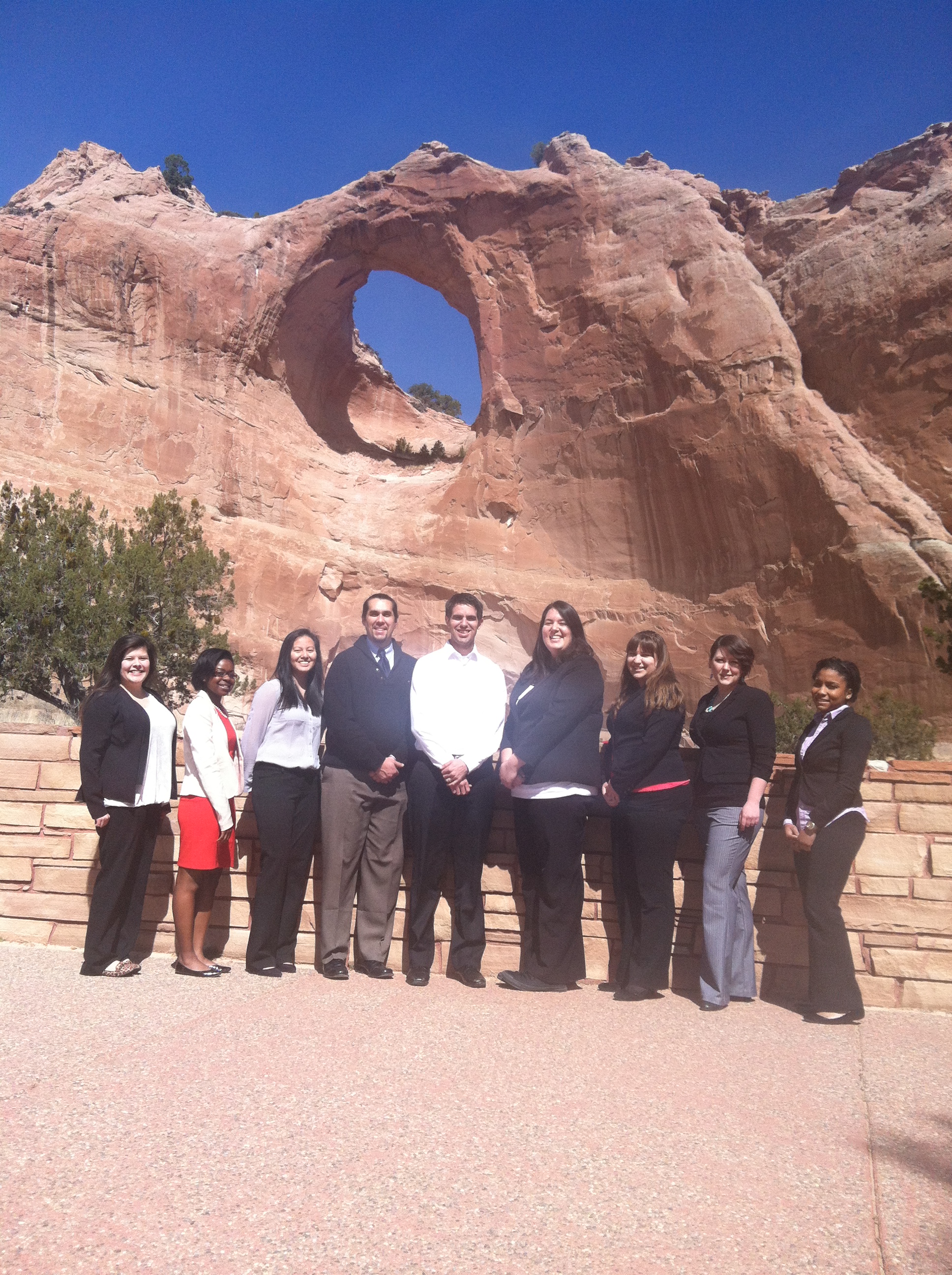
Michigan State University and University of Michigan law students coordinated an alternative spring break to Navajo Nation through the leadership of MSU Law student Tamera Begay and U of M Law student Hunter Cox. MSU students are working at Navajo Nation and U of M students are at DNA Legal Services. Impressive job.
MSU LAW:
Tamera Begay, Emily Smith, John Simermeyer, Chantelle Dial, Patricia Jjemba, Mavis Smith, Elise McGowan, Mike Hollowell, Whitney Gravelle
UofM Law:
Samantha Hall, Breeanna Brewer, Andrew Goddeeris, & Hunter Cox


New Mexico Appleseed
STAFF ATTORNEY
Albuquerque, New Mexico or Santa Fe, New Mexico
Practice Areas: Hunger, homelessness, community development, poverty law, Native American
Job Description
Reporting to Executive Director, the Staff Attorney is responsible for research, analysis, and writing for the organization on a wide variety of poverty-related issues such hunger, homelessness, and foster care. Primary responsibilities include legal research and writing, policy analysis and advocacy, legislative drafting, negotiation, community education, and collaboration with non-profit, community-based, and governmental organizations. This position does not involve litigation. Diverse candidates are encouraged to apply.
Here.
An excerpt:
Leland Morrill was estranged from his Navajo lineage for twenty years. Today, as an author, advocate, and speaker, Morrill shares the unique perspective of how adoption is viewed by Native American family and culture, through the eyes of an adult adoptee.
Here:
SENIOR ATTORNEY POSITION
HUMAN SERVICES AND GOVERNMENT UNIT
NAVAJO NATION DEPARTMENT OF JUSTICE
January 28, 2014
The Navajo Nation Department of Justice is seeking an energetic and motivated Senior Attorney, for its Human Services and Government Unit. The qualified applicant will provide legal advice and representation to various programs, departments and divisions of the Navajo Nation government, regarding a wide range of legal issues, including statutory and regulatory grounds for local authority, contract disputes and procurement issues, and intergovernmental relations. Emphasis will be in the area of Health but could expand beyond that subject.
Current active state bar licensure in any state is required, with the expectation that within a year of hire, the applicant will obtain licensure in the Navajo Nation as well as one of the following states: Arizona, New Mexico or Utah. Preferred qualifications are current membership in good standing in the Arizona, New Mexico, or Utah State Bar Association and the Navajo Nation Bar Association.
Please direct applicant packets consisting of (1) Letter of Interest with current address, telephone numbers, and e-mail address; (2) Navajo Nation employment application; (3) resume; (4) recent legal writing sample; (5) copy of bar membership certificates; and (6) law school graduation documents to Navajo Nation Department of Justice, Attention: Kandis Martine, Acting Assistant Attorney General, Human Services and Government Unit, P.O. Box 2010, Window Rock, AZ 86515, and to the Navajo Nation Department of Personnel Management, P.O. Box 7080, Window Rock, Arizona, 86515.
Please visit http://www.dpm.navajo-nsn.gov/jobs.html to obtain a copy of the Navajo Nation employment application. This is position number 202205 listed on the Navajo Nation’s Job Vacancy Announcement document. Applications are currently being accepted. For any questions, please contact Kandis Martine at 928/871-6935. This position will be available the beginning of February 2014.
Here.
About 50 years ago, Clearwater retraced his great-great-great-grandfather’s footsteps along what Navajo and Mescalero Apache people call The Long Walk. In a series of marches starting in 1864, 9,500 Navajo and 500 Mescalero Apache were forced by the U.S. Army to walk 400 miles from their reservation in northeastern Arizona to the edge of the Pecos River in eastern New Mexico; like the forced march known as the Trail of Tears, thousands died.
H/T DAH
Here is the decision in the Matter of the Protest of Tutt:
This is a case involving state income taxation of an Indian who was domiciled off-reservation, worked on-reservation and had a second place of abode on-reservation. The hearing officer found that the state could not tax the petitioner.
I drafted a paper titled “Tribal Justice Systems” for the Allegheny College Undergraduate Conference “Democracy Realized? The Legacies of the Civil Rights Movement” and posted it on SSRN. You can download here.
Here is the abstract:
This short paper is produced for the Allegheny College conference Democracy Realized? The Legacies of the Civil Rights Movement (March 28-29, 2014).
United States Supreme Court Justice Hugo Black, a former member of the Ku Klux Klan, authored the Court’s opinion in Williams v. Lee, a decision hailed as the opening salvo in the modern era of federal Indian law. The Williams decision was the work of the liberal wing of the Court, with important input by Chief Justice Warren and Justices Brennan and Douglas. Williams, a ringing endorsement of inherent tribal governance authority, more specifically endorsed tribal justices systems as embodied in tribal courts. Without Williams and similar cases, it is unlikely that tribal governments and Congress would act to develop tribal justice systems. Williams, and the tribal courts that arose as a result, was a powerful civil rights decision that commentators rightfully have linked to Brown v. Board of Education.
This paper will survey several tribal justice systems in an effort to identify commonalities and complexities. There are hundreds of tribal justice systems in the United States; each of them unique in the details, but many of them similar to other tribal, state, and federal courts.
The paper is divided into three sections. The first two parts include a section on adversarial tribal justice systems and a section on non-adversarial tribal justice systems, often called restorative justice systems. The third part involves greater discussion of the complexities of incorporating tribal customary and traditional law into tribal common law.
In case one wonders, “Representing Justice” by Judith Resnik and Dennis Curtis influenced the paper.
Here are the materials in United States v. Toledo:
An excerpt:
Defendant–Appellant Dhanzasikam R. Toledo appeals from his conviction of voluntary manslaughter. 18 U.S.C. §§ 1112, 1153. Although the district court instructed the jury on second degree murder and voluntary manslaughter, it denied Mr. Toledo’s request for self-defense and involuntary manslaughter instructions. Our jurisdiction arises under 28 U.S.C. § 1291, and we reverse and remand for a new trial.
 Turtle Talk
You must be logged in to post a comment.