Cert Petition in In re Beaulieu: Chance for SCT to Clarify PL280 Confusion in Minnesota and Wisconsin

Here:

In re Beaulieu Cert Petition

Here are the questions presented:

1. Does Public Law 280 (18 U.S.C. § 1162 and 28 U.S.C. (1360) give the State of Wisconsin jurisdiction to involuntarily civilly commit a member of a federally recognized Indian tribe who is a legal resident of his tribal reservation under Minnesota’s Commitment and Treatment Act (Minn. Stat. Ch. 253B?)
2. Was Minnesota’s involuntary civil commitment of Beaulieu contrary to, and/or an unreasonable application of this Court’s clearly established law limiting Public Law 280’s grant of civil jurisdiction to private civil matters?
Lower court decision here.

DOJ Procedures for Tribes to Request Assumption of Federal Concurrent Criminal Jurisdiction in PL 280 States

Here.

Federal Court Finds Interior Violates Self-Determination Act in Denying 638 Public Safety Funds to Tribes in PL280 States

Here are the materials in Los Coyotes Band of Cahuilla and Cupeno Indians (S.D. Cal.):

DCT Order Granting Los Coyotes Motion

Los Coyotes Band Motion for Summary J

Interior Motion for Summary J

Los Coyotes Reply

Interior Reply

Yakama Tribe’s Efforts to Obtain Retrocession Under P.L. 280

Here’s a news article about the Yakama Tribe’s ongoing efforts to obtain retrocession of state jurisdiction under P.L. 280.

New Scholarship on PL 280 Exemption and Retrocession

Shane Day and Sarabeth Anderson have posted their working paper, “Determinants of Successful American Indian Resistance to the Establishment of State Government Jurisdiction Under Public Law 280: A Comparative Case Study of the Processes of Exemption and Retrocession” on SSRN.

Here is the abstract:

Public Law 280 is a federal law passed in 1953 that grants state governments criminal and some civil jurisdiction over American Indian reservations. In doing so, PL 280 violated the nation-to-nation relationship between Indian tribes and the Federal government and opened the door to greater state interventionism on tribal lands. However, implementation of the law has been quite uneven, resulting in a complex matrix of inter-jurisdictional relationships and conflict. For instance, six states were initially granted “mandatory” PL 280 authority over tribes, with additional states able to apply for jurisdiction under PL 280 through an appeal to Congress. However, in both “mandatory” and “optional” states, certain tribes have been exempted from state jurisdiction. Certain tribal authorities, such as the Red Lake and Warm Springs Reservations, were granted initial exemptions during the initial implementation of the law. Amendments to PL 280 in 1968 also opened up an avenue for tribes to apply for a repeal of state authority, a process known as retrocession. While there is an ample amount of published scholarship examining the history and effects of PL 280, very little work has been conducted in examining cases in which state jurisdiction under PL 280 was initially denied to the states nor cases in which it was subsequently retroceded. This paper presents a typology of state-tribal relationships under PL 280, and seeks to answer the questions of why certain tribes were successful in receiving initial exemptions under PL 280, and why certain tribes, but not others, have been successful in attaining subsequent retrocessions. The paper also outlines a proposed case-based research design and process tracing methodology designed to delve deeper into the various processes and situations identified in our typology.

DOJ Issues Proposed Rule on Tribal Law and Order Act Assumption of Criminal Jurisdiction by Tribes in PL280 States

Here is the proposed rule.

Minn. Supreme Court Affirms Limited Worker’s Comp. Jurisdiction over Indian Country

A divided Minnesota Supreme Court (4-3, at least on the jurisdiction question) held in Swenson v. Nickaboine that the state worker’s comp statute applies to an on-reservation, Indian-owned business where the worker in question was a non-Indian.

Here is an excerpt from the dissent:

The majority holds that Minnesota had subject matter jurisdiction based on 40 U.S.C. § 3172.  But we held in Tibbetts v. Leech Lake Reservation Business Committee, 397 N.W.2d 883, 888 (Minn. 1986), that in section 3172, Congress did not subject the tribe to jurisdiction in Minnesota courts.  The majority distinguishes Tibbetts because that case involved a workers‟ compensation claim brought by a tribal member against a tribe; whereas this case involves an injured worker who is not a tribal member and an employer that is owned by a tribal member but is not a tribal corporation.  But holding that Congress did not waive the sovereign immunity of the tribe in section 3172, as we did in Tibbetts, does not provide a basis for the majority‟s conclusion that Congress, in section 3172, vested subject matter jurisdiction in the state to enforce its workers‟ compensation laws.  In my view, our discussion in  Tibbetts supports the opposite result on the jurisdictional question.

Minnesota Public Radio: White Earth Pushes for More Law Enforcement

From Minn. Public Radio:

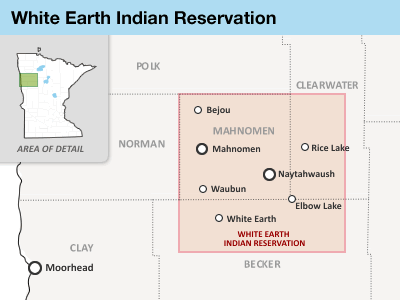
White Earth Indian Reservation, Minn. — Unhappy with the way criminal cases are handled on the White Earth Indian Reservation, tribal officials are seeking more control over law enforcement and the courts.

Tribal officials say local counties don’t prosecute crimes on the reservation aggressively enough.

AN UNEASY RELATIONSHIP

Rape cases particularly are going unpunished on the White Earth reservation, Tribal Attorney Joe Plummer said. Tribal officials want those cases prosecuted to help break the cycle of teen pregnancy and poverty on the reservation.

“These are young girls, 14, 15, 16 years old being impregnated by older men, 21 and older,” Plummer said. “And these are not being prosecuted. I can’t remember when one was prosecuted.”

But county officials strongly disagree. They contend tribal members don’t cooperate with investigators.

The tribe’s dissatisfaction over how criminal cases are handled on the reservation is just one example of the tension between White Earth and Mahnomen County over land, taxes and crime.

“I can’t remember when [a rape case] was prosecuted.”
– Tribal Attorney Joe Plummer

A review of Mahnomen County court records from 2008 to 2009 appears to confirm Plummer’s complaint about the lack of prosecution for criminal sexual conduct cases. But it’s unclear if all of the records from those years are entered in the public database.

When it comes to fighting crime on the White Earth Reservation, counties control the system. The tribe can investigate crimes, but county prosecutors decide who gets charged with a crime.

The two sides often disagree on how cases are handled. It’s one of many areas where the tribe and the county don’t see eye to eye.

COUNTY ATTORNEY: VICTIMS DON’T COOPERATE

Mahnomen County Attorney Julie Bruggeman said she’s not the problem. She said crime victims don’t cooperate with her office.

She also questions whether tribal officials really want justice for all the people accused of a crime. Bruggeman accused tribal officials of wanting to pick and choose who is prosecuted based on tribal connections.

Continue reading

Minnesota SCT Excludes Minnesota Warriors for Justice Candidates from Election

Here are the dual opinions in Paquin v. Mack, and Beaulieu v. Mack.

Interesting cases, in that the Paquin case raised a challenge to state election law based on Public Law 280.

Minnesota American Indian Bar Association 2010 Annual CLE — June 17-18 @ Leech Lake

Brochure here (updated): MAIBA Brochure(4)

Keynotes:

Hon. Korey Wahwassuck, Associate Judge of the Leech Lake Band of Ojibwe Tribal Court

Matthew L.M. Fletcher, Associate Professor of Law & Director of the Indigenous Law & Policy Center, Michigan State University College of Law

Other speakers include:

Colette Routel, Assistant Professor of Law, William Mitchell College of Law

Chris Strandlie, Assistant Cass County Attorney

Frank Bibeau, Legal Director, Leech Lake Band of Ojibwe

Continue reading