Here are the briefs:
Sault Tribe CA6 Substitute Brief
Here.
Here are the materials so far in Saginaw Chippewa Indian Tribe v. NLRB:
Petition for Review – Filed Case No. 13-1569
The NLRB decision is here.
Here is the decision:
Soaring Eagle Board Decision 16APR2013
This comes a few weeks after a similar decision involving the Little River Band of Ottawa Indians.
Update — NLRB Materials:
Administrative Law Judges Decision
SCIT Objections to ALJ Decision
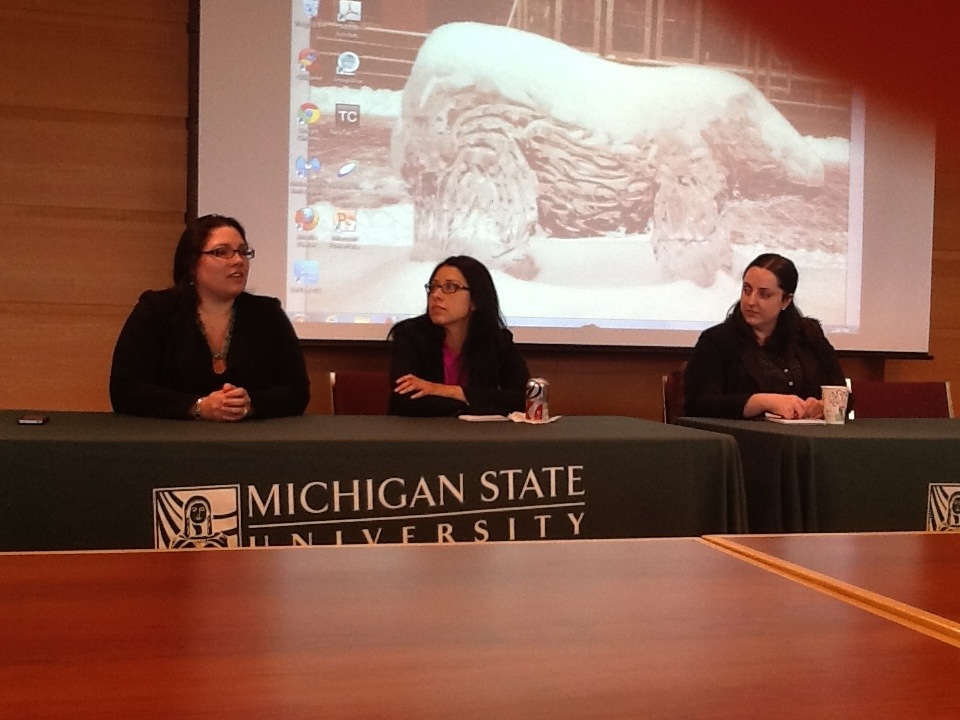
Karrie Wichtman, Sharon Avery, Erin Lane
Here.
Here is a study of the effects of gaming per capita payments on tribal members of three Michigan tribes (Keweenaw Bay Indian Community, Saginaw Chippewa Indian Tribe, and Pokagon Band of Potawatomi Indians). In line with the 1491s’ hilarious video in which a candidate for tribal office runs on the platform of “progression, procreation, per cap,” the study suggests that tribal members receiving per caps leads to “decreased work efforts,” while “weak” evidence exists that per cap payments increase fertility. Enjoy.
Here is the study:
The abstract:
The purpose of this research is to provide a preliminary examination of the effects of per capita tribal payments on the decision making of tribal members. Standard microeconomic theory suggests that unearned income changes the labor-leisure tradeoff in utility maximization models. While the results of per capita payments on hours of work can be easily anticipated, the effects of these payments on human capital accumulation and family size are more ambiguous. Using Census data from 1990 and 2000 we shed some light on the impact of these per capita tribal payments on the lives of the recipients. We concentrate on three tribes in the state of Michigan: the Saginaw Chippewa Tribe, the Keweenaw Bay Indian Community, and the Pokagon Band of Potawatomi Indians of Michigan. The results lend support to the basic labor theory conclusion that an increase in nonlabor income causes individuals to decrease their work efforts. There is also weak evidence that the payment of per capita payments from casino profits is increasing the fertility rate of Saginaw Chippewa tribal families.
Press release:
Tribal council resolution:
From the press release:
The Saginaw Chippewa Indian Tribe of Michigan has planned a Flash Mob Round Dance for Friday, January 11, 2013, at 1 p.m. on the comers of Broadway and Main streets in Downtown Mt. Pleasant, Michigan, in conjunction with peaceful demonstrations entitled Idle No More.
Here.
This morning The Environment Report covered NAGPRA and a road project in Oscoda County where workers uncovered remains. The Department of Transportation is working with the Saginaw Chippewa Tribe.
Also, the Report covered potential invasive species in the Great Lakes and an online resource developed by NOAA’s Great Lakes Environmental Research Lab to identify the species (including killer shrimp. Huh.).
 Turtle Talk
You must be logged in to post a comment.