Addendum to Justice Scalia’s Record

Update to Justice Scalia post….

We now have a link to the Charlie Rose show where Justice Scalia made a statement about his vote in the Holyfield matter — it starts at about 34:20 into the show, or at about 19:20 remaining. NYTs coverage here. Yes, he absolutely got the facts wrong….

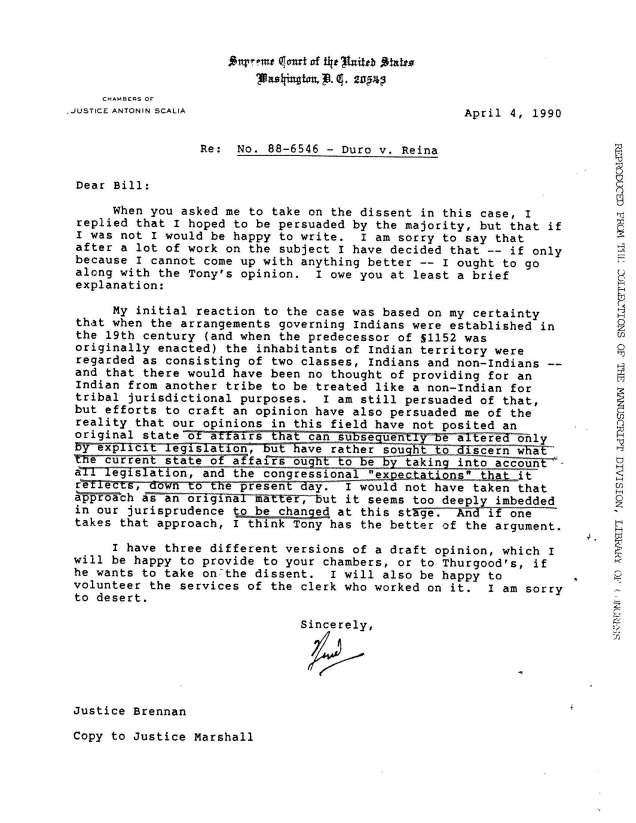
Also, and I regret forgetting this, see below Justice Scalia’s internal memorandum to Justice Brennan in the Duro v. Reina deliberations, uncovered by David Getches in Justice Marshall’s papers (if I recall correctly):

DuroVReinaScaliaMemo

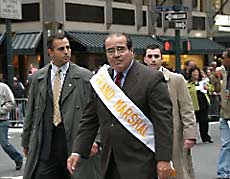
And we conclude with a pic of the Justice as Grand Marshal of the Columbus Day parade in NYC about 10 years ago — the title of the NYTs article was “Who’s That Guy? Without Robes, Grand Marshal Is Mystery“:

:

Scalia Grand Marshal


Justice Scalia’s Indian Law Record

Justice Scalia’s death allows us to reflect on his Indian law record. If you were an Indian person or an Indian tribe as a party in a Supreme Court matter, it was very unlikely you would have his vote, although he did on occasion surprise.

Overall, during Justice Scalia’s tenure on the Supreme Court (his first case was Iowa Mutual), tribal interests prevailed in 21.4 percent — 12 wins, 44 losses, and 8 split decisions or no decisions. Justice Scalia voted in favor of tribal interests 16.2 percent of the time — I count 8 1/2 votes in favor, and 52 1/2 votes against.

Justice Scalia authored five majority opinions — all of them defeats for tribal interests — and he wrote three dissenting opinions — two of them favoring tribal interests.

Majority Opinions

Justice Scalia’s most important purely Indian law opinion was the opinion for the Court in Nevada v. Hicks. There, the Court held that tribal courts cannot entertain federal civil rights suits against state officials. Scalia’s opinion also purported to extend the Montana analysis onto tribal trust lands, and recognized the authority of state officers to investigate violations of state law on tribal trust lands, neither of which, in my view was necessary to deciding the question.

Justice Scalia’s most important opinion with an Indian law element was the opinion for the Court in Employment Division v. Smith. There, the Court held that a nondiscriminatory state law that burdened religious exercise was constitutional under the First Amendment, abrogating precedents that applied a strict scrutiny analysis to such burdens in favor of a rational basis standard. Congress would attempt to undo that decision in the Religious Freedom Restoration Act.

The next most critical opinion authored by Justice Scalia was Blatchford v. Native Village of Venetie. There, the Court held that the Eleventh Amendment barred Indian tribes from suing states. The case was antecedent to the Court’s earth-shattering Eleventh Amendment decision in Seminole Tribe in 1996.

Justice Scalia wrote the majority opinion in County of Yakima v. Yakima Indian Nation, a case holding that the General Allotment Act effectively authorized states to tax allotted fee lands. Finally, Justice Scalia wrote the majority opinion in United States v. Navajo Nation II, where the Court again rejected a trust breach claim by the tribe arising from the Peaboady Coal-Interior Secretary Hodel ex parte communication.

Dissenting Opinions

Justice Scalia also wrote three short dissenting opinions, at least one of which was a vote in favor of tribal interests that may have surprised observers.. In South Florida Water Management Dist. v. Miccosukee Tribe of Indians, a Clean Water Act case with minimal Indian law questions, he filed a brief dissent objecting to the majority’s analysis, and would have affirmed the lower court. In Adoptive Couple v. Baby Girl, he dissented separately to state he would have recognized the birth father’s rights. In Michigan v. Bay Mills, he joined the primary dissent and wrote separately to acknowledge that he had changed his position supporting tribal sovereign immunity in Kiowa Tribe.

Other Comments

We’ve heard many times over the years that Justice Scalia spoke about Miss. Band of Choctaw Indians v. Holyfield as a vote he most regretted (he voted for the tribe) but felt forced to because of the clarity of the statute. If anyone has video of his comments, please send it along.

For those of you wondering, Justice Scalia voted for tribal interests in Holyfield, Potawatomi (presumably on the immunity issue alone), Sac and Fox (Bill Rice’s case), KiowaArizona v. California (2000), S. Fla. Water Management Dist., Cherokee Nation v. LeavittSalazar v. Ramah, and Adoptive Couple.
 

Saginaw Chippewa v. NLRB Cert Petition

Here:

Saginaw Cert Petition and Appendix- Filed

Questions presented:

For more than sixty years, the National Labor Relations Board correctly declined to exercise jurisdiction over tribal operations on tribal lands. But in recent years, the Board has belatedly asserted the extraordinary power to regulate the on-reservation activities of sovereign Indian tribes, precipitating a three-way circuit split in the process. Nothing in the text of the National Labor Relations Act changed in that interval; it contains no language granting the Board authority over Indian tribes. Nor has the language of various Indian treaties, like those between the Saginaw Chippewa Indian Tribe and the United States, changed; they continue to recognize the Tribe’s authority to exclude non-members. And despite the Board’s complete lack of expertise in Indian law, the Board now dictates that some tribal operations are subject to the NLRA and others are not based on its evaluation of the centrality of certain functions to tribal sovereignty and subtle differences in treaty language. 

This case presents two questions, both of which have divided the courts of appeals:

(1) Does the National Labor Relations Act abrogate the inherent sovereignty of Indian tribes and thus apply to tribal operations on Indian lands? 

(2) Does the National Labor Relations Act abrogate the treaty-protected rights of Indian tribes to make their own laws and establish the rules under which they permit outsiders to enter Indian lands?

Lower court materials here.


Little River Band v. NLRB Cert Petition

Here:

Little River Petition and Appendix COMBINED

Question presented:

Whether the National Labor Relations Board exceeded its authority by ordering an Indian tribe not to enforce a tribal labor law that governs the organizing and collective bargaining activities of tribal government employees working on tribal trust lands.

Lower court materials here.

Oral Argument in Oklahoma Tax Commission v. Sac and Fox Nation: Bill Rice Addresses the Court

For one of the finest oral arguments of our time, and a very good thing for National NALSA moot court competitors to hear as they prep for the competition a few weeks away, check out Bill Rice arguing before the Supreme Court, beginning at about 34:20:

Here.

Justice Scalia Reported Dead

Here from BBC.

San Antonio press.

CBS. NBC.

LA Times.

NYTs.

John LaVelle on United States v. Bryant

Here is “‘Uncounseled’ convictions a threat to Indians.”

United States v. Bryant Background Materials

Merits Stage Briefs:

Brief for the United States

NCAI Amicus Brief

NIWRC Amicus Brief

Former US Attys Amicus Brief

Respondent’s Brief

Brief of Amici Curiae Criminal Justice Organizations and Scholars

Brief Amici Curiae of Professor Barbara L. Creel and the Tribal Defender Network

Brief Amici Curiae of the National Association of Criminal Defense Lawyers and Experienced Tribal Court Criminal Litigators

Cert Stage Briefs:

Cert Petition

NCAI Amicus Brief in Support

Opposition Brief

US Cert Stage Reply

Lower court briefs (en banc stage):

CA9 Order Denying En Banc Petition + Opinions

US En Banc Petition

NCAI Amicus Brief

Bryant Response

Lower court briefs (panel):

CA9 opinion in United States v. Bryant

Bryant Opening Brief

US Brief

Bryant Reply Brief

Bryant Supplemental Brief

US Supplemental Brief

Opening Merits Brief in U.S. v. Bryant

Here:

Brief for the United States

SCOTUSBlog Commentary on the Menominee Tribe Decision

Here.