Documents Reveal Pacific International Terminal’s Disturbance of Native Archaeological Site in Washington

Excerpts from the article:

Three summers ago the company that wants to build the largest coal export terminal in North America failed to obtain the environmental permits it needed before bulldozing more than four miles of roads and clearing more than nine acres of land, including some wetlands.

Pacific International Terminals also failed to meet a requirement to consult first with local Native American tribes, the Lummi and Nooksack tribes, about the potential archaeological impacts of the work. Sidestepping tribal consultation meant avoiding potential delays and roadblocks for the project’s development.

Despite the ongoing review of the non-permitted disturbance at the site, the larger review of potential archaeological impacts of the Gateway Pacific Terminal under the National Historic Preservation Act got underway in late July.

It also led to the disturbance of a site from which 3,000-year-old human remains had previously been removed — and where archeologists suspect more are buried.

Pacific International Terminals and its parent corporation, SSA Marine, subsequently settled for $1.6 million for violations under the Clean Water Act.

According to company documents that were released during the lawsuit and subsequently shared with EarthFix, Pacific International Terminals drilled 37 boreholes throughout the site, ranging from 15 feet to 130 feet in depth, without following procedures required by the Army Corps of Engineers under the National Historic Preservation Act. . . .

King said Pacific International Terminals’ unpermitted drilling and disturbance at Cherry Point could put approval of the Gateway Pacific Terminal at risk because the company skirted the requirements of the so-called “106 process” under the National Historic Preservation Act.

“I think the Lummi have a very strong case,” he said. “The site, the area, the landscape – they can show that it’s a very important cultural area and permitting the terminal to go in will have a devastating effect on the cultural value of that landscape.”

The Army Corps of Engineers is now working on finalizing what’s called a “memorandum of agreement” between Pacific International Terminals and the Washington State Department of Archaeology and Historic Preservation. The Army Corps says the document, which was obtained by EarthFix under the Freedom of Information Act, will serve as a retroactive permit “resolving adverse effects associated with the damage caused to 45WH1 associated with non-permitted geotechnical work at Cherry Point.”

The Lummi Nation refused to sign the memorandum or accept the $94,500 that was offered to the tribe as mitigation for the damage through the memorandum.

The archaeological review will follow a separate but parallel track to the environmental review of the project. The first step in the process is to determine the Area of Potential Effect (APE), and that’s already causing a dispute among state and federal agencies.

The State Historical Preservation Office, along with the Lummi and the Federal Advisory Council For Historic Preservation, have written formal letters disagreeing with the Army Corps’ plans to limit the APE to the area immediately surrounding the terminal itself.
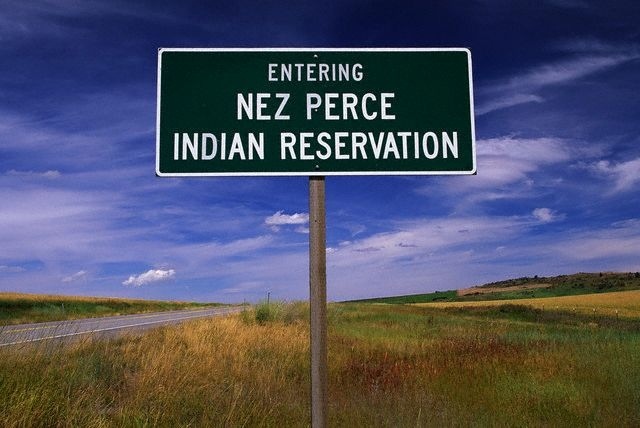
NYTs Coverage of Nez Perce Fight against MegaLoads and Climate Change

Here.

20130926-083837.jpg

Lynn & Whyte: “Indigenous Peoples, Climate Change and the Government-to-Government Relationship”

Kathy Lynn and Kyle Powys Whyte have posted “Indigenous Peoples, Climate Change and the Government-to-Government Relationship” on SSRN. Here is the abstract:

Climate change impacts present indigenous peoples with distinct challenges, from the loss of species needed for subsistence practices like fishing and plant gathering, to coastal erosion that may force some communities to migrate away from areas they have inhabited or used for many years. Students, activists, environmental managers, scholars and corporate and political leaders of all heritages should be aware of how indigenous peoples must address climate change impacts from global to community-level scales, and the obstacles they may encounter due to intersecting oppressions, like cultural imperialism and disempowerment. To create such awareness, there is a need for more work that describes the specific sites of interaction relevant to indigenous peoples and climate change. Sites of interaction are the local and regional places where indigenous peoples are in relationships with governments, non-governmental organizations (NGOs), networks and alliances. Better understanding the relationships that indigenous peoples have with these groups and institutions contributes to fostering unique and necessary indigenous approaches to address climate change that reflect their unique cultural connections to the earth. This paper focuses on one of the critical sites of interaction for indigenous peoples in the United States — the government-to-government relationship. While the government-to-government relation is not a new approach, this paper examines how it might operate in indigenous climate change adaptation contexts in the United States. We describe a set of examples of consultation and collaboration and offer seven recommendations that demonstrate the value of tribal responses to climate change.

NAICJA Resolution Calling for Federal Consultation with Tribal Justice Systems

Here:

NAICJA Res 2013-001_Consultation

Department of Interior Approves Wind Project Despite Objection of Tribes

From  U~T San Diego here:

Native American tribal officials remain concerned about artifacts as well as the basic visual intrusion on a landscape tied to the creation stories of several nearby tribes.

“That’s part of these people’s spiritual identity, and yet they want to put up turbines and destroy and interfere with that reverence and the serenity of what the creator gave them,” said John Bathke, a historic preservation officer for the Quechan Indian Tribe.

And

“We understand that they have those concerns with regard to consultation,” said Erin Curtis, a spokeswoman for the BLM in Sacramento. Federal policy on tribal consultation, she said, “doesn’t necessarily require agreement all of the time.”

The Bureau of Land Management Press Release is here.

The Record of Decision, Final EIS, and other information from the BLM can be found here.

Colette Routel and Jeffrey Holth have posted a paper on tribal consultation on SSRN

It looks like an interesting and valuable piece. Here’s the abstract, and the full paper can be downloaded here.

“The tribal right to consultation requires the federal government to consult with Indian tribes prior to the approval of any federal project, regulation, or agency policy. This article, which provides the first comprehensive analysis of this right, highlights the current inconsistencies in interpretation and application of the consultation duty. It then attempts to provide suggestions for changes that can be implemented by the legislative, executive or judicial branches.

In Part I, we provide a brief overview of the development of the trust responsibility and explain how it came to include three substantive duties: to provide services to tribal members, to protect tribal sovereignty, and to protect tribal resources. In Part II, we offer the first detailed explanation of how the trust responsibility developed the procedural duty to consult with Indian tribes. In this section we also discuss recent attempts by the Obama Administration to reform the federal government’s consultation duty. In Part III, we analyze the consultation policies that have been developed by federal agencies. In doing so, we identify four flaws that have prevented these policies from being truly effective: lack of enforceability, specificity, uniformity, and substantive constraints. Finally, in Part IV we present our proposal for reforming the consultation duty through legislation, and offer suggestions that can be implemented by the judicial and executive branches in the interim. “

Interior Releases Tribal Consultation Policy Draft

From the BIA:

Secretary of the Interior Ken Salazar and Assistant Secretary- Indian Affairs Larry Echo Hawk today provided the Department’s draft Tribal Consultation Policy to the leaders of the nation’s 565 federally-recognized American Indian and Alaska Native tribes for their review and comment. Receiving input from Indian country on the draft policy will guide the Department in carrying out President Obama’s directive to all federal departments to develop ways to improve communication and consultation with Tribal leaders in order to develop positive solutions for issues affecting the First Americans.

And a copy of the draft policy here.

DOJ Tribal Consultation

Save the date!

The United States Department of Justice (DOJ) will be holding a government-to-government Tribal Consultation session October 4-5, 2010, at the Northern Quest Resort in Spokane, Washington.

The first day of the consultation will focus on violence against Native women. DOJ will solicit recommendations from tribal leaders on enhancing the safety of Native women and strengthening the federal response to crimes of domestic violence, dating violence, sexual assault and stalking.

The second day will be devoted to consultation on DOJ grant funding for tribal governments. DOJ officials would like to hear feedback from tribal leaders about their experiences with the Coordinated Tribal Assistance Solicitation (CTAS), the new coordinated tribal grants application process utilized by the Department for Fiscal Year 2010, and solicit recommendations for how the process could be improved for Fiscal Year 2011.

DOJ will be hosting a series of scoping calls with interested tribal leaders to develop the agenda for the upcoming consultation session. The first call will take place on Wednesday, August 25, 2010 at 4pm EASTERN time. The call-in number is 1-888-450-5996; passcode 2179888.

Continue reading

Section 8(a) Business Development Program Consultation Meeting in AK

Indianz.com reports that the SBA has published a notice in the Federal Register on a tribal consultation meeting. Here’s the summary:

The U.S. Small Business Administration (SBA) announces that it is holding a tribal consultation meeting in Fairbanks, Alaska on the topic of the 8(a) Business Development (BD) program regulations. Testimony presented at this tribal consultation meeting will become part of the administrative record for SBA’s consideration when the Agency deliberates on approaches to changes in the regulations pertaining to the 8(a) BD program.

The Indigenous Law & Policy Center recently published a white paper on the importance and linkage of the Section 8(a) BD program to the federal trust responsibility. The paper can be downloaded here as well.