Here.
Federal Agency MOU on Sacred Sites
Here.
Here.
Here.
Here is the full report (pdf), but if you’d like to listen to it in Ojibwe, Cree, Mohawk, or Oji-Cree, here is the link.
THUNDER BAY, ON, Feb. 26, 2013 /CNW/ – The Honourable Frank Iacobucci, former Supreme Court Justice and Independent Reviewer, today released his report on First Nations Representation on Ontario Juries. The report finds that the justice system and juries process are in a state of crisis for Ontario’s First Nations peoples, particularly those living in the North, and identifies 17 recommendations to improve the representation of First Nations individuals on juries and enhance their perception of the jury system.
“For Ontario’s First Nations peoples, particularly in the North, the justice system and juries process generally are in a crisis,” said the Hon. Frank Iacobucci. “As a result of our face-to-face meetings with leaders and community members from 32 First Nations from across Ontario, we developed 17 recommendations that will help ensure that the cultural values, laws, and ideologies of First Nations’ are better reflected in the Canadian justice system.”
The Attorney General of Ontario appointed the Hon. Frank Iacobucci in August 2011 to examine, report, and offer recommendations regarding the process for inclusion of First Nation peoples living in reserve communities on the provincial jury roll.
Key recommendations made by the Independent Reviewer include:
Establishing an Implementation Committee with First Nations membership, government officials and individuals (including a youth Aboriginal member) who would be responsible for the implementation of the report.
Establishing a First Nation Advisory Group to the Attorney General on matters relating to First Nations peoples and the justice system.
Providing cultural training for all government officials working in the justice system who have contact with First Nations peoples (e.g. police, court workers, Crown prosecutors, prison guards and other related agencies).
Determining promptly and urgently the feasibility and suitability of using existing government databases or other suitable sources (e.g. band residency information, Ministry of Transportation information, OHIP roles, and other records) to generate a database of First Nations individuals living on reserve for the purposes of compiling the jury roll.
Amending the questionnaire sent to prospective jurors so that it is more appropriate for First Nations communities.
Considering a procedure whereby First Nations people on reserve could volunteer for jury service as a means of supplementing other jury source lists.
Creating an Assistant Deputy Attorney General position responsible for Aboriginal issues, including the implementation of this report.
Certain readers might be interested to know the author of the report, Hon. Frank Iacobucci, also is a member of the board for Tim Horton’s.
News article here.
OTTAWA – The Canadian Human Rights Tribunal begins hearings into a major case this morning about federal financing for First Nations child welfare.
Read it on Global News: Global News | First Nations child welfare funding in court
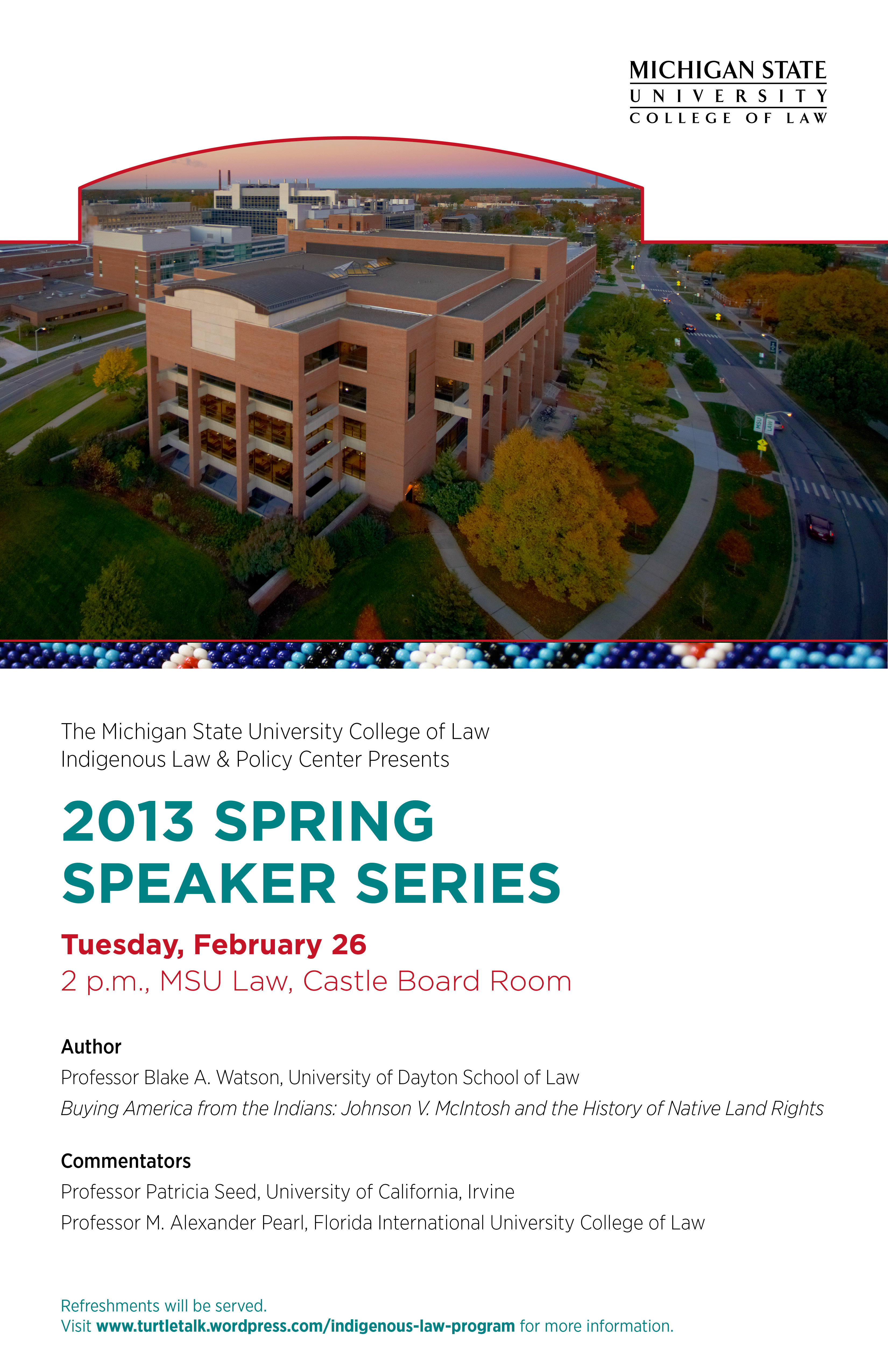
Please join us Tuesday afternoon for a discussion of Prof. Blake Watson’s book, Buying America from the Indians.
Wyoming Supreme Court decision.
Multiple ICWA issues, including applying ICWA to permanent guardianships, the shift from a temporary guardianship to a full or “plenary” guardianship, the requirements of a qualified expert witness, the ability of guardians to provide active efforts, and even a little existing Indian family doctrine in the qualifying of the expert witness.
Job Posting here.
Position Summary:
The Tribal Court Improvement Project (TCIP) Coordinator is responsible for achieving the goals and objectives of the TCIP Grant and ensuring compliance with all federal grant requirements. The Coordinator will work closely with an Advisory Team consisting of the Chief Judge, Director of the Department of Social Services, the Pokagon Band Presenting Officer, member(s) of the Family Welfare Commission and member(s) of Tribal Council. Primary grant goals and objectives include: (1) assessment of Pokagon Band Tribal Court child welfare system, processes and proceedings, and Tribal child welfare services; (2) collection and analysis of data regarding child welfare processes and proceedings as part of the Pokagon TCIP; (3) establishment of data gathering and sharing mechanisms with other tribal and non-tribal entities; (4) organizing and conducting community discussions; and (5) coordinating trainings identified to build capacity and improve systems and services. The Pokagon Band TCIP is a 36-month project funded by the Administration for Children and Families. This is a part-time grant-funded position.
From tonight’s All Things Considered: here.
This week, officials from the Crow Creek Sioux Nation and seven other tribes in the state sent an extensive report to Congress accusing South Dakota of systematically violating the federal Indian Child Welfare Act. The federal law says that, with some exceptions, if the state removes a Native American child, the state must place that child with relatives, tribal members or other Native Americans.
The report, which the officials wrote with the help of the nonprofit Lakota People’s Law Project, concludes that in many instances the state does not have the authority to remove native children from tribal land. When the state does have that authority, through a tribal court order or tribal council agreement, the report says the state is failing to place the majority of those children according to the law.
 Turtle Talk
You must be logged in to post a comment.