Angela Riley & Sarah Glenn Thompson on Dual Sovereignty and Indian Country Crimes

Angela Riley & Sarah Glenn Thompson have posted “Mapping Dual Sovereignty and Double Jeopardy in Indian Country Crimes,” recently published in the Columbia Law Review, on SSRN.

Here is the abstract:

The Double Jeopardy Clause guarantees no individual will be put in jeopardy twice for the same offense. But, pursuant to the dualsovereignty doctrine, multiple prosecutions for offenses stemming from the same conduct do not violate the Clause if the offenses charged arise under the laws of separate sovereigns, even if the laws are otherwise identical. The doctrine applies to tribal prosecutions, but its impact in Indian country is rarely studied. Such an inquiry is overdue, particularly as the scope of crimes potentially subject to dual tribal and federal prosecutions has broadened in recent years. This Article is the first to undertake a preliminary examination of the dual-sovereignty doctrine in the tribal–federal context and describe the complex interplay between the doctrine and the rest of the criminal law fabric in Indian country. Perhaps most significantly, it includes an original typology highlighting when a defendant may be subject to the doctrine, which sovereigns have the authority to prosecute, pursuant to what source of power each sovereign operates, and when and how the sequence of prosecutions matters, if at all. This leads to the Article’s central thesis: Indian tribes are separate sovereigns with inherent sovereignty, and, under current conditions, the dual-sovereignty doctrine plays a central role in ensuring safety in Indian country. The doctrine’s application in Indian country, however, creates unique complexities that may threaten tribal sovereignty and raise issues of unfairness for defendants. This Article offers numerous reforms—some highly ambitious and others more modest—to address these issues.

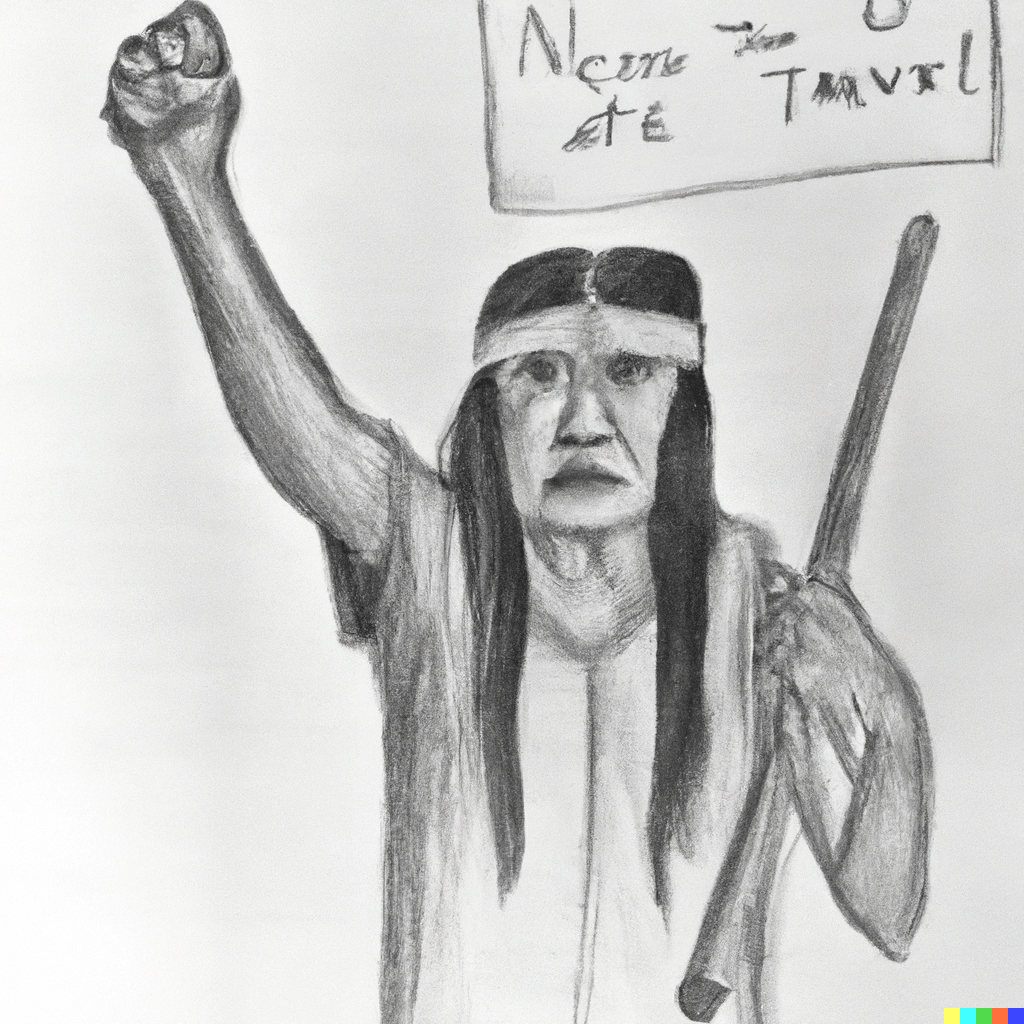
two police officers staring at each other in the style of miro

Water Users Seek SCT Review of Spokane-Federal Water Use Agreement

Here is the cert petition in Sulgrove v. Spokane Tribe:

Here are the questions presented:

  1. Whether landowners, whose water use was exempted from federal enforcement under a decades-old final judgment decreeing tribal reserved water rights, have Article III standing to appeal from a district court order approving a government agreement to amend said judgment so that landowners’ water rights can be subjected to federal enforcement?
  2. May non-party landowners appeal from a district court order approving an agreement by three government parties to amend a decades-old final judgment (and related final orders), when landowners were haled into court by an order to show cause stating their rights will be bound by the amended judgment and landowners fully participated in the show cause proceedings as ordered?

Lower court materials here.

Winnebago Tribe Brings Voting Rights Case in Nebraska

Here is the complaint in Winnebago Tribe of Nebraska v. Thurston County (D. Neb.):

Sault Tribe/Kewadin Gaming Enjoined from Concealing or Dissipating Assets in Gaming Development Company Dispute [recall the $88M judgment]

Here is the order in JLLJ Development LLC v. Kewadin Casinos Gaming Authority (Mich. Cir. Ct.):

Prior post here.

California Federal Court Dismisses New Amended Complaint in Coyote Valley Contract Case

Here are the updated materials in Coyote Band of Pomo Indians v. Findleton (N.D. Cal.):

91 Second Amended Complaint

95 Motion to Dismiss

103 Combined Opposition

104 Reply in Support of 95

105 Reply in Support of 100

Prior post here.

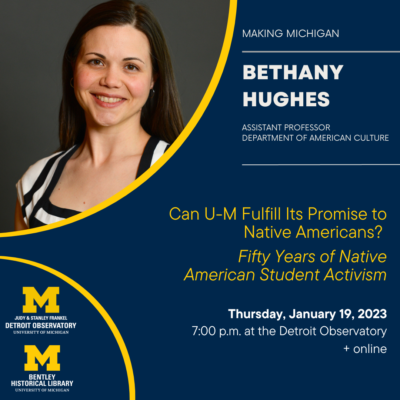
Bethany Hughes on the History of Natives at UMich

The University of Michigan has a complicated history with Native American communities, which were vital to its very existence. Join us for a discussion with Bethany Hughes, assistant professor of American Culture, on the historic and ongoing activism of Native American students.

Can U-M Fulfill Its Promise to Native Americans?
Fifty Years of Native American Student Activism

Thursday, January 19, 20237:00 – 9:00 P.M. Guests may attend in-person at the Judy and Stanley Frankel Detroit Observatory or attend virtually.

The talk will examine the founding of the Native American Student Association, the work to compel the University to recognize the promise of education made to Native Americans in the 1817 Treaty of Fort Meigs (including a critical lawsuit brought by a U-M football player), and the decades-long work to bring to light the racial stereotyping and misuse of Native American symbols by the Michigamua student organization.

>> REGISTER TO ATTEND IN PERSON <<

>> REGISTER TO ATTEND VIRTUALLY <<

ABOUT THE SPEAKER: Bethany Hughes is an Assistant Professor in the Department of American Culture and a core faculty member in the Native American Studies Program. A performance scholar and cultural historian, her research focuses on theatre and performance in America, Indigenous performance, and the possibilities for making and remaking culturally legible categories through live performance. She teaches classes on Native American Studies, Indigeneity and Performance, Authenticity and Representation, American Performance, and Broadway and American Culture. An enrolled member of the Choctaw Nation of Oklahoma, her writing can be found in Theatre Journal, Theatre Survey, Theatre Topics, Mobilities and on HowlRound.com. Her current book project is an investigation of redface in 19th and 20th century American theatre and its implications for Indigenous identity and sovereignty.

Alaska Sues Interior over Trust Land Acquisition for e Central Council of Tlingit and Haida Indian Tribes

Here is the complaint in State of Alaska v. Newland (D. Alaska):

Lunch in Indian Country CLE: Supreme Court Update on Indian Law [with Fletcher]

Supreme Court Update on Indian Law

Co-Sponsored by the State Bar of Arizona and the State Bar’s Indian Law Section

January 18, 2023, 12:00-1:00 MST

1.0 Total CLE Unit

Join Professor Matthew Fletcher as he reviews the most recent Supreme Court decisions affecting Indian Country.

Faculty:

Matthew Fletcher, Harry Burns Hutchins Collegiate Professor of Law, Michigan Law

 
Chairpersons:
Doreen McPaul, President, Tribal In-House Counsel Association
Virjinya Torrez, Assistant Attorney General, Pascua Yaqui Tribe

Register: https://azbar.inreachce.com/Details/Information/1661e72a-831b-45a2-ad84-a06a235557ee

Jack Fiander on the Constitutional Foundation of Federal-Tribal Relations

Jack Fiander has posted “The Melding of International Law and the Customary Law of Tribal Nations; The Constitutional Origin of Federal-Tribal Relations” on SSRN.

Here is the abstract:

To seek understanding of the basis for the relationship of the government of the United States with tribal nations it is necessary to examine not only the intent of the “Founding Fathers” but also that of the tribal nations with whom those framers of the United States Constitution dealt at the time of America’s founding. To do otherwise is ethnocentric, at best, and omits half the equation. Establishing a Constitutional relationship requires the perspective of both sides, not only that of those acting on behalf of the fledgling United States. At the time this nation’s founding, tribal nations were mighty in number and therefor treated by Colonists as sovereign nations to be dealt with in conformity with respect for their respective forms of customary and international law. Recognizing tribal sovereignty required adherence to what might be described as tribal laws of nations to manage their own internal affairs, as is evident in the framers’ deferential dealings with Tribal Nations in the founding era and thereafter. Because Colonists understood the need to gain alliances with the powerful tribal nations to secure protection against foreign powers, the Framers appropriated concepts from Tribal nations, which paralleled those in the international Law of Nations, to which much Constitutional authority for the relationship of the United States with tribal nations is traceable.

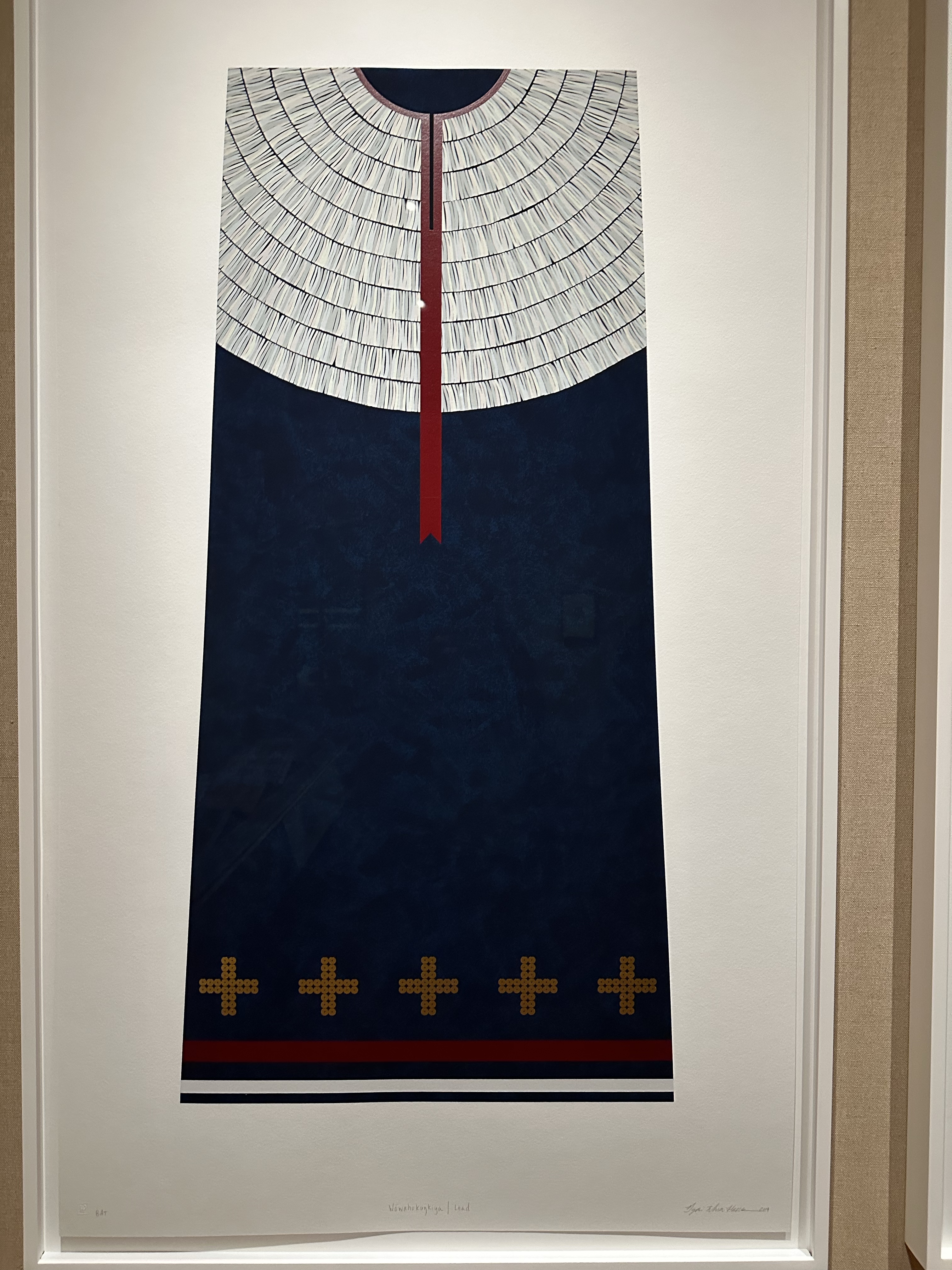
Dyani White Hawk, Detroit Institute of Arts