Many First Nation individuals appear to accept that debates about belonging to First Nations political community are properly framed as debates about citizenship. Interlocutors frequently identify the ongoing significance of kinship, but fold it into their conception of citizenship. This Article resists citizenship’s orthodoxy. Kinship is not a unique feature of First Nations citizenship, but rather is its own model of belonging to a political community: a model internal to First Nations law, understood on its own terms. There are, then, two models of belonging to First Nations political community, citizenship and kinship, within and over which debates about belonging play out.
For First Nations political communities using their own systems of law, kinship is a source of fundamental legal interests, just as citizenship is a source of fundamental rights and freedoms in modern liberal democracies. However, comparativists, legal theorists, and political theorists have struggled to appreciate this reality because internal (or settler) colonialism disconnects kinship from legality conceptually and thus institutionally. Those connections must be reestablished.
To that end, this Article shows that, functionally, kinship is a full answer to citizenship. The argument is made in two interwoven parts, each of which turns on the picture of kinship as a structural feature of First Nations law, understood on its own terms. First, kinship is citizenship’s political equal insofar as it offers a justificatory account of belonging to a political community; second, kinship is citizenship’s legal equal insofar as it, too, serves as a foundation for fundamental legal interests. The gravamen of this Article is, thus, twofold. First, one is not hearing what First Nations law says about belonging if one is only willing or able to listen in the language of citizenship. Second, the stakes in one’s choice of model are significant: citizenship and kinship structure legality in fundamentally different ways.
The land-back movement in its current state began in 2018 and has rapidly gained traction since. The main call in this movement is for the return of government owned ancestral lands to their Indigenous stewards. This paper quantifies the economic impacts of land-back movements on income and employment for over 1,700 Indigenous communities, using both panel data instrumental variables and endogenous treatment techniques. We find uniformly promising results (reductions in the percentage of citizens living on low incomes, and reductions in the unemployment rate) that recommend continued return of tribal lands not only for racial justice reasons, but as a catalyst for economic stability of populations living in proximity to Indigenous peoples.
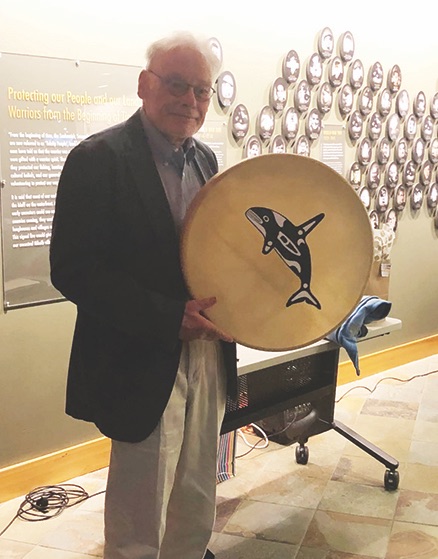
I first heard about Mike Taylor from John Petoskey, who had known him a long time and marveled at his audacity (Indigenacity(?), with apologies to the Dead Pioneers) in the Stock West cases and in masterminding the Quil Cede economic development project at Tulalip). If the Tribal In-House Counsel Association existed back in those days, he would be far better known.
In recent years, after his retirement, Mike started emailing me with hot tips to post on Turtle Talk. Later on, Mike explained to me that he repped Quinault in the US v. Washington trial that led to the Boldt decision. For whatever reason, Q was unwilling to intervene in the case at first, but when they did (Mike likely carried the laboring oar on that issue), they arrived as kind of a deus ex machina, being the only tribe with experience in regulating treaty fishing rights exercise at a time in the trial when Judge Boldt was asking if tribes could do so.
Mike was writing an autobiography. I sincerely hope that someone will be able to find those documents and put them together for publication. He shared a few snippets with me and all I can say is . . . LEGEND.
Grant Christensen has posted “Tribal Judicial Power,” forthcoming in the University of Southern California Law Review, on SSRN.
Here is the abstract:
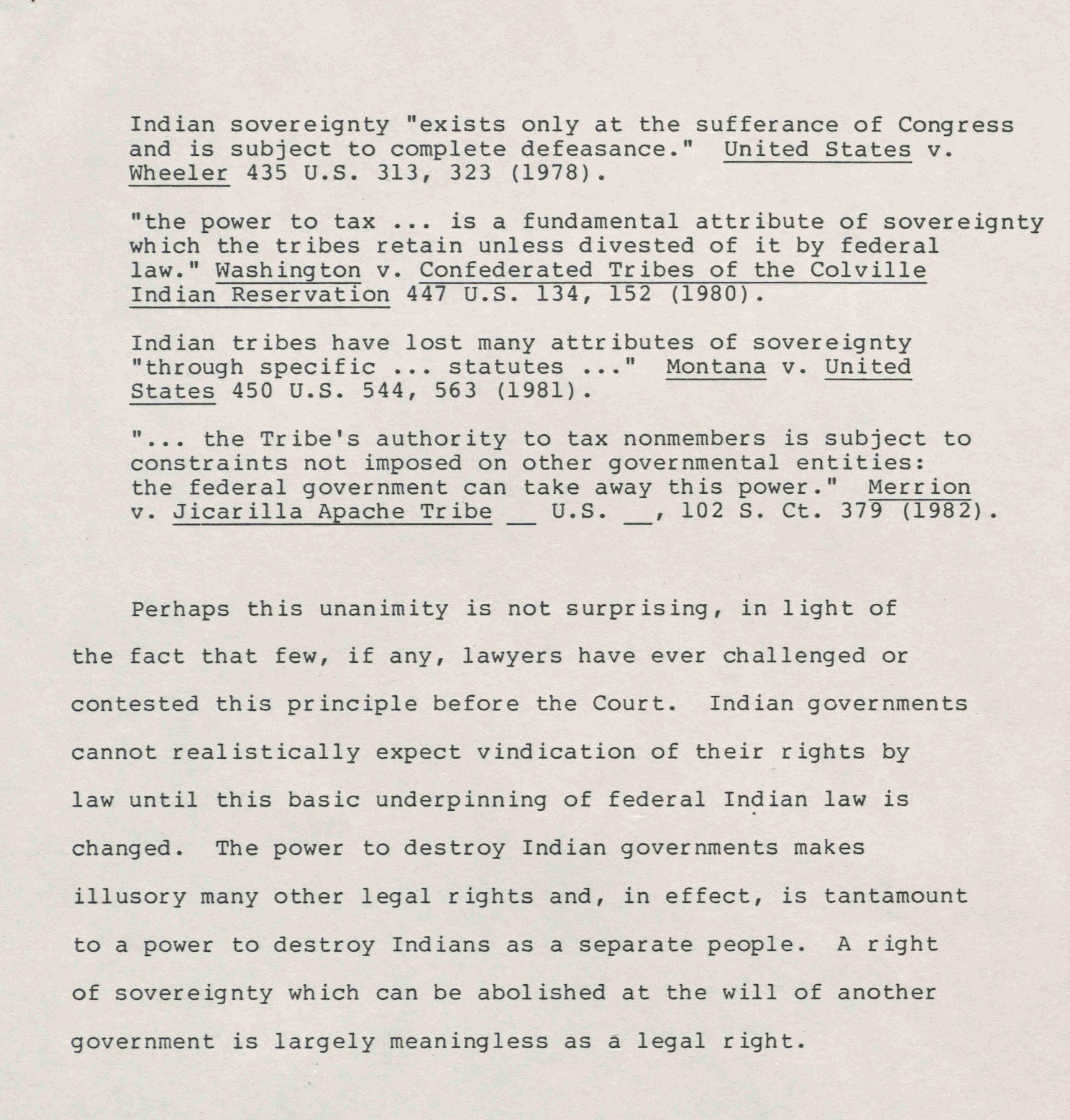
In 1978’s Oliphant v. Suquamish Indian Tribe the Supreme Court announced a new common law rule: tribal courts lack criminal jurisdiction over non-Indian defendants. Under the guide of the common law, unmoored from interpreting the text of any treaty or statute, the Oliphant opinion made reservation communities less safe by denying tribal governments a critically important tool in law enforcement – the power to arrest, charge, prosecute, and sentence persons who commit crimes on tribal lands. This unilateral evisceration of an inherent tribal power has contributed directly to the crisis of missing and murdered Indigenous women in the United States by preventing tribal law enforcement from prosecuting non-Indian offenders. The Oliphant precedent has made Indian country less safe for everyone by hobbling the ability of tribal governments to criminally convict non-Indians who openly violate tribal law.
In 2004 the Court made its first concession to the absolutist approach taken in Oliphant by recognizing that its decisions limiting the scope of the inherent power of Indian tribes were not constitutionally mandated but rather reflected the understanding of the Court “at the time of those decisions.” It is a new day, and the Court’s understanding of inherent tribal power can evolve. It can remove the common law barrier preventing tribes from exercising their pre-constitutional powers.
This Article takes the position that Congress’s reauthorization of the Violence Against Women Act in 2022 is the death knell of the Oliphant opinion and a congressional restoration of tribal judicial power. The gossamer strands of the Court’s 1978 reasoning can no longer survive even cursory review in an era when Congress has given its imprimatur upon both inherent tribal power and tribal court criminal jurisdiction over non-Indian defendants. Oliphant was never a constitutional nor statutory barrier to the assertion of inherent tribal power, and it should not take an act of Congress to reverse. As non-Indians again contest their criminal prosecution in tribal courts under the expanded powers recognized in VAWA, federal courts should reconsider the common law rule announced almost fifty years ago and, consistent with the direction of legal and congressional precedent, make clear that Oliphant no longer accurately reflects American common law.
Rosalind McClanahan was just twenty-two when she set one of the most important cases in federal Indian law into motion. On April 1, 1968, she filed her Arizona tax return, along with a protest that all the money withheld from her pay—$16.29—should be refunded because she was a Navajo citizen whose income was earned entirely on the Navajo reservation. The Arizona Tax Commission ignored her claim and the Arizona courts rejected it. But the Supreme Court ruled unanimously in her favor, building a foundation for many more decisions rebuffing state jurisdiction as well as landmark legislation such as the Indian Child Welfare Act and Indian Gaming Regulatory Act. This Essay, the first full history of McClanahan, examines the origins of the decision as part of the Kansas Law Review’s symposium on impact litigation in Indian country.
Rosalind McClanahan was born in an era of renewed pressure for Indian assimilation but came of age as tribes and Indigenous people increasingly insisted on self-determination. This moment had a direct influence on her case: her education at Window Rock High School (where she was elected Class Treasurer) resulted from new pathways to challenge Indian exclusion from public schools; her employer was the First Navajo National Bank, which opened in 1962 as the first bank on the 16-million-acre Navajo Nation; and her lawyers came from Diné be’iiná Náhiiłna be Agha’diit’ahii-Legal Services (shortened to “DNA”), which the Navajo Nation brought to the reservation as part of a new wave of federally funded organizations providing legal services to the poor. Each of these developments shaped both the decision and its impact.
I really enjoyed this article, especially the origin story of the DNA-People’s Legal Services. Recommended!!






 Turtle Talk
You must be logged in to post a comment.