Second Circuit Decides Cayuga Nation v. Tanner

Here is the opinion.

An excerpt:

Plaintiffs‐Appellants, the Cayuga Nation, a federally recognized Indian tribe, and individual officers, employees, and representatives of the Cayuga Nation, filed this action in the United States District Court for the Northern District of New York (David N. Hurd, Judge) against the Village of Union Springs, the Board of Trustees of the Village, and individual Village officials, seeking declaratory and injunctive relief. Plaintiffs contend that the federal Indian Gaming Regulatory Act, 25 U.S.C. §§ 2701‐2721, preempts the defendants’ efforts to enforce a local anti‐gambling ordinance against a gaming facility located on land owned by Cayuga Nation.

The district court dismissed the complaint, holding that it lacked subject matter jurisdiction to hear the case because it could not determine, in light of an ongoing leadership dispute within Cayuga Nation, whether the lawsuit was authorized as a matter of tribal law. Following a motion for reconsideration, the district court additionally held that the individual plaintiffs lacked Article III standing to sue in their own right.

On appeal, the plaintiffs argue that the district court had jurisdiction because the Bureau of Indian Affairs had recognized Clint Halftown, who initiated this suit, as the Cayuga Nation’s “federal representative,” thereby relieving the court of the need to resolve questions of tribal law, and because the individual plaintiffs had standing to challenge the anti‐gaming ordinance. We agree and therefore VACATE the district court’s order dismissing the complaint and REMAND for further proceedings consistent with this opinion.

Briefs here.
Eight Circuit Decides Wolfchild Appeal

Here is the opinion in Wolfchild v. Redwood County.

An excerpt:

Appellants-plaintiffs filed this purported class action claiming the right to title and possession of twelve square miles of land in southern Minnesota (“twelve square miles”). Specifically, Appellants allege they are lineal descendants of the Mdewakanton band of the Sioux tribe who were loyal to the United States during the 1862 uprising (“loyal Mdewakanton”). Appellants claim the Secretary of the Interior set apart the twelve square miles for the loyal Mdewakanton and their descendants and, thereby, the loyal Mdewakanton have the exclusive right to title, use, and possession of the twelve square miles. Appellees physically possess or claim a property interest in the twelve square miles. The issues underlying this case are complex, requiring interpretation of over 150-year-old statutes, regulations, and legislative history, understanding of past mistreatment of Indian tribes by the United States, and a complicated area of the law. For the reasons set forth below, we affirm the district court’s grant of Appellees’ motions to dismiss. But we conclude the district court abused its discretion when imposing sanctions and vacate the district court’s sanctions order. We, further, hold issues relating to the appellate-cost bond are moot. But we remand to the district court for the limited purpose of assessing whether the municipal government Appellees (“Municipal Appellees”) are entitled to costs pursuant to Fed. R. Civ. P. 54(d) and 28 U.S.C. § 1920.

Briefs here.

SCOTUS Denies Cert in Seneca Gaming Case, Citizens Against Casino Gambling in Erie County v. Chaudhuri

Here is the order list today.

Briefs here.

News Profile of Samoan Birthright Citizenship Cases

From Mother Jones, here is “The Obama Administration Is Using Racist Court Rulings to Deny Citizenship to 55,000 People.”

HT to How Appealing.

Ninth Circuit Holds Timbisha Leadership Dispute Mooted by Adoption of New Constitution

Here is the opinion in Timbisha Shoshone Tribe v. Dept. of Interior.

The court’s syllabus:

The panel dismissed, as moot, an appeal from the district court’s dismissal of a case challenging the Department of the Interior’s recognition of the election results for leadership authority over the Timbisha Shoshone Tribe. The panel held that the Tribe’s recent adoption of a new constitution, which overhauled tribal membership requirements, mooted the appeal because there was no chance that a remand to the Bureau of Indian Affairs would make any difference whatsoever in the election results.

Briefs here.

National Indian Law Library Bulletin (5/26/2016)

Here:

The National Indian Law Library added new content to the Indian Law Bulletins on 5/26/16.

State Courts Bulletin
http://www.narf.org/nill/bulletins/state/2016state.html
Kitras v. Town of Aquinnah (Easement by Necessity)
In re A.R.V.S. (Indian Child Welfare Act – Juvenile Dependency Appeals)
People in Interest of A.B. (Indian Child Welfare Act – Expert witnesses)

News Bulletin
http://www.narf.org/nill/bulletins/news/currentnews.html
In the Education section, we feature an article about a Native American student who filed a class-action lawsuit in an education scandal.

U.S. Legislation Bulletin
http://www.narf.org/nill/bulletins/legislation/114_uslegislation.html
One bill became law: H.R.4238, To amend the Department of Energy Organization Act and the Local Public Works Capital Development and Investment Act of 1976 to modernize terms relating to minorities became PL 114-157.
We added two new bills:
S.2953: Indian Health Service Accountability Act of 2016.
S.2959: A bill to amend the White Mountain Apache Tribe Water Rights Qua ntification Act of 2010 to clarify the use of amounts in the WMAT Settlement Fund.

Caddo Nation Sues Witchita Nation over Sacred Site UPDATED (6/9/2017)

Here is the complaint in Caddo Nation of Oklahoma v. Witchita and Affiliated Tribes (W.D. Okla.):

Complaint

4 Motion for TRO

21 TRO Order

27 DCT Order Vacating TRO

Complaint in Mission Creek Band of Mission of Indians v. Jewell

Here, filed in the Central District of California:

Complaint

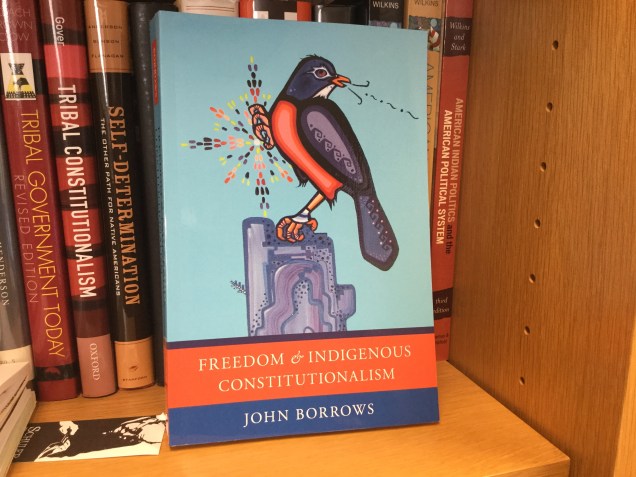
Turtle Talk Bookbag: John Borrows’ “Freedom & Indigenous Constitutionalism”

Book page here. Highly recommended.

JB.jpg

Blurb:

Indigenous traditions can be uplifting, positive, and liberating forces when they are connected to living systems of thought and practice. Problems arise when they are treated as timeless models of unchanging truth that require unwavering deference and unquestioning obedience.Freedom and Indigenous Constitutionalism celebrates the emancipatory potential of Indigenous traditions, considers their value as the basis for good laws and good lives, and critiques the failure of Canadian constitutional traditions to recognize their significance.

Demonstrating how Canada’s constitutional structures marginalize Indigenous peoples’ ability to exercise power in the real world, John Borrows uses Ojibwe law, stories, and principles to suggest alternative ways in which Indigenous peoples can work to enhance freedom. Among the stimulating issues he approaches are the democratic potential of civil disobedience, the hazards of applying originalism rather than living tree jurisprudence in the interpretation of Aboriginal and treaty rights, American legislative actions that could also animate Indigenous self-determination in Canada, and the opportunity for Indigenous governmental action to address violence against women.