Fletcher & Reo Response Paper to Sanders on the Wisconsin Wolf Hunt

Matthew Fletcher & Nick Reo published a short paper, “Response to Sanders: Ma’Iignan as Property,” at the Wisconsin Law Review Online. Jason Sanders’ excellent law review note that started all this is here.

Here is an excerpt:

American law has long recognized the state as the owner of wild game within a state’s borders, including gray wolves (or “ma’iingan” in Anishinaabemowin), within the States of Wisconsin, Minnesota, and Michigan. However, as Anishinaabe scholar Jason Sanders forcefully demonstrates, the Anishinaabeg—indigenous people of the western Great Lakes known as the Ottawa (Odawa), Potawatomi (Bodewadmi), and Chippewa (Ojibwe)—considered ma’iingan siblings, not property. One does not hunt one’s siblings.
***
Sanders’s paper is a fine example of cutting edge, pragmatic legal scholarship that will allow the stakeholders, in time, to push through the adversarial rhetoric and move into a more useful cooperative mode. Federal Indian law, often through the assertion of American Indian treaty rights, has historically been a powerful engine for change. Treaty rights cases arising from Anishinaabeg treaties often do not result in a winner-take-all outcome, with either tribes or states prevailing over all opponents. Instead, the rule of law as exemplified by Indian treaty rights forces state interests to reckon with the interests of a discrete and insular minority. As such, regulation of hunting, fishing, gathering, and other activities on or near Indian country is an intergovernmental affair, dominated by cooperative fact finding and negotiation.


IMPORTANT REMINDER: Deadline for Purchase Offers Fast Approaching for Landowners with Interests at Pine Ridge, Makah Reservations

 IMPORTANT REMINDER: Deadline for Purchase Offers Fast Approaching for Landowners with Interests at Pine Ridge, Makah Reservations

The Department of the Interior announced in December 2013 that owners of fractionated land interests at the Pine Ridge and Makah Reservations were the first to receive purchase offers under the Department’s Land Buy-Back Program for Tribal Nations (Buy-Back Program). The Pine Ridge Reservation is among the most highly-fractionated locations in the United States; landowners with purchasable interests have been located in 46 states across the country.

Owners Must Respond Soon. The due date for the first round of purchase offers is quickly approaching, with responses due between January 29 and February 10, 2014. Purchase offers are valid for 45 calendar days from the date of the Cover Letter that is included in the Offer Package provided to owners.

Staff Ready to Answer Owner Questions. Landowners can contact the Trust Beneficiary Call Center at (888) 678-6836 with questions about their purchase offers, visit their local Office of the Special Trustee for American Indians (OST) office, contact their tribe’s staff working with the Buy-Back Program, or find more information atwww.doi.gov/buybackprogram.

Sellers Receive Fair Market Value. The Buy-Back Program was created to implement the land consolidation component of the Cobell Settlement, which provided a $1.9 billion fund to purchase fractionated interests in trust or restricted land from willing sellers, at fair market value, within a 10-year period. Interested sellers will receive payments directly into their IIM accounts. Consolidated interests will be transferred to tribal governments for uses benefiting the tribes and their members.

Sellers receive fair market value for their land, based on objective appraisals. In addition, sellers also receive a base payment of $75 per offer, regardless of the value of the land. Some owners have already received more than $100,000 for their interests (offer amounts will vary based on the particular interests held).  Interests purchased from individuals through the program will be restored to Indian tribes.

Outreach Events Are in Progress. For more than a year, tribes and Interior have conducted outreach events throughout Indian Country, such as pow-wows, community meetings, and large Indian organizational gatherings to get the word out about the program and give landowners the opportunity to gather information in order to make informed decisions about their land. Additional events are scheduled to occur in the next two weeks in Neah Bay and Auburn, Washington, regarding Makah fractional interests, and in Rapid City, South Dakota, and communities on the Pine Ridge Reservation. For information about this week’s event for Makah, contact Dale Denney at 360-645-3106. For details about the Pine Ridge events, contact Georgine Looks Twice at 605-867-2610.

Participation Is Voluntary. Participation in the Buy-Back Program is voluntary and selling land does not jeopardize a landowner’s ability to receive individual settlement payments from the Cobell Settlement. Cobell Settlement payments are being handled separately by the Garden City Group, (800) 961-6109.
N.M. Taxation and Revenue Dept. Decision on Taxation of Indian Domiciled Off-Reservation

Here is the decision in the Matter of the Protest of Tutt:

2013-12-02 Decision and Order

This is a case involving state income taxation of an Indian who was domiciled off-reservation, worked on-reservation and had a second place of abode on-reservation. The hearing officer found that the state could not tax the petitioner.

Fletcher: “A Unifying Theory of Tribal Civil Jurisdiction”

Please see “A Unifying Theory of Tribal Civil Jurisdiction” on SSRN. Here is the abstract:

This paper addresses one of the most dynamic and useful areas of American Indian law. I situate my arguments between two competing and intractable theories dominating the field – the consent theory, which limits tribal jurisdiction to those who expressly consent to tribal governance; and the territory theory, which expands tribal jurisdiction to anyone in Indian country. The consent theory unnecessarily undercuts tribal authority on Indian lands, assuming without evidence that nonconsenters will not receive a fair shake in tribal forums. Meanwhile, the territory theory unnecessarily exposes nonconsenters to Indian authority on non-Indian owned land, where tribal power is weakest and least justified.

I propose a simpler solution that unites the two theories and brings realism to the discussion. Where activities occur on Indian lands, tribal jurisdiction should be presumed subject to a simple fairness test any court could conduct, but that is currently (and ironically) barred by the Supreme Court. The reality is that tribal governments are already successfully exercising this power, but the common law is lax in its recognition of tribal governance, generating unpredictability and confusion.

Substantive comments welcome.

R.I. SCT Holds Narragansett Tribe Has Standing to Challenge 2011 Casino Act

Here is the opinion in Narragansett Indian Tribe v. State of Rhode Island.

An excerpt:

The defendant, the State of Rhode Island (State), appeals from the entry of partial summary judgment in the Superior Court for the plaintiff, the Narragansett Indian Tribe (Tribe), finding that the plaintiff had standing to pursue a constitutional challenge to the 2011 Casino Act, G.L. 1956 § 42-61.2-2.1, as enacted by P.L. 2011, ch. 151, art. 25, § 2.1 This case came before the Supreme Court for oral argument on December 4, 2013, pursuant to an order directing the parties to appear and show cause why the issues raised in this appeal should not be summarily decided. After carefully considering the written and oral submissions of the parties, we are satisfied that this appeal may be resolved without further briefing or argument. For the reasons set forth in this opinion, we affirm the judgment of the Superior Court.

New Scholarship on Mapping Intergenerational Memories

Robert Hershey, Jennifer McCormack, and Gillian E. Newell have posted “Mapping Intergenerational Memories (Part I): Proving the Contemporary Truth of the Indigenous Past” on SSRN.

Here is the abstract:

How Indigenous communities choose to represent spaces or spatial information is integral to constructing and archiving cultural memory, articulating current environmental use, and dealing with evidentiary issues for title or land claim cases. For Indigenous communities around the world, the legacy of Western (often, colonial) cartography and spatial theory is disconnected from the many distinct narratives of space (and time) in Native communities.

Specifically in legal situations, this disconnect often reflects a power struggle between a Western, Cartesian division of space and time, and a relational, dynamic capitulation of space and time by an Indigenous group. Indigenous communities attempting to utilize Western legal forums for recognition of their rights face evidentiary hurdles caused by the ethnocentrism inherently built into legal systems. Although exceptions exist to hearsay rules, which allow oral history to be admitted as evidence and are common in multiple jurisdictions, fact finders are not comfortable placing conclusive weight on intergenerational memories. This discomfort is based on Western society’s ideas about what constitutes reality and reliability and results in Indigenous communities being held to strictly Western and often overly lineal principles. Indigenous communities need concrete methods to bring their intergenerational memories into Western courtrooms and have lawyers and judges receive and understand these fully and from an Indigenous standpoint.

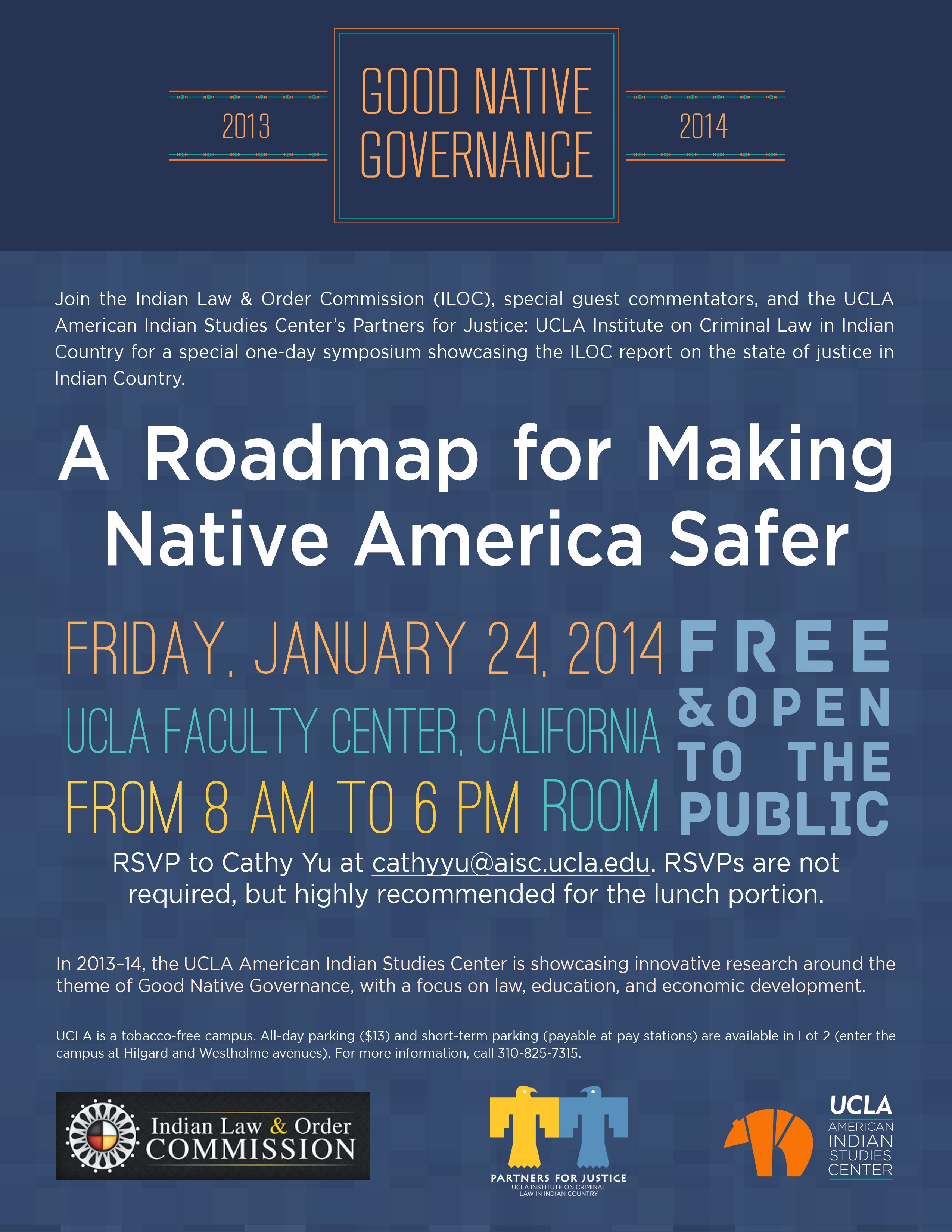
UCLA Indian Law and Order Commission Report Conference — Jan. 23, 2014

Here:

iloc_flyer_updated

Zephier v. United States & Wolfchild v. United States Cert Petitions

Here:

Wolfchild v US Cert Petition

Zephier v US Cert Petition

Wolfchild questions presented:

1. Whether the court of appeals interpretations of statutes specific to the Mdewakanton Band — 1863 Acts, 1888-1890 Acts and 1980 Act: (a) contradict Tohono O’Odham Nation because the court of appeals failed to appreciate that the U.S. Court of Federal Claims (CFC) is to provide a judicial forum for most non-tort requests for significant monetary relief against the United States; (b) contradict Nevada v. Hicks, because the court of appeals opinions, including the Eighth Circuit opinion in Smith v. Babbitt, essentially refer the Mdewakanton Band’s federal claims to tribal courts which lack jurisdiction; (c) contradict Mitchell I, Mitchell II, White Mountain Apache, and Navajo Nation because the court of appeals misinterpreted statutory trust and other legal obligations and failed to properly apply the money-mandating duty requirement; (d) conflict with the First Circuit opinion in Passamaquoddy Tribe because the court of appeals failed to apply the “plain and unambiguous” requirement to the 1980 Act for the purported termination of the Mdewakanton Band and its statutory property rights; and (e) contradict Carcieri because the court of appeals treated the three non-tribal communities as sovereign historical tribes when they are not.

2. Whether the court of appeals’ interpretation of statutes general to American Indians: (a) contradict Oneida I and Oneida II and their progeny because the court of appeals failed to properly interpret the Indian Nonintercourse Act to require Congressional authorization prior to the purported termination of the Mdewakanton Band’s tribal statutory property rights; (b) contradict Carcieri and the 1934 Indian Reorganization Act (IRA) because the court of appeals deemed the purchased IRA lands to be held exclusively in trust for the three post-1934 non-tribal communities; and (c) misinterpreted the six-year statute of limitations and the Indian Trust Accounting Statute (ITAS) to bar the Mdewakanton Band’s monetary claims.

3. Whether summary judgment should have been granted to petitioners on the pre-1980 and post-1980 statutory fund claims and the statutory land claim.

Zephier questions presented:

I. Whether the Federal Circuit’s 2013 holding that a February 16, 1863 Act of Congress, providing that “the Secretary of Interior is hereby authorized to set apart of the public lands . . . eighty acres in severalty” to loyal Mdewakanton Indian individuals, is “too discretionary to support a viable claim,” thereby conflicts with this Court’s and other precedents holding that power given to public officers in permissive form statutory language, but involving individual property rights calling for its exercise, the language used is “in fact peremptory” and money-mandating?

II. Whether the Panel failed to recognize the trust nature of the February 1863 Act in rejecting Petitioners’ “two basic claims” and thus issued a determination that conflicts with a previous authoritative decision in Wolfchild v. United States, 559 F.3d 1228 (Fed. Cir. 2009), which found that the language of the Act of February 16, 1863, Section 9, ch. 37, 12 Stat. 652, “created an inheritable beneficial interest in the recipients of any land conveyed under the statute . . . [and] explicitly created a trust relationship” with the Federal Government?

III. Whether the Secretary of Interior’s 1865 actions “invoking the land-allocating authority of the two 1863 Acts” created an equitable estoppel against the Government, conflicting with the 2013 Panel’s conclusion that “those 1865 actions . . . cannot support a timely claim for relief?”

IV. Whether the Panel erred in failing to find an actionable violation of the 1851 and 1858 treaties between the Government and the loyal Mdewakanton by the Government’s failure to fully implement Section 9 of the Act of February 16, 1863?

Lower court materials here.

Fletcher Paper on “Tribal Justice Systems”

I drafted a paper titled “Tribal Justice Systems” for the Allegheny College Undergraduate Conference “Democracy Realized? The Legacies of the Civil Rights Movement” and posted it on SSRN. You can download here.

Here is the abstract:

This short paper is produced for the Allegheny College conference Democracy Realized? The Legacies of the Civil Rights Movement (March 28-29, 2014).

United States Supreme Court Justice Hugo Black, a former member of the Ku Klux Klan, authored the Court’s opinion in Williams v. Lee, a decision hailed as the opening salvo in the modern era of federal Indian law. The Williams decision was the work of the liberal wing of the Court, with important input by Chief Justice Warren and Justices Brennan and Douglas. Williams, a ringing endorsement of inherent tribal governance authority, more specifically endorsed tribal justices systems as embodied in tribal courts. Without Williams and similar cases, it is unlikely that tribal governments and Congress would act to develop tribal justice systems. Williams, and the tribal courts that arose as a result, was a powerful civil rights decision that commentators rightfully have linked to Brown v. Board of Education.

This paper will survey several tribal justice systems in an effort to identify commonalities and complexities. There are hundreds of tribal justice systems in the United States; each of them unique in the details, but many of them similar to other tribal, state, and federal courts.

The paper is divided into three sections. The first two parts include a section on adversarial tribal justice systems and a section on non-adversarial tribal justice systems, often called restorative justice systems. The third part involves greater discussion of the complexities of incorporating tribal customary and traditional law into tribal common law.

In case one wonders, “Representing Justice” by Judith Resnik and Dennis Curtis influenced the paper.


ASU Law Conference on the Federal Recognition Process — Jan. 16-17, 2014

Frank Ettawageshik, our mentor and former LTBB tribal chair, helped to organize this one: “Who Decides You’re Real? Fixing the Federal Recognition Process.”

Agenda is here.