North Dakota Flips Argument at Supreme Court in Seeking to Overturn Redistricting Win for MHA Nation

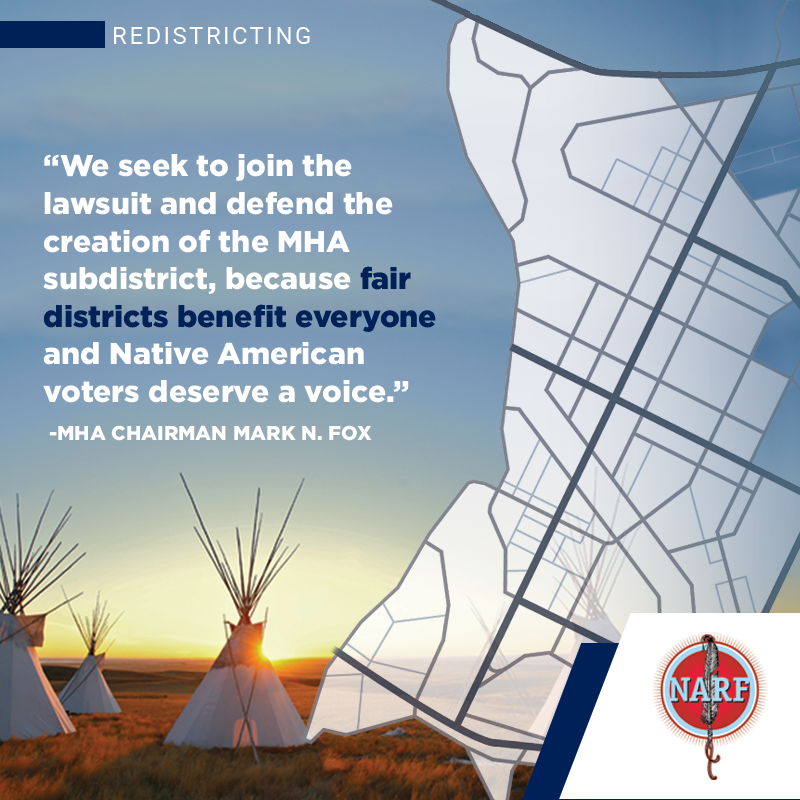
To defend a challenge to a North Dakota State House subdistrict that the North Dakota Legislature approved in 2021, the the Mandan, Hidatsa, and Arikara (“MHA”) Nation intervened as a defendant to support North Dakota.  After MHA Nation and the state successfully won summary judgment in the district court, North Dakota is now asking the Supreme Court to vacate the state’s (and the MHA Nation’s) win in the lower court.

Here is the jurisdictional statement from the Plaintiffs.

Here is MHA Nation’s Motion to Dismiss or Affirm.

And here is North Dakota’s Response.

Media coverage:

North Dakota changes course on tribal redistricting case, asks US Supreme Court to rule – InForum | Fargo, Moorhead and West Fargo news, weather and sports

North Dakota’s 180-Degree Turn in Redistricting Case Sparks Outcry from MHA Nation | Currents (nativenewsonline.net)

More here.

Tribal Nations Move to Intervene to Protect Baaj Nwaavjo I’tah Kukveni

Motion to Intervene in Arizona State Legislature v. Biden

Motion to Intervene in Heaton v. Biden

More here.

Request for Applications; Tribal Issues Advisory Group

In view of two upcoming vacancies in the at-large membership of the Tribal Issues Advisory Group, the United States Sentencing Commission hereby invites any individual who is eligible to be appointed to the at-large membership of the Tribal Issues Advisory Group to apply. An applicant for membership in the Tribal Issues Advisory Group should apply by sending a letter of interest and resume to the Commission as indicated in the ADDRESSES section below. Application materials should be received by the Commission not later than December 26, 2023.

Here is the official notice:

Turtle Mountain and Spirit Lake Win Redistricting Lawsuit Against North Dakota

On November 17, 2023, the North Dakota federal district court ruled in favor of the Turtle Mountain Band of Chippewa Indians and the Spirit Lake Nation against the North Dakota Secretary of State. The Plaintiffs proved at trial that the North Dakota legislative redistricting plan violates Section 2 of the Voting Rights Act (VRA) by diluting the voting strength of Native American voters living on and near both reservations.  The state has been ordered to submit a VRA compliant redistricting plan to the court by December 22, 2023.

The Order is here:

Previous post on this matter here and PR here.

MHA Nation Prevails in Redistricting Lawsuit

On November 2, 2023, the North Dakota federal district court ruled in favor of the MHA Nation and North Dakota on motions for summary judgment. The Plaintiffs were alleging that the newly created MHA state legislative district was an illegal racial gerrymander.  North Dakota’s 2021 redistricting plan resulted in the election of an MHA tribal member to the state legislature in 2022.  The order means that the district will remain unchanged and MHA tribal member Representative Lisa DeVille will continue to serve as a state legislator.

Order here.

MHA Motion for Summary Judgment here:

State Motion here:

Plaintiff Motion here:

You can see a press release here and previous post on this matter here.

Utah District Court Dismisses Utah and Individual Challenges to Bears Ears National Monument

On Friday, August 11, 2023, United States District Judge David Nuffer of the United States District Court of the District of Utah granted motions to dismiss the cases challenging the Bears Ears National Monument designation.

Here is the Order:

Previous post with briefs here and here.

Bears Ears at Sunset. Photo credit: Tim Peterson.

10th Cir. Decision in Crow Tribe of Indians v. Repsis

Despite the Supreme Court’s decision in Wyoming v. Herrera, which affirmed that the Crow Tribe’s treaty-reserved right to hunt in the Big Horn National Forest remained intact following Wyoming’s statehood, the State continued to prosecute Mr. Herrera for taking an elk in the Forest. The State argued that notwithstanding the Supreme Court’s decision in Herrera, Mr. Herrera was precluded from asserting his treaty defense because he (being in privity with the Crow Tribe as a Tribal member) was bound by the Tenth Circuit’s decision in Crow Tribe of Indians v. Repsis, which held that the Tribe’s treaty right was extinguished upon Wyoming’s statehood. Accordingly, the Crow Tribe sought relief from the Repsis judgments pursuant to Rule 60(b), so that the State could not continue to use Repsis. The Wyoming Federal District Court initially denied the Tribe’s Rule 60(b) motion, but the Tenth Circuit has now vacated that decision, remanding to the district court to consider the merits of the Tribe’s Rule 60(b) motion.

Here is the decision:

Prior posts on this matter here and here.

Supreme Court Decides Allen v. Milligan (Voting Rights)

On June 8, 2023, the Supreme Court of the United States in Allen v Milligan upheld the lower court’s determination that the newly adopted Alabama congressional maps likely violate Section 2 of the Voting Rights Act. After lower courts found that Alabama’s most recent redistricting likely violated the Voting Rights Act, the state chose to appeal the case rather than draw non-discriminatory electoral districts. The state argued that, contrary to the protections embodied in the Voting Rights Act, race should not be taken into consideration in redistricting efforts. The Supreme Court disagreed.

Last July, the National Congress of American Indians, represented by NARF, filed an amicus brief in the case arguing against the proposal to eliminate race from redistricting considerations. Participating in American democracy provides Native Americans the opportunity to remedy past injustices by electing representatives who understand and honor Native Nations’ political status within American federalism, who will advance treaty rights, advocate for basic resources, and respect and value Native Americans’ contributions to this country.

The brief explained that there is an ongoing and critical need for Section 2 of the Voting Rights Act to address racial discrimination and contemporary voter suppression that dilutes Native American votes and political power. In fact, the only Section 2 enforcement action brought by the Department of Justice during President Trump’s tenure was a challenge to an at-large district that prevented the election of Native American candidates of choice to a school board.

Motion to Dismiss briefing in Bears Ears Litigation

Lena’ Black v. Broken Arrow Public Schools

High school graduate Lena’ Black, an enrolled member of the Otoe-Missouria Tribe and of Osage descent, filed a lawsuit on May 15, 2023, against the Broken Arrow School District for violating her rights to free exercise of religion and freedom of speech. Black seeks restitution for emotional distress caused when school officials singled her out and attempted to take her sacred eagle plume by force, damaging the plume that she received in ceremony when she was three years old.

“My eagle plume has been part of my cultural and spiritual practices since I was three years old. I wore this plume on graduation day in recognition of my academic achievement and to carry the prayers of my Otoe-Missouria community with me,” said Lena’ Black. “The law protects my right to wear this eagle plume at my graduation, and school officials had no authority to forcibly remove it from my cap.”

Governor J. Kevin Stitt recently vetoed Oklahoma Senate Bill 429, passed by the state legislature with near unanimous bipartisan support to prohibit discriminatory graduation dress codes. The bill would have reaffirmed the rights of Native American students like Black to wear tribal regalia at graduations, a critical protection in the state with the second highest concentration of American Indians. Following his veto, Governor Stitt suggested this issue should instead be resolved at the district level.

Black is represented by the Native American Rights Fund (NARF) and Pipestem Law, P.C. “We will hold the Broken Arrow School District accountable for its discriminatory actions,” said NARF Staff Attorney Morgan Saunders. “The Broken Arrow School District violated Ms. Black’s rights despite existing laws that should have ensured she was able to wear her eagle plume without incident.”

“This lawsuit demonstrates why these decisions cannot be left up to individual school districts,” said Pipestem Law Partner Wilson Pipestem. “Without clarity from the State, Native students will continue to be forced to seek justice in the courts after their rights have been violated and their graduation ceremonies are long since over.”

“I filed this lawsuit to ensure everyone understands the importance of items like my eagle plume, and to prevent schools from targeting Native students like me in the future. No student should face ignorance and discrimination in their school or their community,” said Black.

While traditions vary, members of many tribal nations wear specific clothing or objects, like eagle plumes, at graduation ceremonies to signify their academic achievement and in recognition of their spiritual and religious beliefs. Schools, school district leaders, educators, parents, students, and allies can learn more about creating inclusive graduation ceremonies and positive change at: https://narf.org/cases/graduation/.