RCMP Report on Missing and Murdered Aboriginal Women Shows Disproportionate Rates of Homicide and Missing Women Cases

Today, the Royal Canadian Mounted Police issued “Missing and Murdered Aboriginal Women: A National Operational Overview.”

Link to full report here.

Speakers at the press conference highlighted numerous disturbing statistics and then officially resolved to promote more national prevention initiatives.

The report only looked at police reported cases from 1980-2012. This means that any unreported cases, closed cases, or cases from prior to 1980 will not be represented in the statistics.

Some key finding:

  • 1181 homicides and unsolved cases involved Aboriginal women. Of that number 160 were missing and 1017 were homicide victims.
  • 225 of those cases remain unsolved, 105 unsolved missing women cases and 120 homicides.
  • As of November 2013, 6,420 people are missing in Canada, 22% of these are missing women and of that group 11.3% are Aboriginal women.
  • For women involved in the sex trade, the solve rate is only 60% for Aboriginal women and 65% for non Aboriginal women.

Disproportionate Impact:

Aboriginal women are only 4.3% of the population, yet comprise 11.3% of total missing women cases and 16% of total female homicide cases. *Later it was mentioned that while female homicide rates are decreasing in general in Canada, there is not a similar decrease in Aboriginal female homicides. Therefore, the percentages are actually higher – more like 23% of female homicides.

Perpetrators:

89% are males, average age of 35, and the majority knew their victims. Some common characteristics: underemployed, high use of intoxicants, criminal records, and a history of violence against the victim.

The full report includes much more information, but these few statistics demonstrate what many in Indigenous communities have been saying – Indigenous or Aboriginal women comprise a disproportionate amount of missing and murdered women in Canada. These limited statistics are proof of the terrible reality that Indigenous community members have been discussing for years. Some will say that these numbers still do not truly show the full situation. It remains to be seen whether this report will signal the beginning of better cooperation among national and provincial police with Indigenous communities to protect Indigenous women and girls or if it will remain one more depressing report to be filed away and forgotten.

*As a side note, when we will we see a similar study in the United States? Where are U.S. national statistics on missing and murdered Native women?

Previous coverage of missing and murdered Indigenous women in Canada here.
 

Senate Vote on Diane Humetewa Nomination Today

H/T to NNABA for the information:

The Senate vote on Diane Humetewa’s historic nomination will be held after 5 p.m. eastern today.

Wednesday, May 14th

5:15pm (EST)—up to 4 roll call votes:

1.     Confirmation of Executive Calendar #664, Steven Paul Logan, of Arizona, to be United States District Judge for the District of Arizona

2.     Confirmation of Executive Calendar #665, John Joseph Tuchi, of Arizona, to be United States District Judge for the District of Arizona

3.     Confirmation of Executive Calendar #666, Diane J. Humetewa, of Arizona, to be United States District Judge for the District of Arizona

Watch the Senate vote at: http://www.c-span.org/live/

Select Senate

Inupiat Elder Brings His Perspective to Arctic Development Debate

While politicians, lobbyists, activists, and business leaders regularly comment on whether or not the Arctic should be developed, how it should or should not be developed, and the implications of development, the voices of the indigenous people in the area are rarely given much press time. Edward Itta, Inupiat elder, member of the U.S. Arctic Research Commission, former mayor of North Slope Borough, and Senior Advisor, Pt Capital recently wrote an article expressing this concern. As he says in the article,

Like any other community, we Iñupiat don’t speak with one voice. What matters in this debate is that our views and concerns are taken into account. We need to be heard, because our perspective is fundamentally different from that of the warring parties. We aren’t just staking a claim to the Arctic. We’re part of it, and we always will be.

Full article here.

Excerpt from article:

Ours is a communal culture. Sharing has always been a key to our survival. It’s a good thing, because now there’s a whole lot of sharing going on. Lands that once belonged to us are under siege by two warring tribes — the environmentalists and the oil companies. Neither group owns any land outright. The federal government controls the 19-million-acre Arctic National Wildlife Refuge (ANWR) to the east of Prudhoe Bay and the 23-million-acre National Petroleum Reserve-Alaska (NPRA) in the west. Native corporations own smaller areas, primarily around the eight villages that are home to our Iñupiat people. . . .

We are a practical people. That’s how we survived for thousands of years in the Arctic. We have supported oil development in some cases and fought against it in others. We don’t have a default position, because the well being of our people depends on both oil and protected land. Our traditional hunting culture is linked to the health of wildlife habitat, while access to decent housing, food and transportation requires us to earn a living. We don’t choose between the two — we try to balance them.

The Impact of Resource Extraction on Inuit Women and Families in Nunavut

A Report for the Canadian Women’s Foundation was released in January 2014, outlining the impact that resource extraction is having on the Inuit women and families living in Qamani’tuaq, Nunavut. The report contains a literature review and qualitative data as well as a series of recommendations based on the collected data. While much anecdotal information is available about the impact that the extractive industry is having on indigenous peoples around the world, it is nice to see some data that can be used to support anecdotal accounts.

The full report is available here.

The research looked at the following areas:

  • The Work Environment (including issues like sexual harassment and employment opportunities)
  • Material Well-Being/Income
  • Family Relations
  • Addictions
  • Socio-Cultural Concerns

A few excerpts from the report:

Mining is one of the oldest occupations on the planet. It is an industry whose activities, especially in the case of open-pit mining, are very visual. The impacts of these modifications to the landscape also introduce serious environmental risks. It is therefore not surprising that since the early 1970s, a wealth of literature on the topic of mining, extraction industries and sustainable development has been produced. There are far fewer sources that specifically cover the social and gendered impacts of mining—even less that focus explicitly on Indigenous people. Very little material is Inuit-specific. . . .

There is very little evidence in the literature on Indigenous peoples and mining that identifies resource extraction that has been done with thoughtful consultation, support and that has contributed fairly to nearby communities, with little impact on the land, water and people.1

Despite some benefits and exemplary cases,2,3 the majority of sources cite people’s dissatisfaction with the mining process; from discussion, planning, implementation, monitoring, evaluation, to the closure of mines.4,10 The imposition of economic and political structures, Western values and beliefs, displacement, dispossession of lives and culture at considerable social costs are all cornerstones of what many authors describe, in reference to mining and Indigenous peoples, as capitalist and colonial relations.5, 6 Many authors make reference to complicity between the State and extractive industries.1, 10 Although people are identified as having greater access to some degree of income security, the benefits of mining projects are not distributed equally between industry and the people directly affected. 7, 8, 9 Mining projects in the Canadian North have become part of a social and political attitude that can be described as ‘new frontierism’,10 where a great expanse of land and resources are waiting to be discovered and profited from, the benefits of which will ‘trickle down’ to those framed as ‘tragically destitute’. The “anxious”3 arguments for territorial and extractive expansion are reminiscent of a very familiar paternal discourse that associates the Canadian Arctic with Canadian identity and opportunity, in a rhetoric that often leaves out Inuit altogether. ‘The north serves, primarily, “our”—easily understood to mean southern Canadian—interests and aspirations.11 . . . .

The Canadian economy has been, historically, and continues to be focused on resource extraction and development. These activities cannot be viewed without attention to environmental, historical, political, economic and social interconnections. Resource extraction has, and continues to generate considerable controversy and debate among Canadians. Over the past year Canadians have seen 2.5 million rivers and lakes protected by the Navigable Waters Protection Act drop to only 160 with the passing of Omnibus Bill C-45. Proposals for the twinning and expansion of pipelines for the transportation of crude oil across the continent have been moving forward in the presence of oil spills in Alberta and British Columbia and the Lac-Mégantic explosion in Québec. The Alberta tar sands are seen by many to contribute to greenhouse gas emissions and thus global warming; a concern with regard to the environmental and social consequences for Arctic Canada. These developments generate controversy, with some politicians, business people, economists and members of the public focusing on the economic advantages – the contribution of oil sands development to employment and the Canadian economy. The Canadian economy is heavily reliant on the export of resources. In 2010, the energy, forest, agriculture and mining sectors accounted for 60.8% of the country’s exports. Total exports accounted for about 30% the country’s GDP.13 Internationally, countries struggling with poverty increasingly see the export of their mineral wealth as a means for lifting themselves out of poverty and as a way of participating in a globalized capitalist economy.14, 15 Since World War II mining has played an increasingly important critical role in fueling capitalist growth and expansion.14, 16, 17

A growing concern in all economies—increasingly in western European as well as ‘south’ countries—is growing economic inequality and the long-term implications for social well-being and the functioning of civil society. Cheap labour facilitates the accumulation of capital for development.18 The role of resource development in the creation of unequal outcomes and the dispossession of some to the advantage of others is an international concern related to mining and resource development.12 Colonial expansion—internationally—has strong ties to the history of the development of gold and other minerals.19 The history of gold mining—including its recent history—is full of intrigue and controversy. Naylor provides a trenchant portrayal of the recent history of international gold mining, including attention to the technology and environmental implications of the chemicals and processes used to extract gold from ore, and the impact of gold mining on Indigenous peoples.20 Internationally, gold mining continues to generate considerable opposition from Indigenous peoples whose traditional lands – from Papua New Guinea, to Latin America, Australia and Canada—continue to be subject to considerable pressure from the ebb and flow of international desires for ‘glamorous gold’.16

At the same time, there are individuals in the mining industry and companies that are clearly attempting to ‘do things differently’. This is not always possible as mining companies, heavily dependent upon investment and sensitive—as are all corporations—to their share price on Canadian and international stock exchanges, must still live with attention to the ‘bottom line’. Depending on the values, orientation and pressures acting on those responsible for decision- making, the promises made in an impact benefit agreement may get compromised, environmental protection, in an attempt to save money and remain competitive, may be compromised. The pressures operating on management decisions in the mining industry are many. The literature dealing with the social and environmental impacts of mining is overwhelmingly concerned with these realities.

The history of the relationship of Canadians to the Arctic pre-dates confederation and the transfer of lands and resources under the control of the Hudson’s Bay Company and the Arctic islands under the control of Great Britain to the newly formed Canadian state. The colonization of northern lands, peoples and resources proceeds in a fashion that paralleling settlement of eastern and then later, western Canada. Displacement is literally and symbolically critical to capitalist expansion and colonial initiatives.10, 12, 21, 22 Incorporating colonial subjects into developing economies has been a concern related to colonial expansion since the early 1800s. In the Canadian Arctic, Inuit were first employed in the whaling industry. With its collapse just before the First World War, they were integrated into the fox fur trade of the Hudson’s Bay Company. The collapse of the fur trade following the Second World War introduced a period of welfarism with Inuit increasingly dependent for sustenance and survival on the newly-developed liberal welfare state. It was a period where Inuit struggled with an epidemic of tuberculosis, the residential and day schooling of Inuit children, a move from hunting camps to consolidated settlements and, in general, phenomenal social, cultural and economic change. 23

These events had devastating and long-lasting impacts on people’s livelihoods, cultural vitality, self-esteem and both physical and mental health.18, 23 Increasingly, efforts were made to integrate Inuit with the Canadian industrial economy, commencing with employment at the North Rankin Nickel Mine operating on the west coast of Hudson Bay from 1957 to 1962 and the construction of the Distant Early Warning (D.E.W.) Line (1956-57). These efforts are also evident in the development of Nanisivik, a lead-zinc mine developed near the Inuit community of Arctic Bay on the northern tip of Baffin Island. Planning commenced in the early 1970s and the mine operated from 1978 until 2002. It employed around 200 people from neighbouring communities and, along with the Polaris Mine operating on Little Cornwallis Island in the high Arctic, introduced many Inuit to wage employment for the first time.24 Studies have revealed that the long-term or sustainable benefits of these projects for Inuit were few—if any.24 They neither benefited from the infrastructure associated with the mines, nor were investments made in alternative income-generating activities that would sustain Inuit families after the mines were shut down.

Pascua Yaqui Tribe set to prosecute first non-Indian under VAWA

News coverage includes an overview of the challenges Tribes have faced when non-Indian men batter Indian women on the reservation, a little about the battle to get the VAWA provisions passed, and information about the prosecutor, judge, and public defender who will be involved with this first case. Full article here.

Press Release from Pascua Yaqui regarding the VAWA pilot program here.

From the article:

Tribal police chief Michael Valenzuela drove through darkened desert streets, turned into a Circle K convenience store and pointed to the spot beyond the reservation line where his officers used to take the non-Indian men who battered Indian women.

“We would literally drive them to the end of the reservation and tell them to beat it,” Valenzuela said. “And hope they didn’t come back that night. They almost always did.”

About three weeks ago, at 2:45 a.m., the tribal police were called to the reservation home of an Indian woman who was allegedly being assaulted in front of her two children. They said her 36-year-old non-
Indian husband, Eloy Figueroa Lopez, had pushed her down on the couch and was violently choking her with both hands.

This time, the Yaqui police were armed with a new law that allows Indian tribes, which have their own justice system, to prosecute non-Indians. Instead of driving Lopez to the Circle K and telling him to leave the reservation, they arrested him.

Inside a sand-colored tribal courthouse set here amid the saguaro-dotted land of the Pascua Yaqui people, the law backed by the Obama administration and passed by Congress last year is facing its first critical test. . . .

Some members of Congress had fought hard to derail the legislation, arguing that non-Indian men would be unfairly convicted without due process by sovereign nations whose unsophisticated tribal courts were not equal to the American criminal justice system.

“They thought that tribal courts wouldn’t give the non-Indians a fair shake,” said Pascua Yaqui Attorney General Amanda Lomayesva. “Congressmen all were asking, how are non-Indians going to be tried by a group of Indian jurors?”

Against that opposition last year, the Obama administration was able to push through only the narrowest version of a law to prosecute non-Indians. While it covers domestic and dating-violence cases involving Native Americans on the reservation, the law does not give tribes jurisdiction to prosecute child abuse or crimes, including sexual assault, that are committed by non-Indians who are “strangers” to their victims. In addition, the law does not extend to Native American women in Alaska.

“It was a compromise the tribes had to make,” Lomayesva said. “It only partially fixes the problem.”

Still, what will play out over the next months on the Pascua Yaqui reservation is being watched closely by the Justice Department and by all of Indian country. The tribe’s officials are facing intense scrutiny and thorny legal challenges as they prepare for their first prosecution of a non-Indian man.

“Everyone’s feeling pressure about these cases,” said Pascua Yaqui Chief Prosecutor Alfred Urbina. “They’re the first cases. No one wants to screw anything up.”

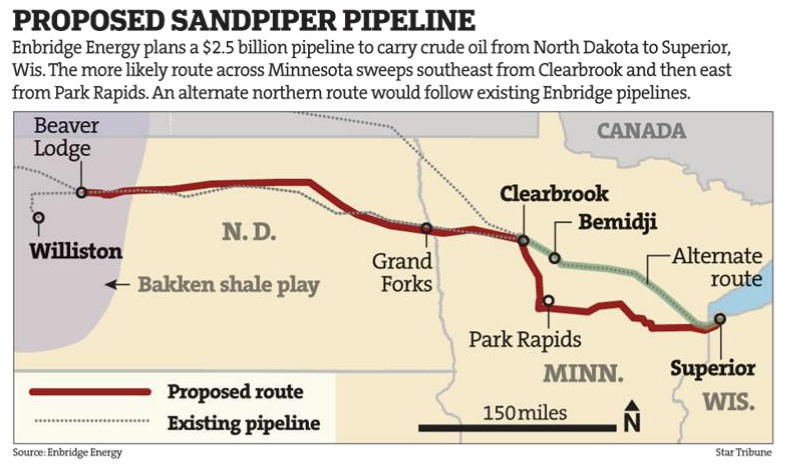
Upcoming Event, Raising Awareness and Knowledge of Proposed Pipelines that Threaten MN Wild Rice

April 17, 11:30 am – 12:30 pm, Hamline University School of Law will host a law student training event. The students will learn about administrative processes related to proposed oil pipelines, specifically focusing on the ones slated to run through Minnesota.

From the press release:

Honor the Earth, a Native-led environmental organization, has joined with a coalition of related organizations to protect Minnesota’s wild rice stands. The group is participating in the Minnesota Public Utilities Commission (“PUC”) and administrative processes regarding two proposed oil pipelines threatening some of the most significant wild rice stands in the state. To advance those efforts, Winona LaDuke of Honor the Earth and her team of legal allies will train Minnesota environmental law students on April 17th. Hamline University School of Law will host the event from 11:30 am to 12:30 pm which will also be available statewide via webcast. Environmental law students from all four Minnesota law schools (University of Minnesota, William Mitchell, Hamline, and St. Thomas) will be reviewing the legal and administrative cases. 

Press interviews will also be offered from 10:30 am – 11:25 am in the Moot Court Room.

Further information on the pipelines and efforts to propose alternative routes can be found in the press release:

Press Release Honor the Earth

News coverage here.

Sandpiper map

Dan Snyder, Owner of Washington Football Team Issues Letter, Announces Original Americans Foundation

Mr. Snyder, owner of the infamous Washington team, has decided that instead of changing the racial epithet used in the team’s name, he will start a foundation to address social ills within Native American communities. Taken from his letter Letter-from-Dan-Snyder-032414:

The mission of the Original Americans Foundation is to provide meaningful and measurable resources that provide genuine opportunities for Tribal communities. With open arms and determined minds, we will work as partners to begin to tackle the troubling realities facing so many tribes across our country. Our efforts will address the urgent challenges plaguing Indian country based on what Tribal leaders tell us they need most. We may have created this new organization, but the direction of the Foundation is truly theirs.

He claims that this decision was based on information he gathered while touring reservations.

Several months ago I wrote you about my personal reflections on our team name and on our shared Washington Redskins heritage. I wrote then – and believe even more firmly now – that our team name captures the best of who we are and who we can be, by staying true to our history and honoring the deep and enduring values our name represents. In that letter, I committed myself to listening and learning from all voices with a perspective about our Washington Redskins name. I’ve been encouraged by the thousands of fans across the country who support keeping the Redskins tradition alive. Most – by overwhelming majorities – find our name to be rooted in pride for our shared heritage and values. . . .

What would my resolve to honoring our legacy mean if I myself—as the owner of and a passionate believer in the Washington Redskins—didn’t stay true to my word? I wanted and needed to hear firsthand what Native Americans truly thought of our name, our logo, and whether we were, in fact, upholding the principle of respect in regard to the Native American community. So over the past four months, my staff and I travelled to 26 Tribal reservations across twenty states to listen and learn first-hand about the views, attitudes, and experiences of the Tribes. We were invited into their homes, their Tribal Councils and their communities to learn more about the extraordinary daily challenges in their lives.
Considering the vast number of articles, Facebook posts, and tweets by Native people vehemently opposed to keeping the name, it is interesting that only those in favor of allowing it to remain seem to have been heard. Previous coverage here.
Here is one article reacting to this announcement.

Job Announcement: Public Defender, Lawyer Judge at Fort Peck

Public Defender:

The Fort Peck Tribes are seeking an attorney for the full-time position of Public Defender in the Fort Peck Tribal Court. The position is in Poplar, MT. Candidates must be admitted to practice in any jurisdiction.  Salary DOE.  The job description is available at the HR office at fortpecktribes.org or contact Rita Weeks, rweeks@fptc.org.

Lawyer Judge:

The Fort Peck Tribes are seeking a lawyer judge for a half-time position in the FortPeck Tribal Court in Poplar, MT. Experience preferred.  Candidates must be admitted to practice in any jurisdiction. Salary DOE. The job description is available at the HR office at fortpecktribes.org or contact Rita Weeks, rweeks@fptc.org.

15 Years Ago Today, Minnesota v. Mille Lacs was Decided

With all of the depressing Indian Law cases that we read, it is always nice to remember the victories.

This is taken from the Great Lakes Indian Fish & Wildlife Commission’s Facebook page:

Honoring Treaty Day 2014

A unique Ojibwe holiday, GLIFWC bands established Treaty Day following the US Supreme Court ruling in the Minnesota v. Mille Lacs case. That decision, issued 15 years ago today, found that reserved rights in the Minnesota 1837 ceded territory continued to exist—a ruling that supported earlier court decrees on other ceded lands and waters.

To the treaty-era Ojibwe headmen, tribal harvesters (across the centuries), legal experts, caretakers of treaty resources, and today’s men and women that lead tribes into the 21st Century: Chi Miigwech! COR


Congratulations to Teller Aklaqs for Their First Ever Appearance in State 1A Basketball Championship

The Teller Aklaqs Girls Basketball Team made their first appearance ever at the 2014 Alaska School Activities Association’s 1A State Basketball Championship. They finished in 4th place. Congratulations on a great season team! We hope to see you back at state next year.

*Aklaq = Grizzly Bear in Inupiaq

1959516_10152258366241421_1041627698_n

1521930_3961789979924_452836056_n