Buy Indian Act, Final Rule

The Department of the Interior is finalizing regulations guiding implementation of the Buy Indian Act, which provides Indian Affairs (IA) with authority to set aside procurement contracts for Indian-owned and controlled businesses. This rule supplements the Federal Acquisition Regulation (FAR) and the Department of the Interior Acquisition Regulation (DIAR).

Federal Register here.

Press Coverage here.

Sliver of a Full Moon Performed at Women Are Sacred Conference

Sliver of a Full Moon is a portrayal of resistance and celebration. It is the story of a movement that restored the authority of Indian tribes over non-Indian abusers to protect women on tribal lands. Although thousands contributed to this victory, Sliver of a Full Moon follows the story of five Native women who took a stand and one Native man, Congressman Tom Cole, who stood with them to win this victory. The cast includes the Native women who stepped forward to publicly share their stories of abuse by non-Indians and counter staunch opponents to the tribal provisions including Diane Millich (Southern Ute), Lisa Brunner (White Earth Ojibwe), Deborah Parker (Tulalip), and Billie Jo Rich (Eastern Band Cherokee). Their stories are that of a movement with a vision of a full moon under which the sovereignty of Indian tribes is fully restored over their lands and peoples. Professional actors will join these women to portray the character of Congressman Tom Cole and that of Eastern Band Cherokee Councilwoman Terri Henry.

Press Release here.

Link to video of live performance here.

Previous VAWA coverage here.

First Same Sex Couple Married at LTBB Invited to White House

Tim LaCroix and his longtime partner, Gene Barfield, will be guests of President Barack Obama on Thursday at a reception honoring LGBT Pride Month, MLive.com reportedtoday. LGBT stands for lesbian, gay, bisexual and transgender.

The men were married in March by the LittleTraverse Bay Bands of Odawa Indians, of which LaCroix is a member. Same-sex marriage is prohibited in Michigan, but federally recognized Native American tribes are self-governing and aren’t bound by state law.

Story here.

Previous coverage here.

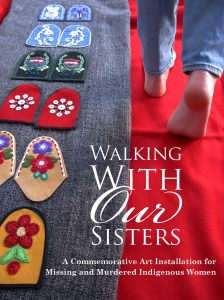
“Walking With Our Sisters” Commemorating Missing and Murdered Indigenous Women in Canada and the U.S.

The “Walking With Our Sisters” project will be wrapping up and beginning its journey across Canada and possibly into the United States in just over a month (it is currently booked through the beginning of 2018), but there is still time to participate for anyone interested.

If you are not familiar with this project, here is a description from project founder Christi Belcourt:

“Walking With Our Sisters” A Commemorative Art Installation for the Missing and Murdered Indigenous Women of Canada and the United States.

Although statistics in the U.S. are not available at present, In Canada, it is estimated that 600+ native women have gone missing or have been murdered in the last 20 years. Many have vanished without a trace with little to no concern paid by the media, the general public or politicians. This is a travesty of justice.

600+ moccasin tops are being created by hundreds of caring and concerned people to create one large collaborative art piece that will be installed for the public in various galleries and sites. They will be installed in a winding path of beaded vamps on cloth over a gallery floor. Viewers would need to remove their shoes to walk over the cloth and walk along the path.

 The exhibit is currently booked to tour across Canada and perhaps into the United States.

This project is about these women, paying respect to their lives and existence on this earth. They are not forgotten. They are sisters, mothers, daughters, cousins, grandmothers. They have been cared for, they have been loved, and they are missing.

A recording of traditional honour songs will also be created for the audio portion of the installation. A separate call to traditional singers anywhere in Turtle Island has gone out.

The due date for work is July 15, 2013. Mailed to Christi Belcourt, P.O. Box 5191, 133 Barber St., Espanola, ON, P5E 1A0. Send all work by a traceable package (Expedited, Registered, Express Post, etc.)

Donations towards the purchase of cloth, tobacco, shipping costs and other expenses directly related to the exhibit tour can be made by e-transfer to wwos@live.ca. Or directly to TD Canada Trust. Checks or money orders can be made out to Walking With Our Sisters and mailed.

All the work for the project is being done 100% by volunteers. No one is being paid for this work.

Link to the Facebook page for more information here.
479454_10151597299165272_552223_o

Shakopee Mdewakanton Gives $10 Million to 18 Tribes

The Shakopee Mdewakanton Sioux Community announced Tuesday that it would be donating more than $10 million to 18 American Indian tribes across 18 states.

The Shakopee Mdewakanton have donated more than $270 million since 1992 and made more than $500 million in loans to other tribes for economic development projects.

Here.

“Gifts from the Elders”

I am looking forward to seeing this film.

In the filmGifts from the Elders, five Anishinaabe youth take a summer to embark on a journey via the stories of their Elders. The youth are taken back to a time when people could live healthily off the land, and they contrast it to the options of today.

“Their stories chronicle the devastating impact that environmental and cultural dispossession had on the flow of knowledge from Elders to youth, and ultimately on the health of their people,” the filmmakers say on the documentary’s website.

Article about the film here.

Official site for the film here.


Q&A with James Anaya on Implementing Prior Consent with Indigenous Peoples

Most of the questions relate to implementation of this standard in Latin America, but his answers to the final two questions were particularly interesting to me, and applicable to many nations that are being called on to implement the prior consent standard.

Q: Do you think the state would lose its sovereignty if an indigenous community has the last word on whether or not an investment project can be undertaken on their territory?

A: The state does not lose its sovereignty if it respects human rights or indigenous rights. It has to comply with these rules to respect those rights; the state cannot do whatever it wants.

I would say that the respect of these rights is a way of ensuring that this sovereignty is exercised. When the state respects human rights, it exercises its sovereignty, because it is acting in favour of its citizens and peoples.

Q: Nevertheless, there has been a loss of trust in governments. What can be done to ensure legitimate consultations and to open up dialogue?

A: The mistrust and prejudice need to be overcome. It is a matter of creating open processes where indigenous peoples can voice their opinions and influence decisions, and where there is the necessary will to seek consensus.

The problem is that sometimes there is a belief that consent is about saying yes or no, about who wins. Consent is linked to consultation; the purpose of consultation is to reach consent, to reach consensus. It is not a question of one side imposing its opinion on the other.

Alberta First Nations Band Win Right to Trial Over Oil Sands’ Effect on Treaty Rights

A small First Nations band in Alberta has racked up a big win against the energy industry, clearing the way for a trial over whether its treaty rights are being infringed upon as industrial development such as the oil sands expands.

The Beaver Lake Cree Nation argues the so-called cumulative effects of oil sands and other industries such as mining and forestry violated their treaty rights. The provincial and federal governments grant permits which allow for development. Beaver Lake Cree Nation launched a legal battle five years ago and now Edmonton and Ottawa have lost their attempt to have it tossed out.

Full article here.

UN Working Group, Navajo Nation Collaborate on Human Rights Issues

On April 27, in an official visit to the United States, a United Nations Working Group on Business and Human Rights met with the Navajo Nation’s human rights experts and others in Flagstaff, Arizona. The Navajo representatives reported on two situations facing the Navajo people:Arizona Snowbowl, a ski resort that has begun a much-opposed project to spray treated wastewater on the sacred San Francisco Peaks, and predatory lending issues surrounding the lending group Santander Consumer USA.

 
The rest of the article can be found here.
Previous coverage here.