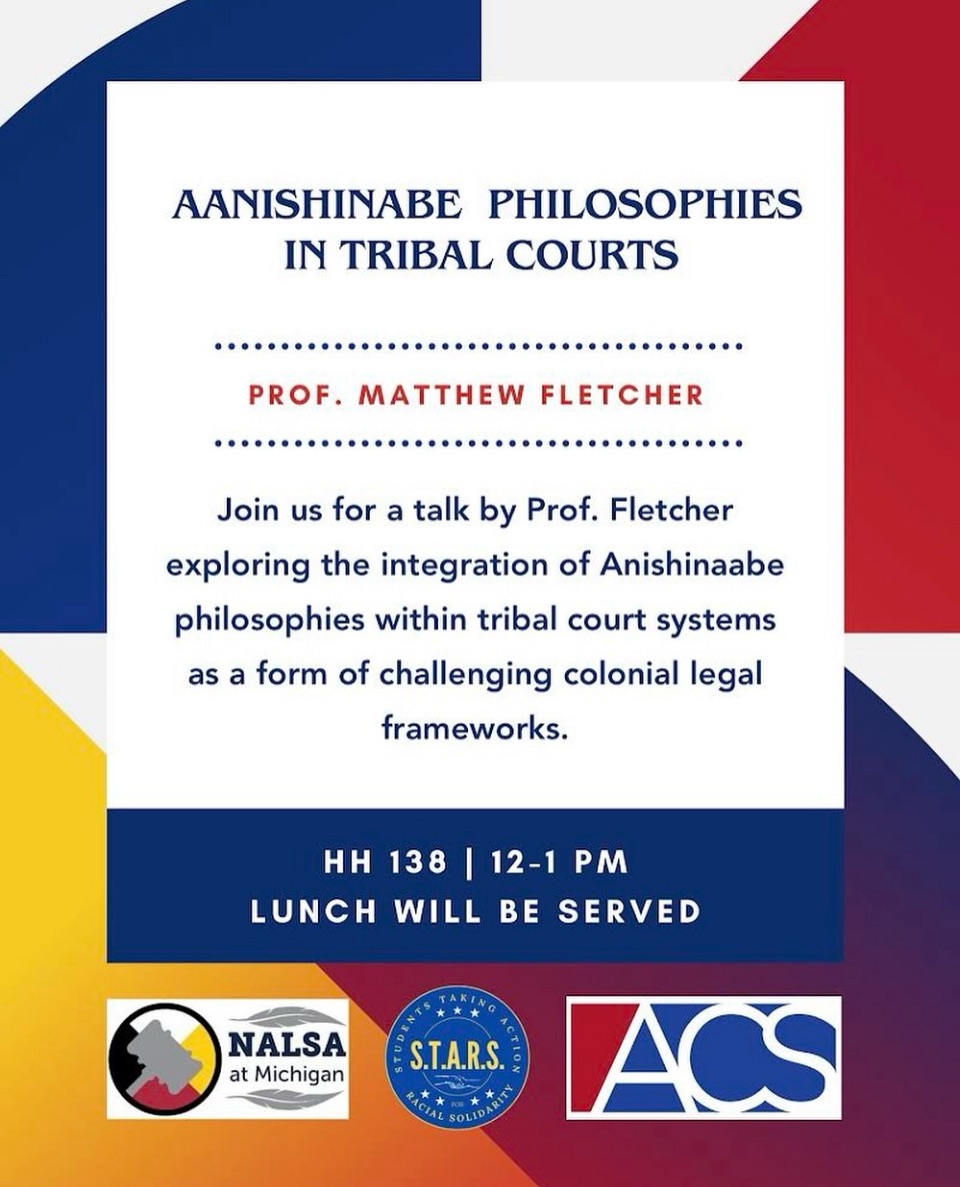
UM STARS Anti-Colonial Week Talk Today on Anishinaabe Law
Kekek Jason Stark has published “Tribal Court Jurisdiction and the Exhausting Nature of Federal Court Interference” in the University of Cincinnati Law Review. PDF
HIGHLY RECOMMENDED.

Check out “The Sovereignty Problem in Federal Indian Law” on SSRN.
Here is the abstract:
There is a sovereignty problem in federal Indian law, namely, that the federal government’s sovereign defenses prevent tribal nations and individual Indian people from realizing justice in the courts. Often, compelling tribal and Indian claims go nowhere as the judiciary defers to the interests of the United States, even where Congress has expressly stated its support for tribal interests. Conversely, tribal judiciaries allow claims to proceed to the merits, invoking customary and traditional law to hold tribal governments accountable.
Sovereignty theory helps to explain why justice can be done in one court system but not another. But federal, state, and tribal courts are all American courts than can and should learn from one another. This paper is an effort to show that federal sovereign defenses are not inevitable, nor are they even necessary.

First Nations Development Institute (First Nations) is pleased to launch a new online series of essays that focuses on Native justice. With generous support from the Chan Zuckerberg Initiative (CZI), First Nations invited multiple experts to discuss the root causes of Native injustice and highlight possible frameworks to move forward toward Native justice.
This essay by Matthew L.M. Fletcher, an appellate tribal judge and law professor at Michigan Law, University of Michigan, discusses traditional and contemporary perspectives on justice among his own tribal nation. In this essay, Professor Fletcher explores how the Michigan Anishinaabek have adapted and modified the American court system to reflect the Anishinaabe philosophy of Mino-Bimaadiziwin, which encourages Anishinaabe people to acknowledge and take responsibility for “their actions and inactions on the surrounding world.” He reasons that this tribally specific approach empowers the Anishinaabe court to better serve their own people and communities.
Here.
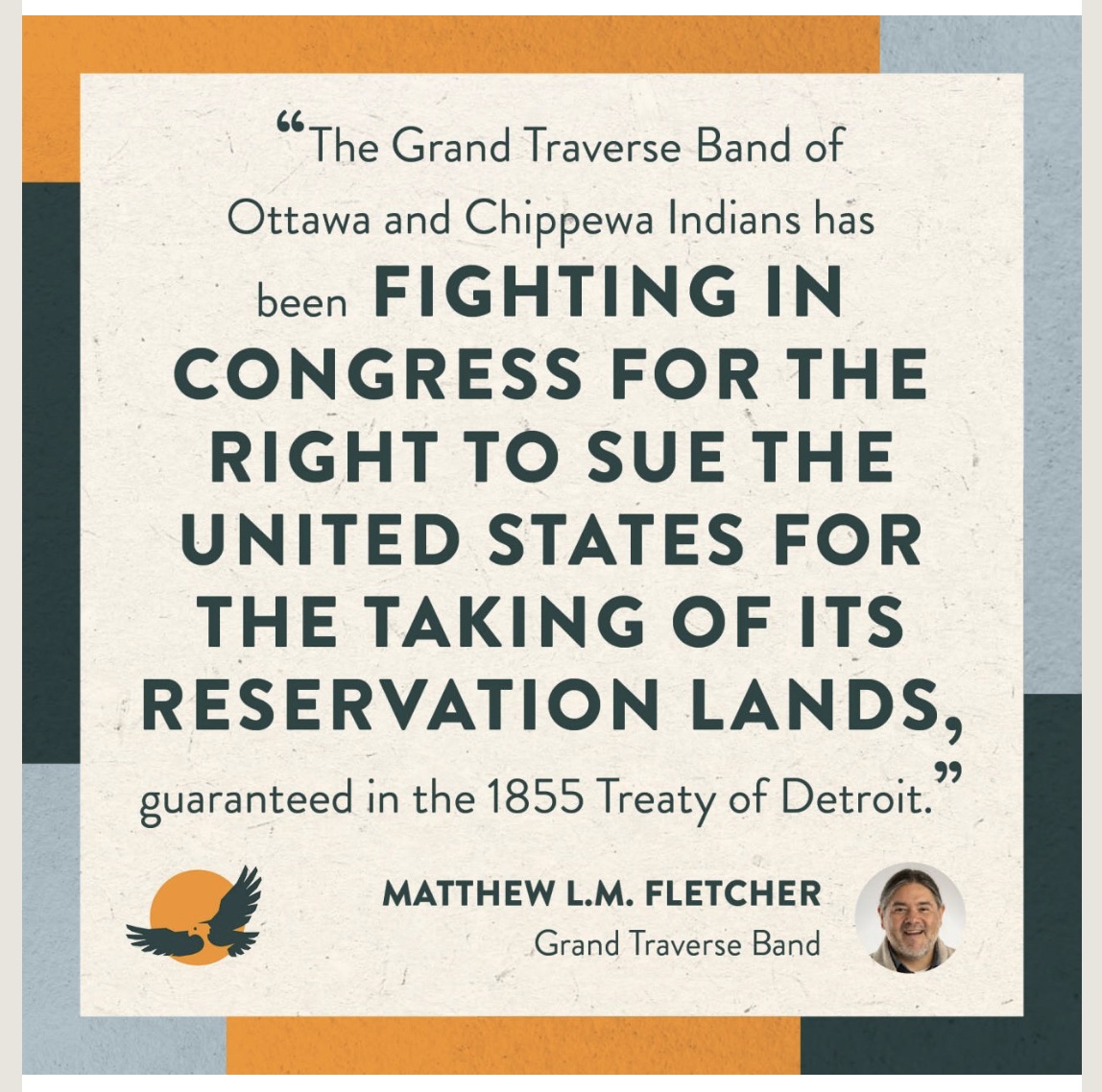
Here is a link to the tribal resolution setting the referendum vote.
Jonelle Walker has published “Wendigocene: A Story of Hunger” with the Turtle Island Journal of Indigenous Health.
Highly recommended.
The abstract:
My mother once told me that if you speak about Wendigos out loud, they will come. They are cannibals, flesh eaters, spirit eaters. Wendigos survive by consuming the life of others without reciprocity, care, consent, or regard in the name of personal gain or profit. Growing up, I was taught that the Wendigo condition was something that you caught like a disease or that grew within yourself like a cancer. They were monsters, they were the closest thing we had to “human.” Afterall, according to the ideological lineages of Marxism, liberal Enlightenment, and settler colonialism, to be “human” is to be a monster, a capitalist, a cannibal. Each of these ideological lineages root the definition of the “human” in transcendence, defined by property, exhibited through man-made aesthetics rooted in capital, white supremacy, anti-Black racism, anti-Indigeneity, and a false human/nature divide. In this paper, I argue that the term “Anthropocene”, much like the “human” it centers, requires an ontological limiting that fails to encapsulate the fullness of Anishinaabe worlds, but most importantly Anishinaabe responsibility to each other. I offer a reframing from my positioning, where the last 500 years of apocalypses can be theorized through an analysis of the rise of the Wendigos. In conversation with other critiques of the well-problematized “Anthropocene,” this contribution offers a theoretical exploration of Wendigo theory to further support that the term “Anthropocene” is reflective of itself (Davis & Todd, 2017, p. 761-780). I suggest the term “Wendigocene” as an alternative to “Anthropocene” within the context of Anishinaabe communities for Indigenous theorists, as this reframing invokes a responsibility to care for our relations and exercise abolitionist legal praxes which are central to our sovereignty.
Angela R. Riley has published “Before Mine!: Indigenous Property Rights for Jagenagenon,” a review of Michael Heller and James Salzman’s book, “Mine!: How the Hidden Rules of Ownership Control Our Lives,” in the Harvard Law Review. PDF
Alyssa Couchie has published “ReBraiding Frayed Sweetgrass for Niijaansinaanik: Understanding Canadian Indigenous Child Welfare Issues as International Atrocity Crimes” in the Michigan Journal of International Law.
Here is the abstract:
The unearthing of the remains of Indigenous children on the sites of former Indian Residential Schools (“IRS”) in Canada has focused greater attention on anti-Indigenous atrocity violence in the country. While such increased attention, combined with recent efforts at redressing associated harms, represents a step forward in terms of recognizing and addressing the harms caused to Indigenous peoples through the settler-colonial process in Canada, this note expresses concern that the dominant framings of anti-Indigenous atrocity violence remain myopically focused on an overly narrow subset of harms and forms of violence, especially those committed at IRSs. It does so by utilizing a process-based understanding of atrocity and genocide that helps draw connections between familiar, highly visible, and less recognized forms of atrocity violence, which tend to be overlapping and mutually reinforcing in terms of their destructive effects. This process-based understanding challenges the neocolonial, racist, and discriminatory attitudes reflected in the drafting and interpretation of the Genocide Convention and other atrocity laws that ignore the lived experiences of subjugated groups. Utilizing this approach, this note argues that, as applied to Indigenous populations, Canada’s longstanding discriminatory child welfare practices and policies represent an overlooked process of anti-Indigenous atrocity violence. Only by understanding current child welfare challenges facing Indigenous communities as interwoven with longstanding anti-Indigenous atrocity processes, such as the IRS system, can we understand what is at stake for affected communities and fashion appropriate remedies in international and domestic law.

The Michigan State Law Review Forum has published my short article, “Due Process and Equal Protection in Michigan Anishinaabe Courts.” Check it out.

Payment v. Election Committee
Hoffman v. Sault Ste. Marie Tribe of Chippewa Indians Board of Directors
MacLeod v. Sault Ste. Marie Tribe of Chippewa Indians
 Turtle Talk
You must be logged in to post a comment.