Here is a link to the tribal resolution setting the referendum vote.
Anishinaabe law
Fascinating New Scholarship on the “Wendigocene”
Jonelle Walker has published “Wendigocene: A Story of Hunger” with the Turtle Island Journal of Indigenous Health.
Highly recommended.
The abstract:
My mother once told me that if you speak about Wendigos out loud, they will come. They are cannibals, flesh eaters, spirit eaters. Wendigos survive by consuming the life of others without reciprocity, care, consent, or regard in the name of personal gain or profit. Growing up, I was taught that the Wendigo condition was something that you caught like a disease or that grew within yourself like a cancer. They were monsters, they were the closest thing we had to “human.” Afterall, according to the ideological lineages of Marxism, liberal Enlightenment, and settler colonialism, to be “human” is to be a monster, a capitalist, a cannibal. Each of these ideological lineages root the definition of the “human” in transcendence, defined by property, exhibited through man-made aesthetics rooted in capital, white supremacy, anti-Black racism, anti-Indigeneity, and a false human/nature divide. In this paper, I argue that the term “Anthropocene”, much like the “human” it centers, requires an ontological limiting that fails to encapsulate the fullness of Anishinaabe worlds, but most importantly Anishinaabe responsibility to each other. I offer a reframing from my positioning, where the last 500 years of apocalypses can be theorized through an analysis of the rise of the Wendigos. In conversation with other critiques of the well-problematized “Anthropocene,” this contribution offers a theoretical exploration of Wendigo theory to further support that the term “Anthropocene” is reflective of itself (Davis & Todd, 2017, p. 761-780). I suggest the term “Wendigocene” as an alternative to “Anthropocene” within the context of Anishinaabe communities for Indigenous theorists, as this reframing invokes a responsibility to care for our relations and exercise abolitionist legal praxes which are central to our sovereignty.
Angela Riley on Indigenous Property Rights for Jagenenon
Angela R. Riley has published “Before Mine!: Indigenous Property Rights for Jagenagenon,” a review of Michael Heller and James Salzman’s book, “Mine!: How the Hidden Rules of Ownership Control Our Lives,” in the Harvard Law Review. PDF
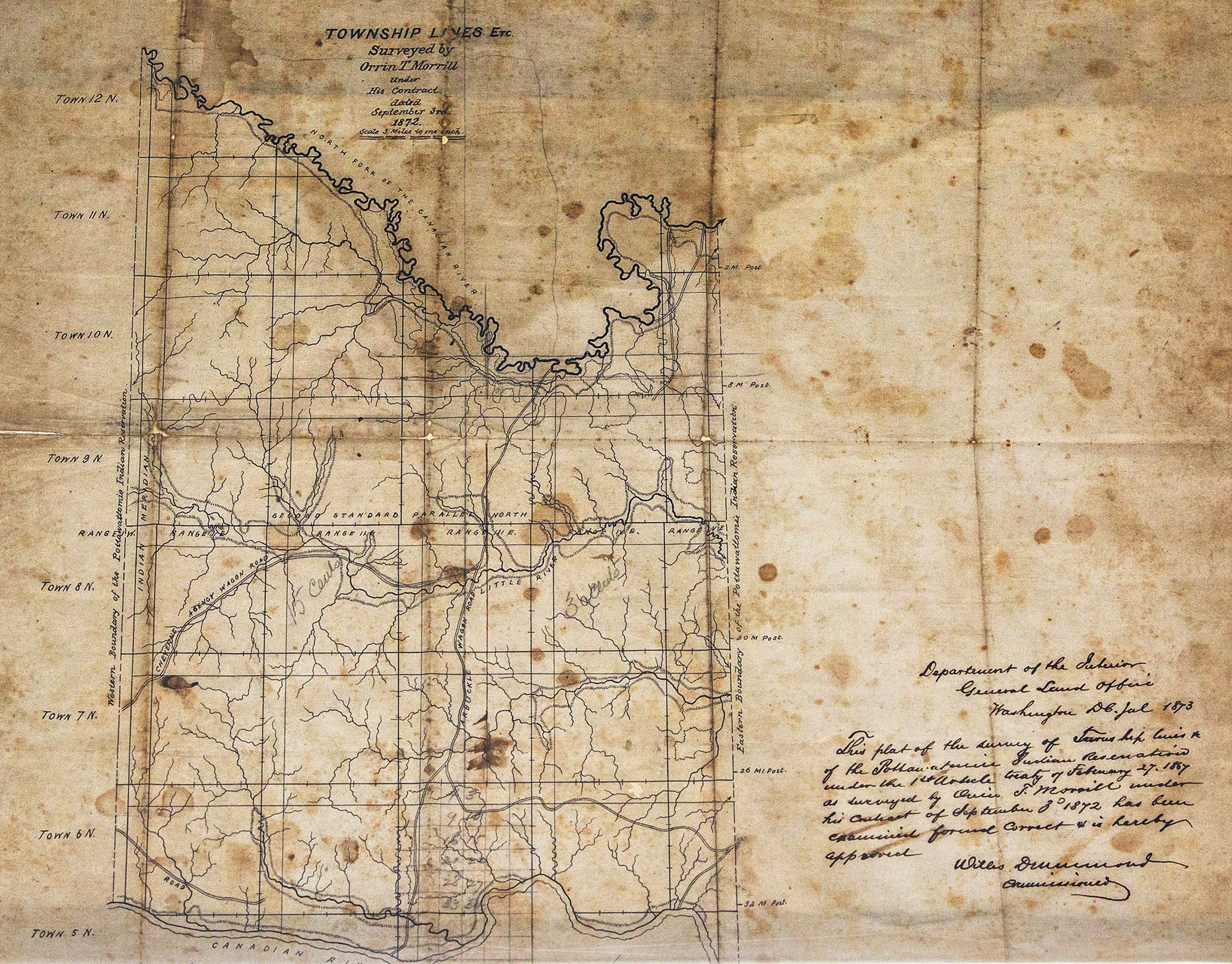
New Anishinaabe Student Scholarship on International Atrocity Crimes and Canadian Boarding Schools
Alyssa Couchie has published “ReBraiding Frayed Sweetgrass for Niijaansinaanik: Understanding Canadian Indigenous Child Welfare Issues as International Atrocity Crimes” in the Michigan Journal of International Law.
Here is the abstract:
The unearthing of the remains of Indigenous children on the sites of former Indian Residential Schools (“IRS”) in Canada has focused greater attention on anti-Indigenous atrocity violence in the country. While such increased attention, combined with recent efforts at redressing associated harms, represents a step forward in terms of recognizing and addressing the harms caused to Indigenous peoples through the settler-colonial process in Canada, this note expresses concern that the dominant framings of anti-Indigenous atrocity violence remain myopically focused on an overly narrow subset of harms and forms of violence, especially those committed at IRSs. It does so by utilizing a process-based understanding of atrocity and genocide that helps draw connections between familiar, highly visible, and less recognized forms of atrocity violence, which tend to be overlapping and mutually reinforcing in terms of their destructive effects. This process-based understanding challenges the neocolonial, racist, and discriminatory attitudes reflected in the drafting and interpretation of the Genocide Convention and other atrocity laws that ignore the lived experiences of subjugated groups. Utilizing this approach, this note argues that, as applied to Indigenous populations, Canada’s longstanding discriminatory child welfare practices and policies represent an overlooked process of anti-Indigenous atrocity violence. Only by understanding current child welfare challenges facing Indigenous communities as interwoven with longstanding anti-Indigenous atrocity processes, such as the IRS system, can we understand what is at stake for affected communities and fashion appropriate remedies in international and domestic law.

Fletcher on Due Process and Equal Protection in Michigan Anishinaabe Courts
The Michigan State Law Review Forum has published my short article, “Due Process and Equal Protection in Michigan Anishinaabe Courts.” Check it out.

Three New (and Fascinating — Read: Lots of Anishinaabe Jurisprudence) Appellate Court Opinions from Sault Tribe COA
Payment v. Election Committee
Hoffman v. Sault Ste. Marie Tribe of Chippewa Indians Board of Directors
MacLeod v. Sault Ste. Marie Tribe of Chippewa Indians
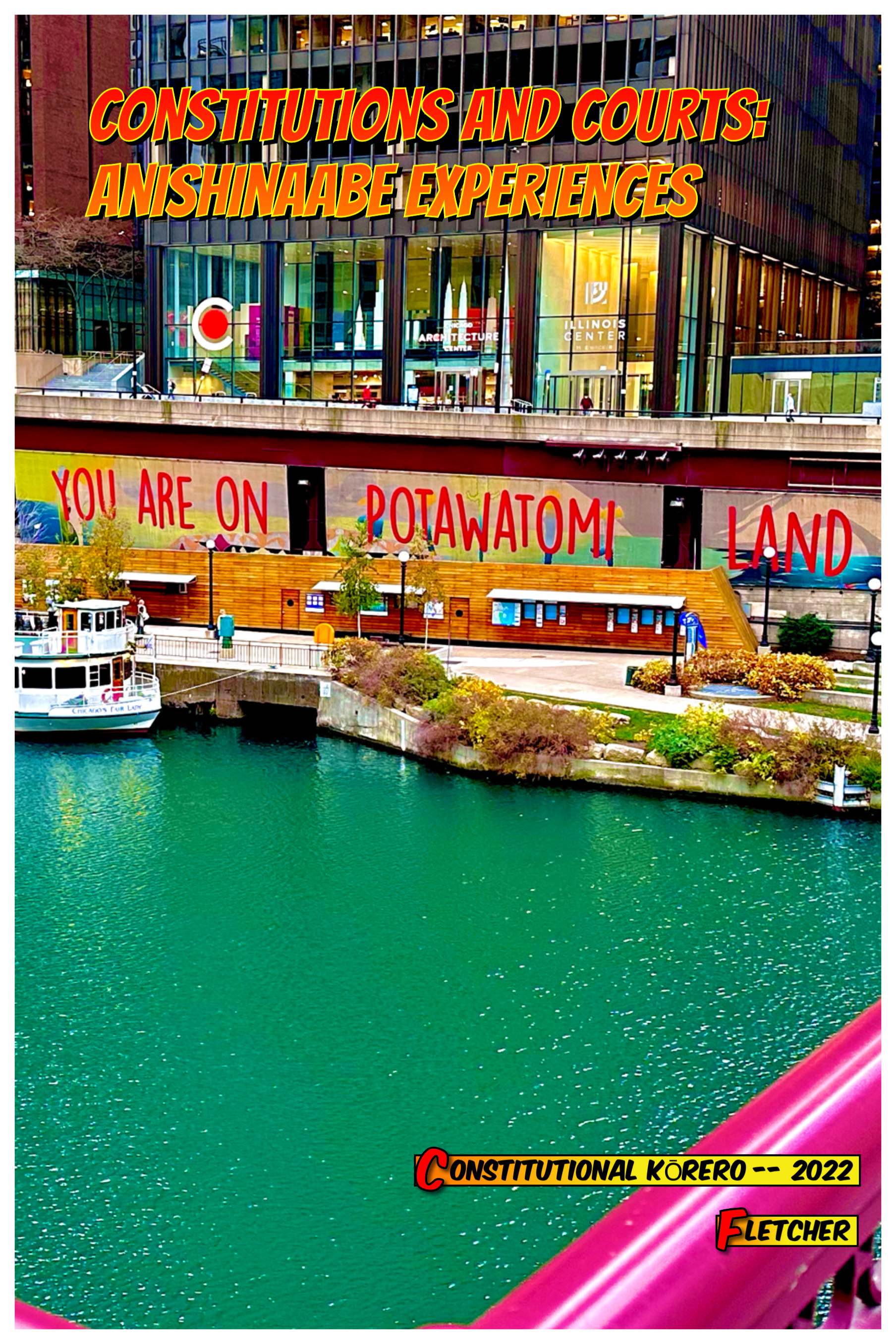
Indigenous Futures and New Zealand’s Constitution — The Constitutional Kōrero: Transforming New Zealand’s Constitution — Turtle Island Panel Today
NM State Bar Indian Law Section Annual CLE Conference

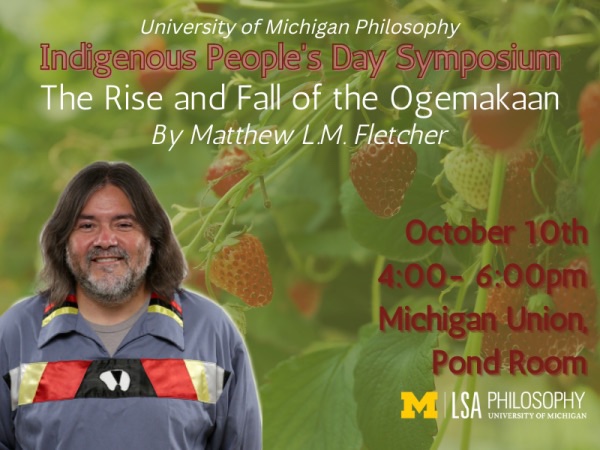
Fletcher UM Philosophy Lecture Today @ 4pm — “The Rise and Fall of the Ogemakaan”
Kekek Stark on Anishinaabe Rights of Nature Cases
Kekek Jason Stark has published “Bezhigwan Ji-Izhi-Ganawaabandiyang: The Rights of Nature and its Jurisdictional Application for Anishinaabe Territories” in the Montana Law Review.
An excerpt:
This article examines the tribal law acknowledging the Rights of Na- ture as a deeply embedded traditional Anishinaabe law principle. This traditional law principle acknowledging the rights of nature is crucial for sustaining the Anishinaabe Nations’ relationship with their territorial lands and natural resources. What does it mean to recognize the rights of ma- noomin (wild rice) to “exist, flourish, regenerate, and evolve” or to be pro- tected in its traditional forms, natural diversity, and original integrity? This article then delineates the various ways that the White Earth Band of Ojibwe has codified their relationship with their territorial lands and natural resources into tribal law. While the rights of manoomin and similar laws have been widely touted in the press as important victories for tribal sover- eignty, this article more deeply evaluates the practical effects and applica- tions of this tribal law to determine whether this law can serve as a frame- work for other Tribal Nations or is merely a symbolic gesture. Moving beyond symbolic gestures is essential for tribes to implement legal regimes more protective than those provided by states that may otherwise permit development activities by non-Indian parties within treaty territories.
HIGHLY, HIGHLY recommended.


You must be logged in to post a comment.