Here’s the BBC article. The article portrays the Mayan people as no longer existing, which is troubling and inaccurate. The good news is that the find apparently helps refute the claim that the world is ending this year.
Author: Ann Tweedy
Racialized Ivory Soap Ad from 1889
I came across this very offensive ad yesterday in the course of microfilm research. It’s from the Daily Argus Leader and was published in 1889.
News on the Northern Arapaho’s suit regarding state taxation & reservation boundaries
The suit was dismissed at the district court level because of the Northern Arapaho’s inability to join the Eastern Shoshone Tribe, which shares the reservation, and the Northern Arapaho Tribe has appealed. Our previous coverage is here.
Here‘s a news article from the Laramie Boomerang, thanks to GW.
New Report on Anti-Indianism in the Skagit County, WA GOP
Here’s a new report from Borderlands Research and Education, based in Silverdale, WA: Anti-Indianism in Skagit County – 4-15-2012 Having practiced in Skagit County, it’s good to see this sort of sentiment, which I found to be fairly prevalent, brought to light. I mentioned the State Republican Party’s resolution requesting termination of tribal sovereignty, which this report addresses in considerable detail, in one of my articles. See 13 U. Pa. J. Const. L. 737 n.239 (2011).
Coverage of the 44th Annual Dakota Conference in the Argus Leader
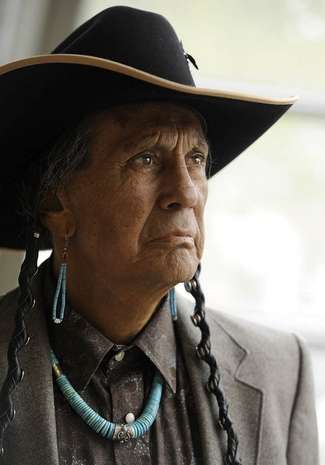
Here are some links to articles on, and photos of, the 44th Annual Dakota Conference that was held this weekend at Augustana College. The theme was Wounded Knee 1973. Unsurprisingly, Russell Means’ comments and keynote address got the most coverage. The highlight for me was a panel on Native Women’s role in Wounded Knee, which included presentations by Professor Elizabeth Castle, Marcella Gilbert, and Danyelle Means. I also really enoyed a talk by Professor Emerita Elizabeth Cook-Lynn and a talk and poetry reading by Allison Hedge Coke and Renee Sans Souci. Finally, a panel discussion by Dennis Banks, Clyde Bellecourt, and Senator James Abourezk was very illuminating, as was a talk by journalist Kevin McKiernan, who covered the occupation from the inside for NPR.
Articles
http://www.argusleader.com/apps/pbcs.dll/article?AID=2012304280008
http://www.argusleader.com/viewart/20120429/NEWS/304290038/Means-lashes-out-during-look-back-AIM
http://www.argusleader.com/apps/pbcs.dll/article?AID=2012304280010
Professor Hunter Receives UCLA’s Native Nations Distinguished Alumnus Award
More information is here.
Swinomish Tribe to Dedicate Story Pole to Skagit Valley College
The pole was carved by Kevin Paul, a Swinomish artist. The event is Monday, April 16, at 2:30. Further information is here.
44th Annual Dakota Conference Happening April 27 & 28
Talk tomorrow at Hamline on Tribes and Civil Rights
Anyone in the Twin Cities is invited to come to Hamline University Law School tomorrow at noon to hear Federal Magistrate Judge Brisbois (who is a White Earth descendant) and I talk about Indians and civil rights. Details below.
Friday, March 23, noon, Room 101
American Indians and Civil Rights: Magistrate Judge Leo Brisbois and Professor Ann Tweedy
(Faculty host: Cathy Deal)
CLE is applied for
Colette Routel and Jeffrey Holth have posted a paper on tribal consultation on SSRN
It looks like an interesting and valuable piece. Here’s the abstract, and the full paper can be downloaded here.
“The tribal right to consultation requires the federal government to consult with Indian tribes prior to the approval of any federal project, regulation, or agency policy. This article, which provides the first comprehensive analysis of this right, highlights the current inconsistencies in interpretation and application of the consultation duty. It then attempts to provide suggestions for changes that can be implemented by the legislative, executive or judicial branches.
In Part I, we provide a brief overview of the development of the trust responsibility and explain how it came to include three substantive duties: to provide services to tribal members, to protect tribal sovereignty, and to protect tribal resources. In Part II, we offer the first detailed explanation of how the trust responsibility developed the procedural duty to consult with Indian tribes. In this section we also discuss recent attempts by the Obama Administration to reform the federal government’s consultation duty. In Part III, we analyze the consultation policies that have been developed by federal agencies. In doing so, we identify four flaws that have prevented these policies from being truly effective: lack of enforceability, specificity, uniformity, and substantive constraints. Finally, in Part IV we present our proposal for reforming the consultation duty through legislation, and offer suggestions that can be implemented by the judicial and executive branches in the interim. “
 Turtle Talk
You must be logged in to post a comment.