Here is the unpublished opinion.
Brief: appellant brief
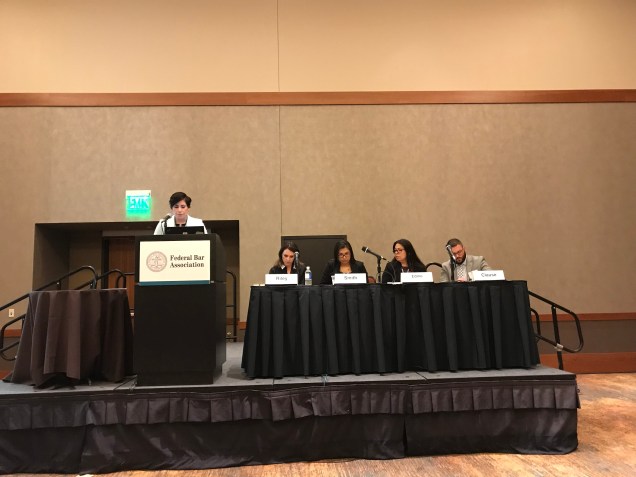
Karla General, Angela Riley, Terri Smith, Se-ah-dom Edmo, and Josh Clause
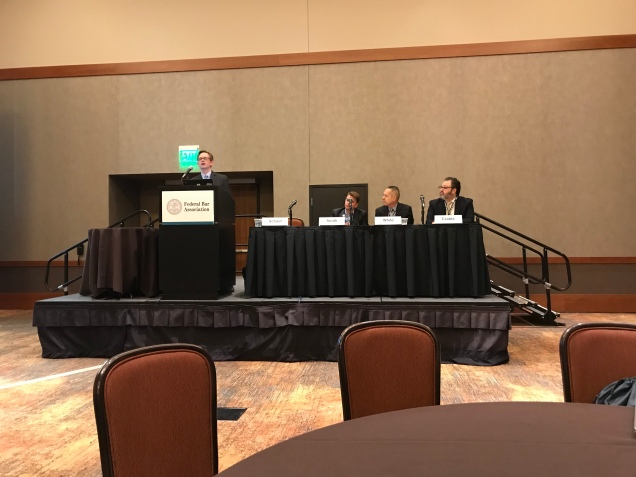
Zach Schauf, David Smith, Dale White, and Trent Crable
I would have called it “Immunizing Indian Law,” but whatever.
Here is “Failed Protectors: The Indian Trust and Killers of the Flower Moon,” forthcoming in the Michigan Law Review.
Abstract:
This Review uses Killers of the Flower Moon as a jumping off point for highlighting for readers how so many Indian people in Indian country can be so easily victimized by criminals. And yet, for however horrible the Osage Reign of Terror, the reality for too many Indian people today is much much worse. The federal government is absolutely to blame for these conditions. This Review shows how policy choices made by all three branches of the federal government have failed Indian people. Part I establishes the federal-tribal trust relationship that originated with a duty of protection. Part II establishes how the United States failure to fulfill its duties to the Osage Nation and its citizens allowed and even indirectly encouraged the Osage Reign of Terror. Part III offers thoughts on the future of the trust relationship in light of the rise of tribal self-determination. Part IV concludes the Review with a warning about how modern crime rates against Indian women and children are outrageously high in large part because of the continuing failures of the United States.
Here:
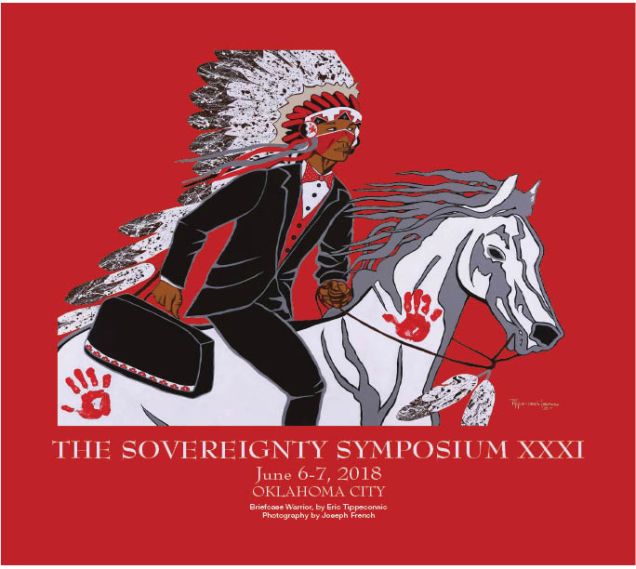
Presented by The Oklahoma Supreme Court and The Sovereignty Symposium, Inc.
When
Wednesday, June 6, 2018 7:30 AM – Thursday, June 7, 2018 5:30 PM Central Time
Where
Skirvin Hilton Hotel in Oklahoma City
1 Park Avenue, Oklahoma City, Oklahoma 73102, USA USA
Dress Code
Business Attire
Here:
Here.
Here are the materials in John v. Garcia (N.D. Cal.):
Here are the materials in Brakebill v. Jaeger (D.N.D.):
92 plaintiffs’ memorandum in support re motion for preliminary injunction
NARF Presser here:
Court Bars Sections of ND Voter ID Law
Citing “Discriminatory and Burdensome Impact on Native Americans”
April 4, 2018 (Bismarck, ND) – Yesterday, plaintiffs achieved a substantial victory when Judge Daniel L. Hovland of the U.S. District Court of North Dakota (ND), filed an order granting in significant part plaintiff’s motion for second preliminary injunction in Brakebill, et al. v. Jaeger. Citing the “public interest in protecting the most cherished right to vote for thousands of Native Americans who currently lack a qualifying ID and cannot obtain one,” Hovland’s order prohibits the enforcement of discriminatory parts of ND’s voter ID law. Additionally, the order allows P.O. box addresses—prevalent in Native American communities—to be used to prove residency, and dramatically expands the types of ID available to voters at the polls to include any document, letter, writing, enrollment card, or other form of tribal identification issued by a tribal authority to be used in lieu of ID cards, until final resolution of the case.
This is the second time Judge Hovland has found North Dakota’s voter ID law discriminates against Native Americans, and it is the second preliminary injunction granted to plaintiffs in this matter. Following the Judge’s last order in 2016, the North Dakota Legislature tried to circumvent the requirements of the order by passing a new law, HB 1369, which intentionally excluded Native American voters living on rural reservations that lacked residential addresses by failing to provide any way for them to prove residency in order to vote. Judge Hovland found “The State has acknowledged that Native American communities often lack residential street addresses . . . Nevertheless, under current State law an individual who does not have a ‘current residential street address’ will never be qualified to vote. This is a clear ‘legal obstacle’ inhibiting the opportunity to vote.” (emphasis in original)
According to Native American Rights Fund (NARF) Voting Rights Fellow Jacqueline De León, one of the attorneys representing the plaintiffs in the case, “Judge Hovland got it. He detailed the unfair nature of the state’s law and again recognized that the law created significant and unnecessary voting obstacles for Native voters in North Dakota. Laws such as these are a direct threat to the functioning of our democracy.”
Judge Hovland’s order also expands the valid forms of voter identification to include documents issued by tribal governments, the Bureau of Indian Affairs, and other tribal agencies. “This distinction is significant because putting that control back in the hands of tribal organizations allows tribal governments to ensure that their citizens do not continue to be disenfranchised,” explains lead attorney on the case, NARF Staff Attorney Matthew Campbell.
Although the case will continue, with this order, the Judge has prevented the discriminatory voter ID law from disenfranchising Native voters in significant part until final determination is made in the matter. As Judge Hovland explains in his order, “common sense and a sense of fairness can easily remedy the above-identified problems to ensure that all residents of North Dakota, including the homeless as well as those who live on the reservations, will have an equal and meaningful opportunity to vote.”
The plaintiffs in Brakebill, et al. v. Jaeger are represented by the Native American Rights Fund, Richard de Bodo of Morgan, Lewis & Bockius LLP, and Tom Dickson of the Dickson Law Office.
Here are the materials:
 Turtle Talk
You must be logged in to post a comment.