Here is the complaint in Simpson v. Washoe Tribe of Nevada and California (D. Nev.):
Author: Matthew L.M. Fletcher
Mitchell Hamline Law Review Indian Law Symposium Issue
Here:
Volume 43, Issue 4 (2017)
“Animals May Take Pity on Us”: Using Traditional Tribal Beliefs to Address Animal Abuse and Family Violence Within Tribal Nations
Sarah Deer and Liz Murphy
Affirming a Pragmatic Development of Tribal Jurisprudential Principles
Todd R. Matha
Traditional Problems: How Tribal Same-Sex Marriage Bans Threaten Tribal Sovereignty
Marcia Zug
Close to Zero: The Reliance on Minimum Blood Quantum Requirements to Eliminate Tribal Citizenship in the Allotment Acts and the Post-Adoptive Couple Challenges to the Constitutionality of ICWA
Abi Fain and Mary Kathryn Nagle
Texas Prevails over Alabam-Coushatta in Gaming Dispute
Here are the materials in State of Texas v. Alabama-Coushatta Tribe of Texas (E.D. Tex.):
76 Tribe Motion to Set Aside Judgment
80 Tribe Reply in Support of 76
99 Tribe Motion for Summary Judgment
105 Tribe Reply in Support of 99
106 Texas Reply in Support of 74
Royal v. Murphy Cert Petition (Death Penalty & Muscogee Reservation Boundaries)
Here:
Question presented:
Whether the 1866 territorial boundaries of the Creek Nation within the former Indian Territory of eastern Oklahoma constitute an “Indian reservation” today under 18 U.S.C. § 1151(a).
Lower court materials here.
UPDATE:
Environmental Federation Of Oklahoma Inc Amicus Brief
Federal Court Rejects Stockbridge-Munsee Effort to Restart Litigation against Ho-Chunk Nation Compact, Denies Motion for Sanctions
Here are the materials in Stockbridge-Munsee Community v. State of Wisconsin (W.D. Wis.):
76 motion to file amended complaint
85 stockbridge-munsee opposition to motion for sanctions
Prior post here.
Tenth Circuit Vacates Arbitration Award Favoring Citizen Potawatomi in Liquor Sales Dispute with Oklahoma
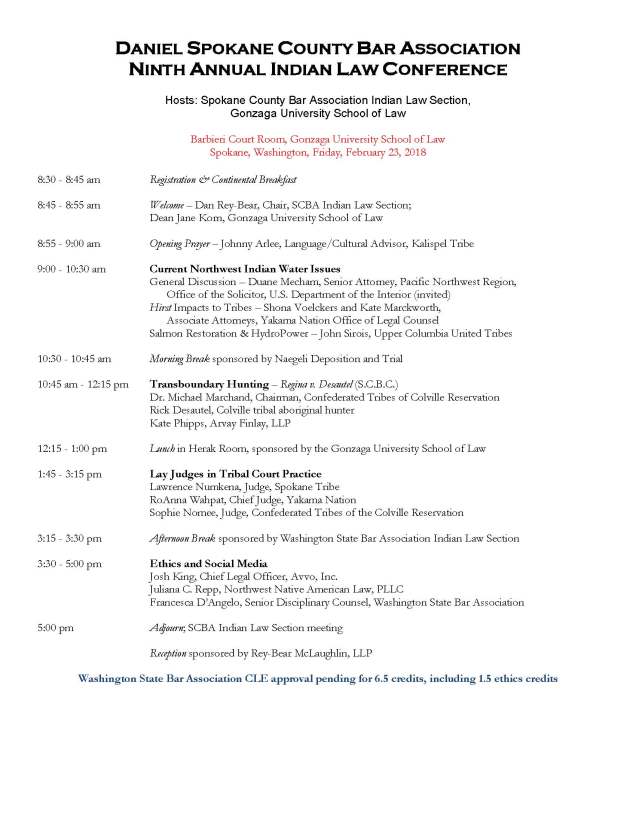
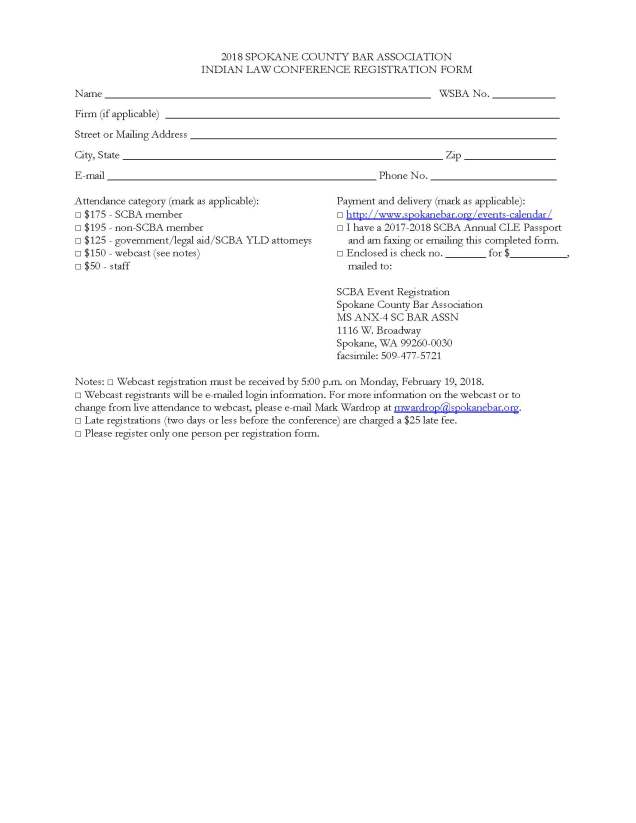
Spokane County Bar Association Indian Law Section 2018 CLE
Tribal Opposition to Trump Administration’s Motion to Change Venue in Bears Ears Matter to Utah
Here is the pleading in Hopi Tribe v. Trump (D.D.C.):
Doc. 26 Plaintiffs’ Opposition to Federal Defendants’ Motion to Transfer 2018-02-01
The motion is here.
NYTs: “Indians in the Hamptons Stake Claim to a Tiny Eel With a Big Payday”
Here.
New Scholarship on Responsible Resource Development
Carla Fredericks, Kathleen Finn, Erica Gajda and Jesse Heibel have posted “Responsible Resource Development: A Strategic Plan to Consider Social and Cultural Impacts of Tribal Extractive Industry Development,” forthcoming in the Harvard Journal of Gender and Law.
Here is the abstract:
This paper presents a strategic, solution-based plan as a companion to our recent article, Responsible Resource Development and Prevention of Sex Trafficking: Safeguarding Native Women and Children on the Fort Berthold Reservation, 40 HARV. J.L. GENDER 1. (2017). As a second phase of our work to combat the issues of human trafficking and attendant drug abuse on the Mandan, Hidatsa and Arikara Nation (MHA Nation), we developed a strategic plan to better understand the time, scale, and capacity necessary to address the rising social problems accompanying the boom of oil and gas development there. During our process, we discovered, through multiple engagements with tribes, that similar negative impacts of rapid economic development are occurring throughout the United States. In particular, many tribes are deeply concerned about the rapid increase in human trafficking on and near their reservations coincident with the entrance or re-entrance of the extractive industries.
The paper is a generalized strategic plan for tribes and other stakeholders to consider in combating the social impacts of extractive industry development. Although the plan is designed to be universal in scope and aspires to assist tribes throughout the country, it does not purport to take into account the unique complexities of individual Indian communities. The history, values, and research are examined to develop a process that will best suit a Native approach to each of the solutions presented, informed foremost by our relationship with the tribal community on Fort Berthold, as well as other tribes nationally. A cornerstone of the plan is that services that center on cultural identity and draw upon family connections are a preferred approach for Native peoples. Further, any approach to trafficking of Native women and children must take account of the colonial genesis of trafficking, generational trauma, and other risk factors.
 Turtle Talk
You must be logged in to post a comment.