New Scholarship on Legal Incidence Doctrine in Indian Taxation Cases

David Y. Kwok has posted “Taxation Without Compensation as a Challenge for Tribal Sovereignty” on SSRN. The paper is forthcoming in the Mississippi Law Journal.

Here is the abstract:

For over 150 years federal courts have held that Indian tribes have immunity from state taxes based upon the sovereignty of tribal lands. The principle of land-based tax immunity, however, has proven difficult to apply in the context of commodity goods like gasoline and cigarettes, which can freely move across state and tribal borders. Should state residents be able to avoid state cigarette taxes by driving onto tribal lands to make purchases? The result has been decades of questionable yet high-stakes litigation between states and tribes over a tax’s “legal incidence,” a judicial fiction that ignores economic reality. I propose a two-part solution to the problem of commodity taxation that will reduce such litigation while also doing justice to both state and tribal interests. First, courts should employ a broad reading of the legal incidence test described in Wagnon v. Prairie Band Potawatomi Nation, 546 U.S. 95 (2005), so as to clearly establish a state’s right to apply nondiscriminatory commodity taxes to sales occurring on tribal lands. To offset the state’s broad taxation power, courts should expand tribal sovereignty beyond tax immunity to also include a tribe’s right to an equitable portion of those commodity tax revenues. The combination of these judicial choices will discourage ongoing litigation and promote equitable negotiated results between states and tribes regarding commodity taxes.


New Scholarship on Arizona v. California

Amy Cordalis and Daniel Cordalis have published “Indian Water Rights: How Arizona v. California Left an Unwanted Cloud over the Colorado River Basin” in the Arizona Journal of Environmental Law.

The abstract:

The Colorado River is one of the most important rivers in the world. The river’s 1,400-mile journey from the Rocky Mountains to the Sea of Cortez takes on waters from seven states and from the reservations of twenty-eight Indian tribes along the way, 244,000 square miles of river basin in all. The Colorado River is also heavily managed: Its waters are allocated through a complex body of laws collectively referred to as the “Law of the River,” which includes an international treaty, two interstate water compacts, numerous federal and state statutes, and more than a dozen Indian water rights settlements. For thousands of years before the Law of the River, however, American Indians lived and irrigated within the Colorado River Basin, making due with its characteristically seasonal rains and difficult growing conditions. Today, in a cruel but all-too common twist for tribes, twelve of the basin’s twenty-eight tribes have not had their water rights completely quantified, leaving many of the basin’s oldest inhabitants without a legally secure source of water. This begs the question of how the Law of the River developed such that the Colorado River is already over-allocated but Indian water rights are to a large extent unaccounted for, and tribes—occupying and using water in the basin since time immemorial—are left struggling for whatever remaining drops they can squeeze out of the basin. And, perhaps more to the point, the question arises how Arizona v. California recognized this exact issue in the Lower Colorado River Basin and could not to fully resolve it. This article finally takes the position that tribes, the states, and the federal government must work together to settle Indian water rights claims to provide certainty to all Colorado River basin water users amidst growing undertainty from polulation growth and climate change.

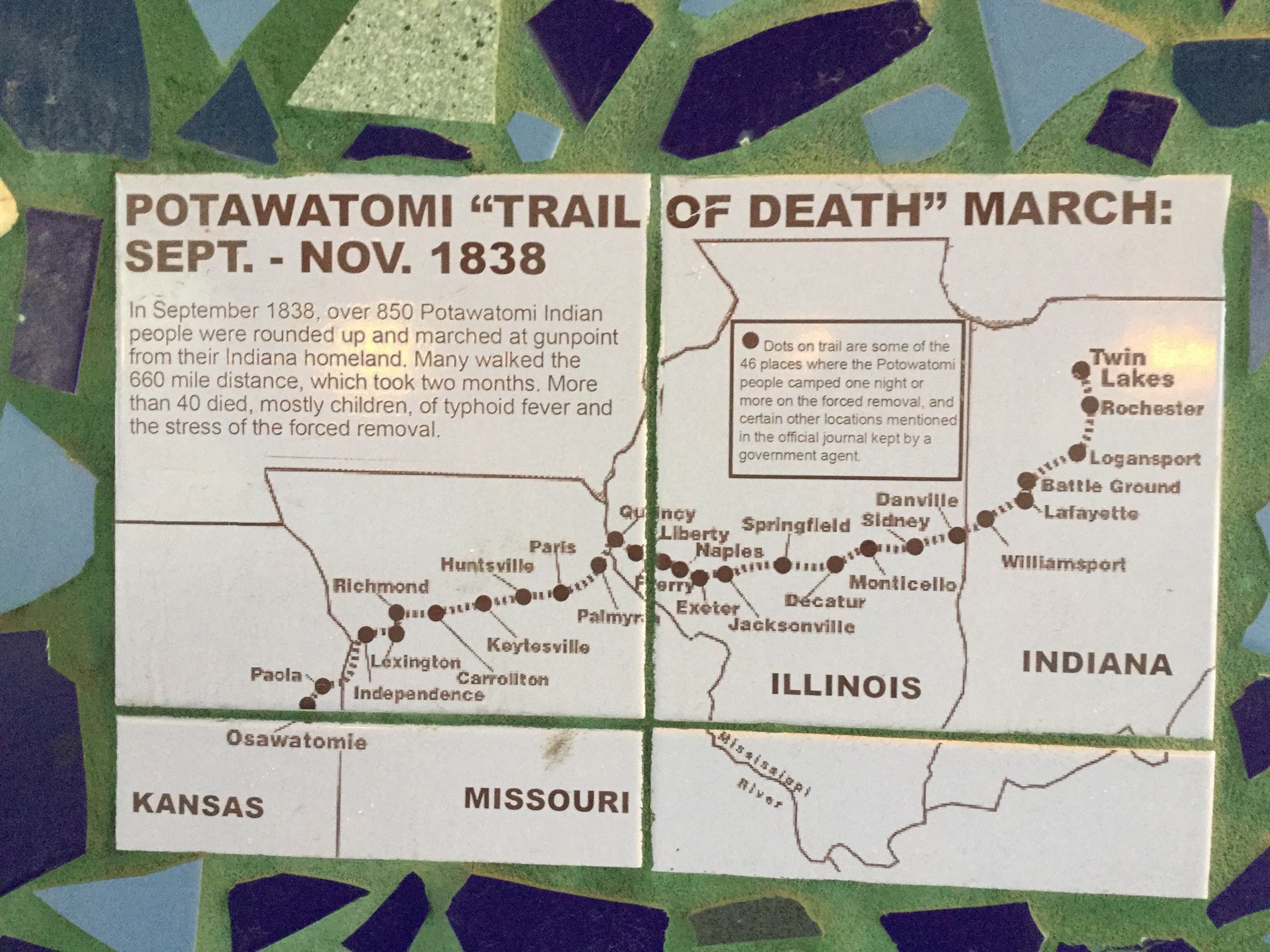
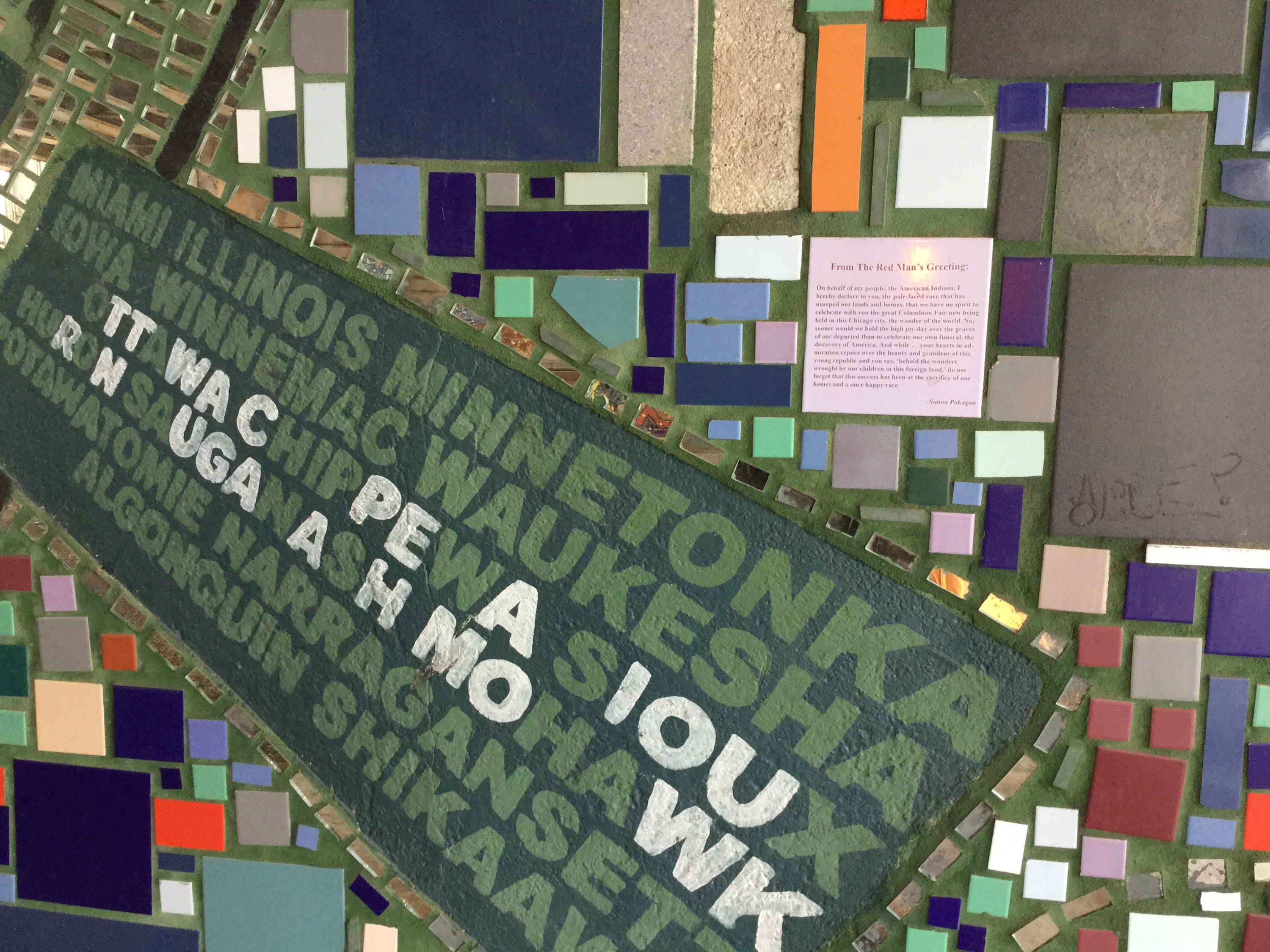
Visit to Potawatomi Underpass in Chicago

Great grampa Leopold and Uncle Simon   


“The Complete Timeline of the Navajo Presidential Dispute”

Paul Spruhan has posted “The Complete Timeline of the Navajo Presidential Dispute.”

WaPo News Profile Critical of Federally-Operated Indian Schools

Here is “Federally-run Indian schools are in rough shape because of a broken bureaucracy.

Federal Court Holds US May Sell Unallotted Timber Resources over Opposition from Chickasaw and Choctaw Nations

Here are the materials in Chickasaw Nation v. Dept. of Interior (W.D. Okla.):

254 Tribes Motion for Summary J

260-1 US Cross-Motion

266 Tribes Reply

269 US Reply

270 DCT Order

Here is the relevant statute authorizing (or mandating) the sale of the resource, as reproduced in the court’s order. Judge for yourself:

That when allotments as provided by this and other Acts of Congress have been made to all members and freedmen of the Choctaw, Chickasaw, Cherokee, Creek, and Seminole tribes, the residue of lands in each of said nations not reserved or otherwise disposed of shall be sold by the Secretary … under rules and regulations to be prescribed by him and the proceeds of such sales deposited in the United States Treasury to the credit of the respective tribes. . . . The Secretary … is hereby authorized to sell, whenever in his judgment it may be desirable, any of the unallotted land in the Choctaw and Chickasaw Nations, which is not principally valuable for mining, agricultural, or timber purposes, in tracts of not exceeding six hundred and forty acres to any one person, for a fair and reasonable price, not less than the present appraised value. . . . Provided further, That agricultural lands shall be sold in tracts of not exceeding one hundred and sixty acres to any one person.

Pro Se Section 1983 Suit against Mille Lacs Ojibwe Dismissed

Here are the materials in Goodman v. Waukey (D. Minn.):

1 Complaint

7 Magistrate Report

11 DCT Order

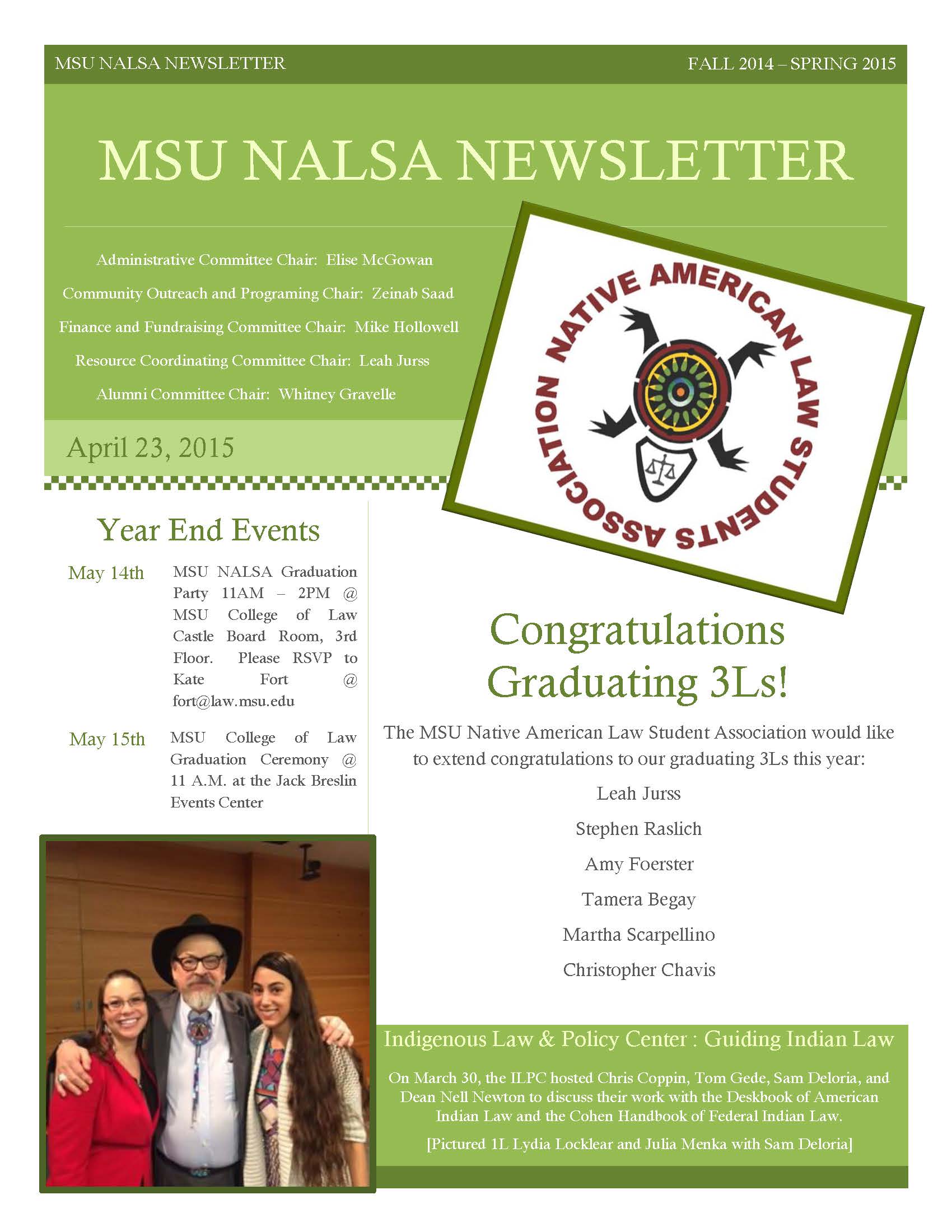
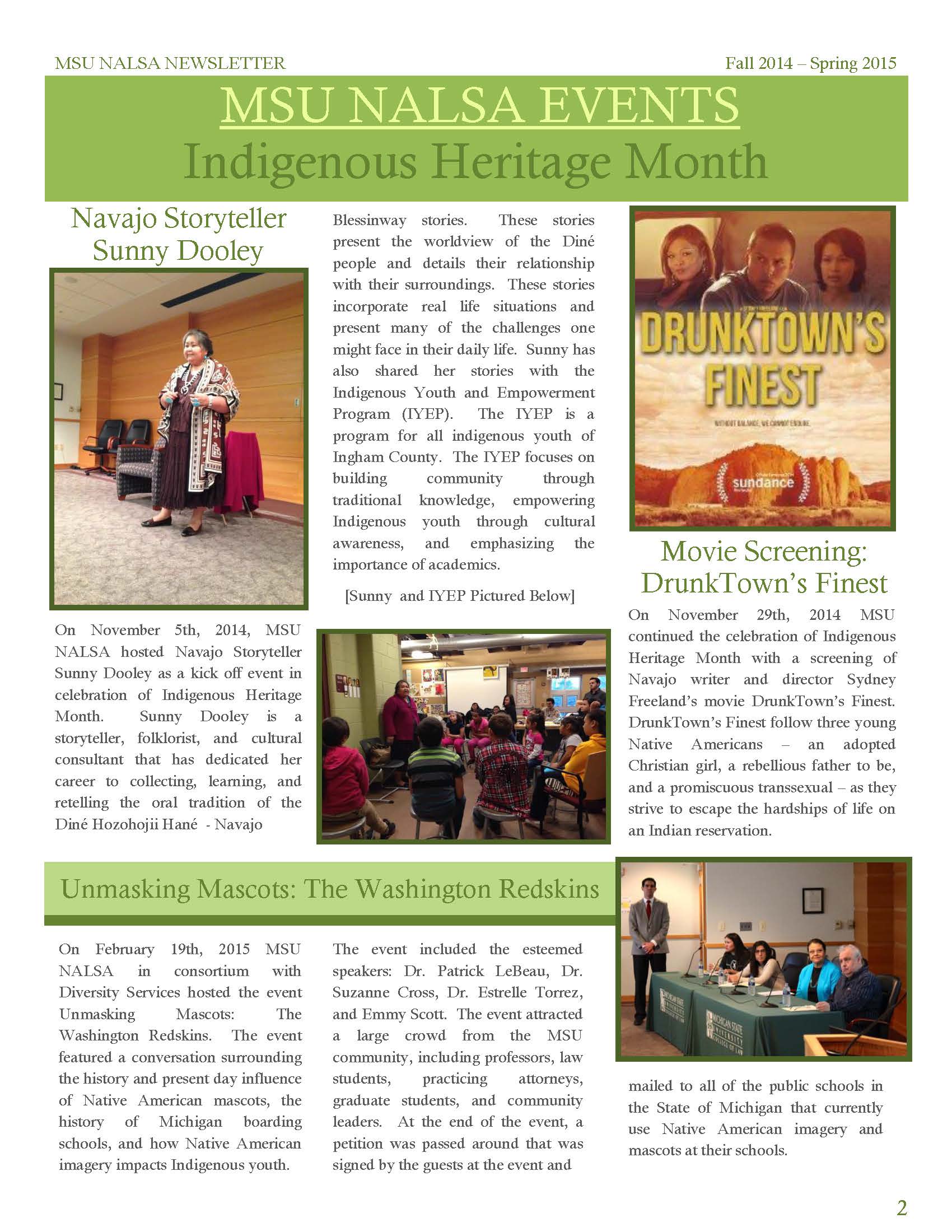
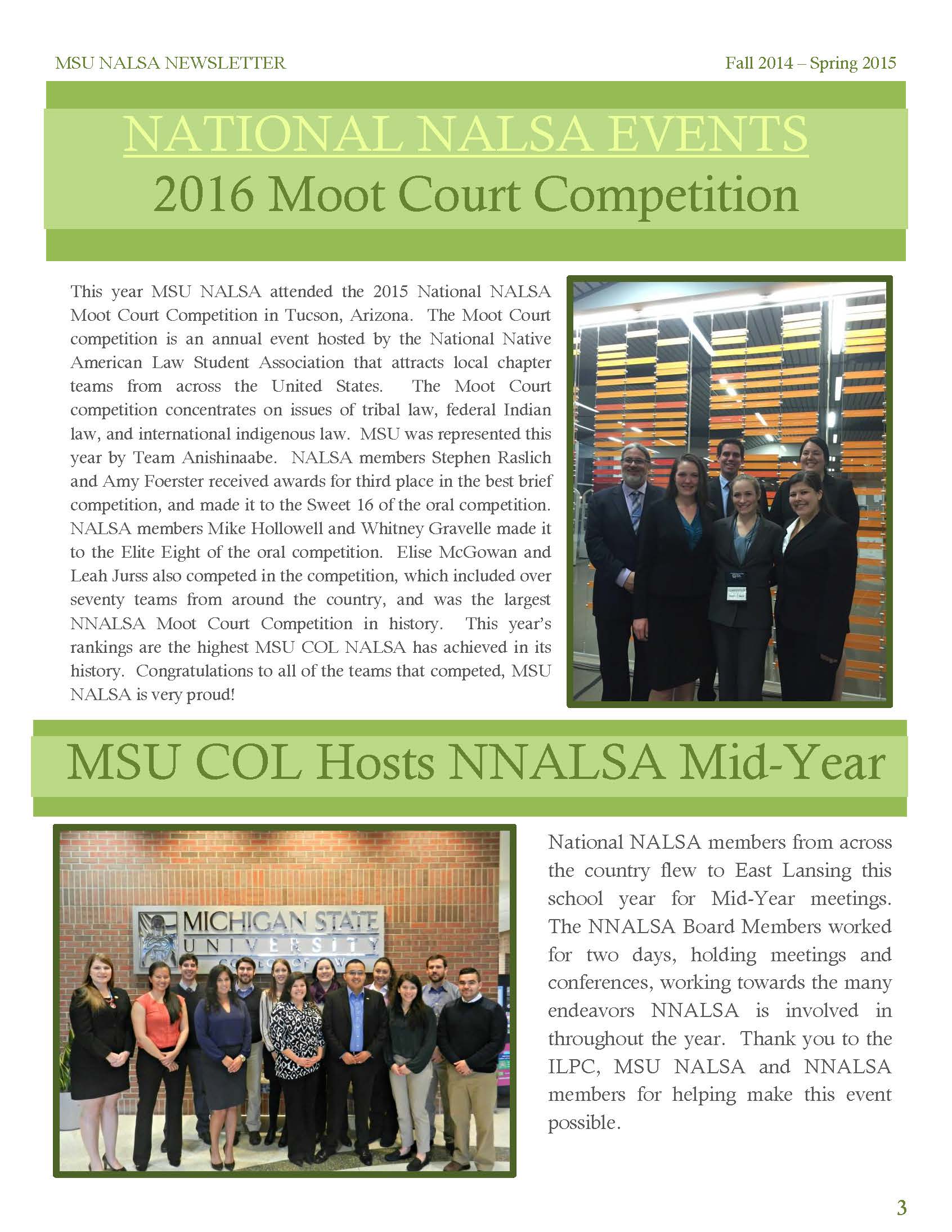
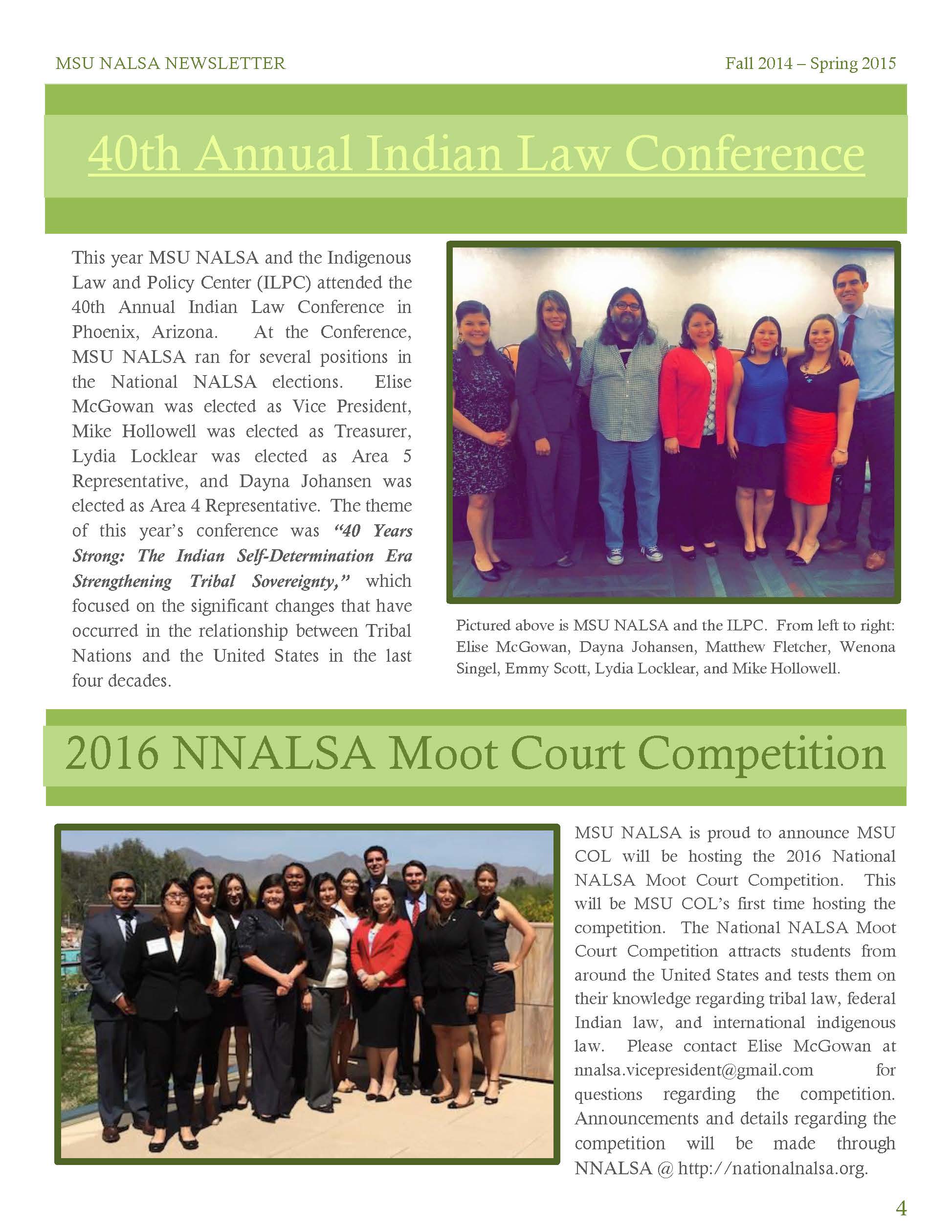
MSU NALSA Spring 2015 Newsletter

Here (MSU NALSA Newsletter 2015):

MSU NALSA Newsletter 2015_Page_1 MSU NALSA Newsletter 2015_Page_2 MSU NALSA Newsletter 2015_Page_3 MSU NALSA Newsletter 2015_Page_4 MSU NALSA Newsletter 2015_Page_5 MSU NALSA Newsletter 2015_Page_6


Controversy over Makah Treaty Whaling Rights Brewing

Here is “Sea Shepherd Announces Revival of Campaign Against Makah Treaty Rights.”
An excerpt:

From the beginning some opponents of Makah whaling engaged in behavior and used rhetoric that can contribute to anti-Indian bigotry and undermine the legitimacy of treaty rights. Some spread misinformation about treaty rights, as when the Sea Shepherd Conservation Society falsely claimed in 2005 that the Treaty of Neah Bay had been abrogated. Sea Shepherd echoed the rhetoric of the organized anti-Indian movement, declaring erroneously that upholding Makah treaty rights would be “tantamount to extra special rights for a group of people based on race and/or culture.” Anti-Indian activists use this same language in their quest to terminate tribal governments and abrogate all treaties. Sea Shepherd, Project Seawolf, Australians for Animals and other groups allied their cause with then-U.S. Representative Jack Metcalf (R-WA). Metcalf (now deceased) was a leader in the anti-Indian movement who maintained a firm foot in the politics of organized white supremacy. Anti-Makah groups have lobbied, litigated and engaged in direct action, including harassing Makah whalers and the tribal community.

Seventh Circuit Rules in Favor of Navajo Inmate on Religious Freedom Claim

Here is the opinion in Schlemm v. Wall.

And a release from Huy.