Who Won Indian Law and Policy in 2014? First Round Bracket — 2 of 8

Here we go again (first bracket here):

# 2 Sault Ste. Marie Tribe of Chippewa Indians

Perhaps the most immediate beneficiary of the Bay Mills win in the Supreme Court, which persuaded the State of Michigan to seek another route to fighting Sault Tribe’s Lansing casino proposal. But not before Sault Tribe proposed two huge off-reservation casinos. Oh yeah, they won a $74 million contract case, too. Pretty good year.

v.

# 15 Fond du Lac Band of Lake Superior Ojibwe

Still embroiled in disputes (here and here) with the City of Duluth over the Fond du Luth Casino and related properties. Won one right before Christmas though.

# 7 Gun Lake Tribe

Seeding might be a little high; a little hometown bias. Anyway, who else got Congress to overturn a Supreme Court decision in 2014, hosted the Potawatomi Gathering, and is an overall, good citizen?

v.

# 10 Wind River Tribes

Lots of action this last year, what with Wyoming going berzerk over the EPA’s decision to let tribal agencies measure air quality, and with much internal strife. 2015 should be a real interesting year.

# 3 Bay Mills Indian Community

Well, they won a Supreme Court case. Not a whole lot else going on. Sault Tribe, as we noted, passed them in the seeding.

v.

# 14 Cowlitz Tribe

Along with Interior, won a big one over neighboring tribes who claimed Cowlitz is a tribe barred from eligibility for trust land acquisitions by Carcieri.

#6 Navajo Nation

How can Navajo be seeded so low? They’re arguably the most important tribe every year, right? Well, yes, but they took some hits this year, too. Lost a tribal civil jurisdiction case in the Ninth Circuit, lost (or did they concede) on whether New Mexico can transport tribal members off rez to take drug tests, is going through one of the ugliest tribal election disputes in recent memory, fighting off Hopi and enviro challenges to their energy generators, lost a big water rights case, suffered through an ugly internal fight over a tribal resources company, lost one in the D.C. Circuit, got some bad news on uranium pollution, and lost legendary code talker Chester Nez. On the other hand, Navajo settled a huge trust case with the feds, won one against HUD, won a big one in the Ninth Circuit on Navajo’s tribal preference in employment statute, and hosted Michigan and Michigan State law students over spring break.

All in all, no one beats Navajo on volume, but this one’s a mixed bag.

v.

# 11 Lac Courte Oreilles Band of Lake Superior Ojibwe (and other Wisconsin treaty tribes)

Won a huge treaty rights case in the Seventh Circuit (miigwetch Judge Posner) on the night deer hunting controversy.
Federal Court Dismisses Duluth Suit over Carter Hotel Property

Here are the materials in City of Duluth v. Fond du Lac Band of Lake Superior Chippewa Indians (D. Minn.):

12 Fond du Lac Motion to Dismiss

23 City Motion for PI

32 City Response to Motion to Dismiss

33 Find du Lac Response to Motion for PI

37 Fond du Lac Reply

38 City Reply

43 DCT Order Dismissing Complaint

Complaint was posted here.

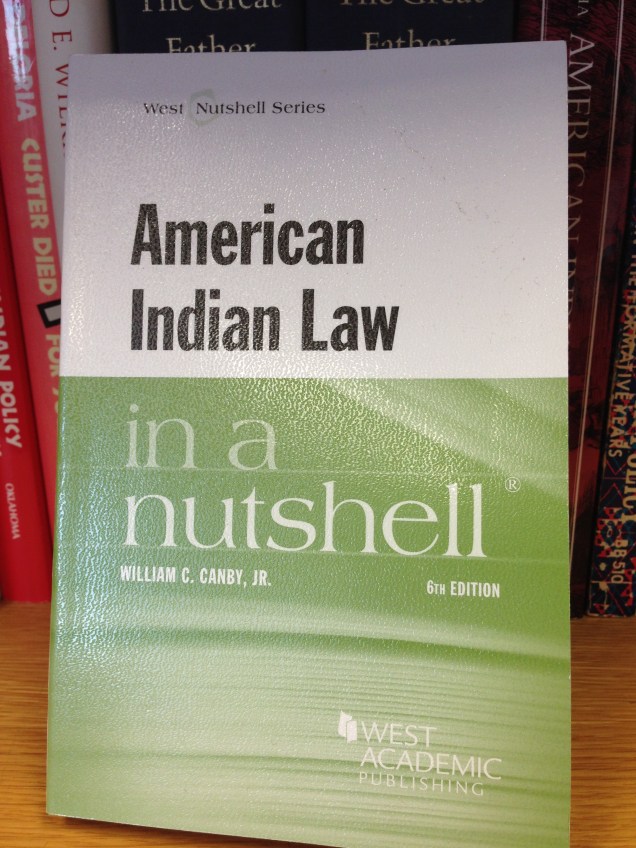
Sixth Edition of Judge Canby’s Nutshell Now Available

Sitting on my desk this morning!

Canby 6th Edition

Rehearing Petition and Amicus Briefs in Support in Native Village of Tununak ICWA Appeal

Here are the new materials in Native Village of Tununak v. State, Dep’t of Health & Social Services, Office of Children’s Services:

Appellant’s Petition for Rehearing

Brief for Grandmother as Amicus Curiae in Support of Appellant

Brief for the United States as Amicus Curiae In Support of Appellant

The court’s opinion is here.


Association of Village Council Presidents Seeks General Counsel

General Counsel

The Association of Village Council Presidents, a non profit organization in Bethel, AK is currently recruiting for General Counsel Attorney.

  • Competitive Salary
  • Excellent Benefits
  • 12 Paid Holidays and 18 days personal leave in the first year
  • Employer paid Health Care for you
  • Retirement Plan with employer contribution after 90 days of service

Summary: The General Counsel will act as the chief legal officer for the AVCP and will report directly to the AVCP President. This position will be accountable for managing both in-house and outside legal counsel; oversee the activities of the Tribal Justice Department; oversee the legal issues of the organization, including litigation; participate in legislative, regulatory and policy initiatives both statewide and nationally; provide advocacy representation and assistance to AVCP’s member Tribes on issues such as tribal sovereignty, self-governance, natural resource law, including subsistence rights under the Alaska National Interest Lands Conservation Act and the Alaska Native Claims Settlement Act; provide advice on tribal justice matters, and protection of civil right s and liberties. This position interacts frequently with the Board of Directors, advising on corporate government matters.

Contact AVCP’s Human Resources Department at 800-478-3521 for an application, to submit your resume or more information. Review our job description at www.avcp.org

Per Public Law 93-638 (Indian Self Determination & Education Assistance Act) qualified Alaskan Natives/ American Indians are given preference but candidates from all backgrounds are welcome to apply.

CashCall v. Inetianbor Cert Stage Briefs

Here:

CashCall Cert Petition

Inetianbor Cert Opp Brief

Questions presented:

I. Whether there is a non-textual “integrality exception” to the mandatory requirement in the Federal Arbitration Act (“FAA”) that a substitute arbitrator “shall” be appointed by the court whenever the parties’ chosen arbitrator is unavailable for “any … reason”? 9 U.S.C. § 5.

II. Whether a court may void an entire arbitration clause – and force the parties to litigate in court – despite the fact that the parties included a severance provision that, if applied, would render the arbitration clause enforceable?

Lower court materials here.

District court materials here.

Split Montana SCT Affirms Denial of Indian Child Welfare Matter’s Transfer to Blackfeet Tribe

Here is the opinion and the various briefs in In the Matter of S.B.C.:

Appellant Brief — Blackfeet Tribe

Appellant Brief — Father

Appellant Brief — Mother

Appellee Brief — Response to Father

Appellee Brief — Response to Tribe

Appellee Brief — Response to Mother

Reply — Blackfeet Tribe

Reply Brief — Father

Reply Brief — Mother

Montana SCT Opinion

Excerpts:

N.B. (Birth Mother) and S.B.C. (Biological Father) appeal from the order entered by the Fourth Judicial District Court, Missoula County, terminating both parents’ rights to their minor child, S.B.C, Jr. (S.B.C), and granting the Department of Public Health and Human Services, Child and Family Services Division (Child Services) permanent legal custody with right to consent to adoption. The Birth Mother and Biological Father also challenge the District Court’s order denying transfer of jurisdiction to the Blackfeet Tribal Court. The Blackfeet Tribe (Tribe) has filed a cross-appeal likewise challenging the denial of its motion to transfer jurisdiction to the Blackfeet Tribal Court and the termination of Biological Father’s parental rights. We affirm.

And:

Lastly, the Tribe argues the District Court improperly considered the socio-economic conditions of the Tribal Court. Subsection (c) of the Guidelines prohibit the consideration of the “[s]ocio-economic conditions and the perceived adequacy” of the tribal court system in making a determination of good cause. 44 Fed.Reg. 67591. In an attempt to demonstrate that the court based its decision on the inadequacy of the Tribal Court system, the Tribe draws our attention to a number of assertions the District Court made in its findings of fact and conclusions of law. The District Court remarked throughout its findings of fact and conclusions of law that the Tribe “chose to sit on its hands and delay seeking jurisdiction over [S.B.C] for tribal financial reasons.” Further, the court insinuated that the Tribe believes its children are sacred “only when it is in its best financial interests to do so.”

From the dissent:

I disagree with the majority’s analysis of the “advanced stage” guideline. The State filed its termination petition on March 6, 2013. The Tribe, having intervened early in the case, moved to transfer jurisdiction on April 10, 2013, thirty-five days later. The District Court order faulted the Tribe for seeking transfer after “all the critical court proceedings [were] completed and decisions made,” yet the District Court had not conducted a hearing nor made a decision to terminate the parents’ rights. The hearing was not held until September 10, 2013, and the order of termination was not signed until January 15, 2014, eight months after the motion to transfer was filed. This situation does not implicate the dangers the “advanced stage” rule is designed to protect against and there is no indication of manipulation by any party.

And:

Finally, I agree with the majority that the District Court’s repeated statements that the Tribe “sat on its hands” until it had a financial reason to seek jurisdiction were inappropriate. The BIA Guidelines specifically provide that a state court cannot base the “good cause” determination on “socio-economic conditions and the perceived adequacy of tribal social services or judicial system.” 44 Fed.Reg. 67,591. These statements reflect, at best, a refusal to comply with the Guidelines and, at worst, a strong bias against the Tribe and the Tribal judicial system. Such statements have no place in the District Court’s order and were highly inappropriate.

AALS Law and Anthro Section Panel: “Legislating Belonging”

Addie Rolnick, Alex Pearl, Jean Dennison, Monica Eppinger, and Hiroshi Motomura

/home/wpcom/public_html/wp-content/blogs.dir/c53/1804110/files/2015/01/img_1280.jpg

Third Circuit Accepts NCAI and Sen. Nighthorse Campbell Amicus Briefs in Jim Thorpe Appeal

Here:

ORDER (MCKEE, Chief and Circuit Judge) granting motions of the National Congress of the American Indians and Ben Nighthorse Campbell to file in support of the petition for rehearing. The Clerk is directed to file the briefs on the docket as statements in support of rehearing and circulate them to the full Court. No response by Appellant is required unless the court directs, filed. [13-2446, 13-2451] (TMK)

The en banc petition is here. The amicus briefs are here.

Rob Williams on Moyers

FULL INTERVIEW
http://billmoyers.com/episode/american-indians-confront-racism/

WEB EXTRA
http://billmoyers.com/2014/12/26/web-extra-american-indians-confront-savage-anxieties/

PERSPECTIVES COLUMN
http://billmoyers.com/2014/12/29/ralph-lauren-post/#at_pco=cfd-1.0