DOJ Release on the Attorney General’s Advisory Committee on American Indian and Alaska Native Children Exposed to Violence Report

Here:

Committee Studying American Indian and Alaska Native Children Exposed to Violence Makes Recommendations to Justice Department

The Advisory Committee of the Attorney General’s Task Force on American Indian and Alaska Native Children Exposed to Violence released policy recommendations to the Justice Department today.

The report recommends a significant rebuilding of the current services provided to Indian Country, through increased partnering and coordination with tribes, and increased funding for programs to support American Indian and Alaska Native children.  Each of the five chapters discusses the Advisory Committee’s findings and recommendations.  The report provides the Advisory Committee’s vision for the development of effective, trauma informed, and culturally appropriate programs and services to protect American Indian and Alaska Native children exposed to violence.

“American Indian and Alaska Native children represent the future, and they face unprecedented challenges, including an unacceptable level of exposure to violence, which we know can have lasting and traumatic effects on body and mind,” said Attorney General Eric Holder.  “We must understand these impacts well so we can pursue policies that bring meaningful change.  That’s why I am deeply grateful for the work of this advisory committee and the continuing mission of this task force.”

Attorney General Eric Holder created the task force in 2013.  It is composed of a federal working group that includes U.S. Attorneys and officials from the Interior and Justice Departments and a federal advisory committee of experts on American Indian studies, child health and trauma, victim services and child welfare.  Former U.S. Sen. Byron Dorgan and Iroquois composer, singer and child advocate Joanne Shenandoah co-chaired the 13-member committee.

These recommendations are a culmination of the research and information gathered through four public hearings held between December 2013 and June 2014 in Bismarck, North Dakota; Scottsdale, Arizona; Fort Lauderdale, Florida; and Anchorage, Alaska, and five listening sessions in Arizona, Minneapolis and Alaska where over 600 people participated from over 62 Tribes and 15 States from across the nation.  More than 70 experts and 60 community members testified at the hearings, addressing domestic and community violence in Indian Country; the pathway from victimization to the juvenile justice system; the roles of juvenile courts, detention facilities and the child welfare system; gang violence; and child sex trafficking.

The Task Force on American Indian and Alaska Native Children Exposed to Violence is part of the Attorney General’s Defending Childhood initiative.  The task force is also a component of the Justice Department’s ongoing collaboration with leaders in American Indian and Alaska Native communities to improve public safety.

To read the entire report and for more information about the advisory committee and public hearings, please visit www.justice.gov/defendingchildhood.

***

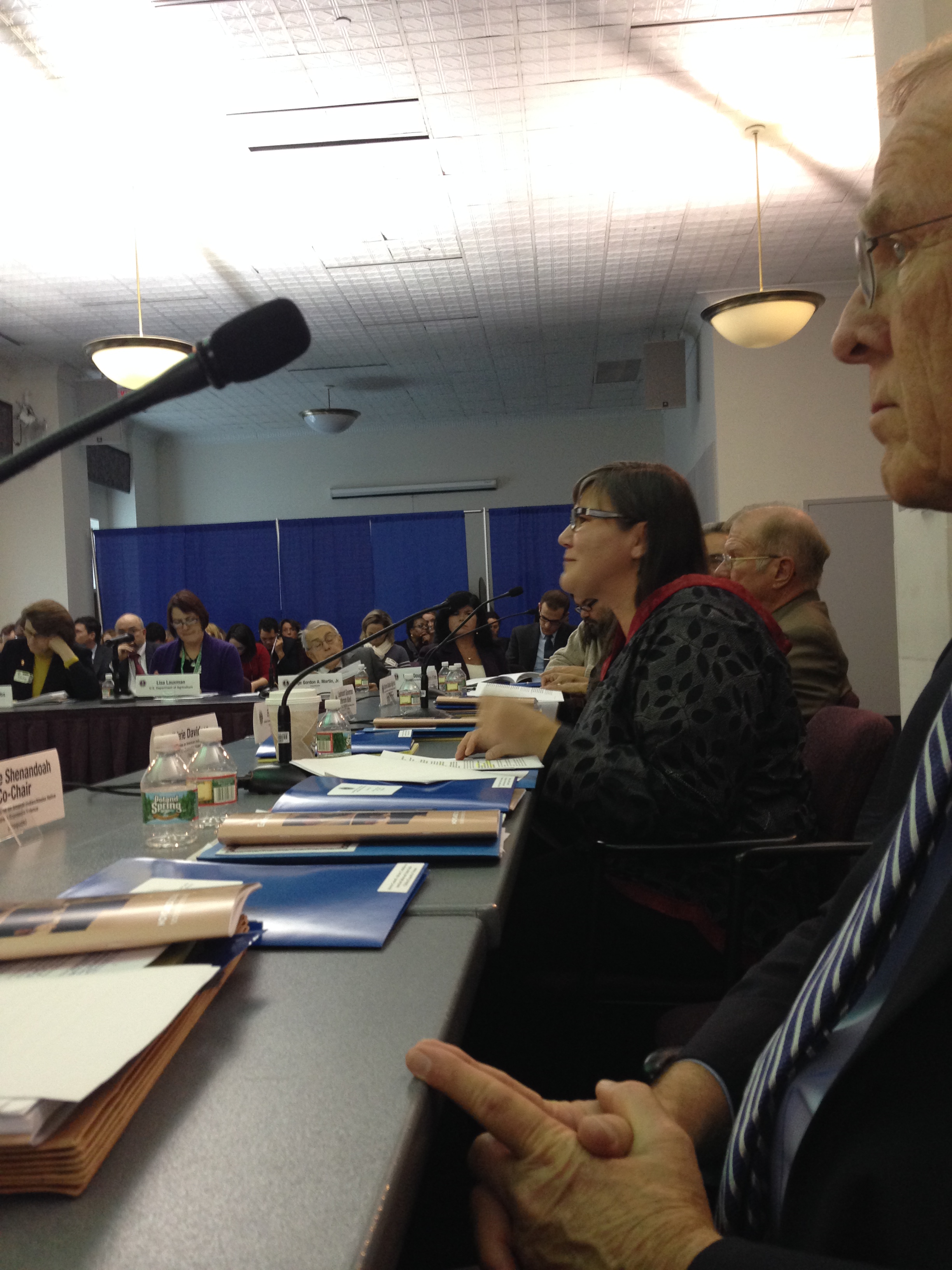
Below are pics of the taskforce, DOJ staff, and the coordinating committee:

TaskforceTaskforce Plus Coordinating Committee Lt. Gov. KeelVal Davidson

Flandreau Santee Sioux Tribe Sues South Dakota over Taxes and Casino Regulation

Here is the complaint in Flandreau Santee Sioux Tribe v. Gerlach (D. S.D.):

1 Complaint

An excerpt:

1. This action seeks a judgment declaring that, under federal law, the State of South Dakota does not have authority to impose its use tax on the use, storage or consumption, by nonmembers of the Tribe, on the Tribe’s reservation, of goods and services purchased by nonmembers from the Tribe at the Tribe’s gaming facility, which is operated pursuant to and in accordance with the Indian Gaming Regulatory Act (“IGRA”), 25 U.S.C. §§ 2701-2721, (the “Tribe’s gaming facility” or the “Tribe’s Casino Complex”) and that the State lacks authority to require the Tribe to collect such use taxes from such non-member patrons and remit such taxes to the State.
2. This action also seeks a declaratory judgment that federal law prohibits the State of South Dakota from refusing to reissue alcoholic beverage licenses to the Tribe for the Tribe’s gaming facility on the basis that the Tribe has failed to remit to the Department of Revenue “all use tax incurred by nonmembers as a result of the operation of the licensed premises, and any other state tax.” SDCL § 35-2-24.
3. This action also seeks a declaratory judgment that pursuant to IGRA, the State of South Dakota does not have authority to regulate the Tribe’s sale of alcoholic beverages at the Tribe’s gaming facility.

Other materials:

Argus_Article_-_11202014

Letter_to_Tribal_Leadership_from_President_Reider

DOI Indian Water Rights Office extends Comment period to December 15, 2014

Here:

NoticeofExtensionofcommentPeriod11 20 14

California COA Decides Gaming Revenue Sharing Dispute involving California Valley Miwok Tribe

Here is the opinion in California Valley Miwok Tribe v. California Gambling Control Commission:

D064271

An excerpt:

California Valley Miwok Tribe (the Tribe) appeals following a summary judgment in favor of defendant California Gambling Control Commission (the Commission). In granting summary judgment, the trial court ruled that until the federal Bureau of Indian Affairs (BIA) indicates, by entering into contract for federal benefits with the Tribe, that an internal tribal dispute about the Tribe’s membership and leadership has been resolved, the Commission is justified in continuing to hold in trust for the Tribe certain funds generated from Indian gaming in California that the Commission is required to distribute to the Tribe on a quarterly basis. As we will explain, we conclude that the trial court properly granted summary judgment in favor of the Commission, and accordingly we affirm the judgment.

Briefs here:

Appellant Brief

Intervenor Brief

Respondent Brief

Appellant Reply

PBS Special on Domestic Violence in Indian Country — TONIGHT

Here is “‘Above the law’: Responding to domestic violence on Indian reservations.

“Glittering World… Navajo Jewelry of the Yazzie Family”

Link to video on Vimeo is here.

Description:

Glittering World presents the story of Navajo jewelry through the lens of the gifted Yazzie family of Gallup, New Mexico—one of the most celebrated jewelry making families of our time. The silver, gold, and stone inlay work of Lee Yazzie and his younger brother, Raymond, has won every major award in the field. Their sister Mary Marie makes outstanding jewelry that combines fine bead- and stonework; silver beads are handmade by other sisters.

Blackhorse Plaintiffs Move to Dismiss Washington Football Team’s Suit

Here is the motion to dismiss in Pro-Football Inc. v. Blackhorse (E.D. Va.):

19 Motion to Dismiss

An excerpt:

In June 2014, the Trademark Trial and Appeal Board (“TTAB”), a component of the United States Patent and Trademark Office (“USPTO”), decided that the USPTO acted contrary to federal trademark law when it issued six trademark registrations to Plaintiff Pro-Football, Inc. (“PFI”), the owner of the Washington NFL team. The TTAB concluded that the marks were not eligible for registration under 15 U.S.C. § 1502(a) because they contain matter that “may disparage” Native Americans.1 Accordingly, the TTAB scheduled the registrations for cancellation by the Director of the USPTO. The TTAB acted after five Native American individuals, the defendants in this action (“Blackhorse Defendants”), petitioned it to cancel the registrations.

PFI could have appealed to the Federal Circuit, where the USPTO could have defended the TTAB decision, but PFI declined to do so. See 15 U.S.C. § 1071(a). Instead, PFI filed this civil action against the Blackhorse Defendants, under 15 U.S.C. § 1071(b)(4).

PFI’s dispute, however, is with the USPTO, not with the Blackhorse Defendants. PFI alleges that the TTAB — not the Blackhorse Defendants — acted unlawfully by scheduling its registrations for cancellation. Likewise, PFI seeks relief only against the USPTO — a declaratory judgment to prevent the Director of the USPTO from carrying out the cancellations. PFI alleges no conduct on the part of the Blackhorse Defendants other than filing a petition with the TTAB. It does not allege that they acted unlawfully or tortiously. Nor does PFI allege that the Blackhorse Defendants claim any interest in PFI’s trademarks or in similar trademarks. This lawsuit will not affect the legal rights or obligations of the Blackhorse Defendants in any way. As a result, the Complaint should be dismissed for the following two reasons:

• The Blackhorse Defendants are not “parties in interest” who may be sued under 15 U.S.C. § 1071(b)(4); and

• This Court lacks subject matter jurisdiction because there is no “Case or Controversy” under Article III of the Constitution as between PFI and the Blackhorse Defendants.

The complaint is here.

Washington State Tax Board Declares Chehalis Tribe’s CTGW LLC Exempt from “Removable” Personal Property Taxation

Materials here:

BOE Orders 10-14

Brief of Respondent Thurston County Assessor

Chehalis Tribe CTGW Opening Brief

Chehalis Tribe Motion to Intervene

CTGW Chehalis Tribe Brief in Support of Jurisdiction

CTGW Chehalis Tribe Opening Statement.pptx

CTGW Chehalis Tribe Reply Brief

Order Granting Motion to Intervene

Stipulated Decision and Order for Parcel 99740331400

Federal Court Rejects Challenge to Federal Decision in Pala Disenrollment Dispute

Here are the materials in Aguayo v. Jewell (S.D. Cal.):

54-1 Aguayo Motion for Summary J

57-1 Federal Cross Motion for Summary J

59 Aguayo Reply

60 Federal Reply

Aguayo v. Jewell Judgement in Civil Case.11.18.14 (1)

Aguayo v. Jewell.Order Dismissing.11.18.14

Prior post in this proceeding here. Related posts here and here.

Alaska SCT Holds Tribal Council Does Not Have Standing to Appeal Indian Child Custody Matter

Here is the opinion in Asa’carsarmiut Tribal Council v. Wheeler. An excerpt:

The superior court awarded Wheeler primary physical custody. Neither Wheeler nor Myre has appealed the superior court’s decision, but the tribal council appeals, arguing that the superior court lacked modification jurisdiction. The narrow question before us in this appeal is thus whether the tribal council has standing to appeal the superior court’s modification decision in light of the parents’ election not to appeal that decision. We conclude that under this circumstance, the tribal council does not have standing, and we therefore dismiss the appeal.