Federal Court Denies Duane Big Eagle’s Section 2255 Motion

Here are the materials in Big Eagle v. United States (D. S.D.):

2 Motion to Vacate Conviction

17 US Response

24 DCT Order

An excerpt:

Big Eagle now has filed a motion to vacate, set aside, or correct sentence under 28 U.S.C. § 2255 in this case. CIV Doc. 1. Big Eagle in his motion raised five grounds, all of which contended that his trial counsel provided ineffective assistance to him. CIV Doc. 1 at 5-6. Big Eagle filed a Memorandum of Law supporting the § 2255 motion. CIV Doc. 2. This Court screened the case and ordered the Government to file a response. CIV Doc. 7. The Government resisted the motion, CIV Doc. 17, and filed an affidavit signed by Big Eagle’s trial counsel disputing Big Eagle’s contentions. CIV Doc. 17-2. Big Eagle filed a reply thereafter. CIV Doc. 20. For the reasons explained herein, this Court denies Big Eagle’s § 2255 motion.

Earlier, related materials here.

Fletcher, Fort, and Reo on “Tribal Disruption” Theory in the Michigan Law Review First Impressions

Matthew L.M. Fletcher, Kathryn E. Fort, and Dr. Nicholas J. Reo have published “Tribal Disruption and Indian Claims” in Michigan Law Review’s First Impressions. PDF. Here is a taste:

Legal claims are inherently disruptive. Plaintiffs’ suits invariably seek to unsettle the status quo. On occasion, the remedies to legal claims can be so disruptive-that is, impossible to enforce or implement in a fair and equitable manner-that courts simply will not issue them. In the area of federal Indian law, American Indian tribal claims not only disrupt the status quo but may even disrupt so-called settled expectations of those affected by the claims.[1] The U.S. Court of Appeals for the Second Circuit has dismissed a round of Indian land claims at the pleading stage, including Onondaga Nation v. New York,[2] because it considered the claims so disruptive.

We agree that Indian legal claims are inherently disruptive and may implicate the centuries-old settled expectations of state and local governments and non-Indians. It is empirically and categorically false, however, that the remedies tribal interests seek are impossible to enforce or implement in a fair or equitable manner. Every year in cases against state governments and their political subdivisions, Indian tribes settle long-standing claims that at their outset, often appear intractable, if not downright impossible, to remedy. The recent settlements of claims by the Oneida Indian Nation of New York,[3] the Saginaw Chippewa Indian Tribe,[4] and five Michigan Anishinaabe tribes[5] demonstrate the falsehood of the idea that Indian claims are too disruptive to be remedied. These negotiated settlements powerfully illustrate that the disruption produced by Indian claims has an important function: forcing federal, state, and tribal governments to creatively seek solutions to difficult governance issues in Indian country.

Part I of this Essay describes recent common law, which dismisses Indian claims on the grounds that they are too disruptive. Part II briefly surveys the history of the relationship between Indians and the United States. Part III describes recent settlements between tribal and local governments. Part IV presents our theory of tribal disruption based on notions of ecological disturbance, studied in ecology and related fields. We argue that ecological disturbance in linked social-­ecological systems offers a useful analog to the disruptive nature of Indian claims. These claims can be compared to disturbances in rivers, forests, or other ecosystems. Floods, forest fires, and windstorms break down existing structures, allowing space for reorganization, diversification, and new growth. Tribal claims similarly clear out a legal space for creative and improved governance institutions.

Friday News Dump: Mechoopda Gaming Decision

Here.

Afternoon Panels at UCLA ILOC Report Symposium

Judge Theresa Pouley, Ted Quasala, Dorothy Alther

20140124-155343.jpg

Judge Pouley, Carole Goldberg, Addie Rolnick, and Affie Ellis

20140124-155448.jpg

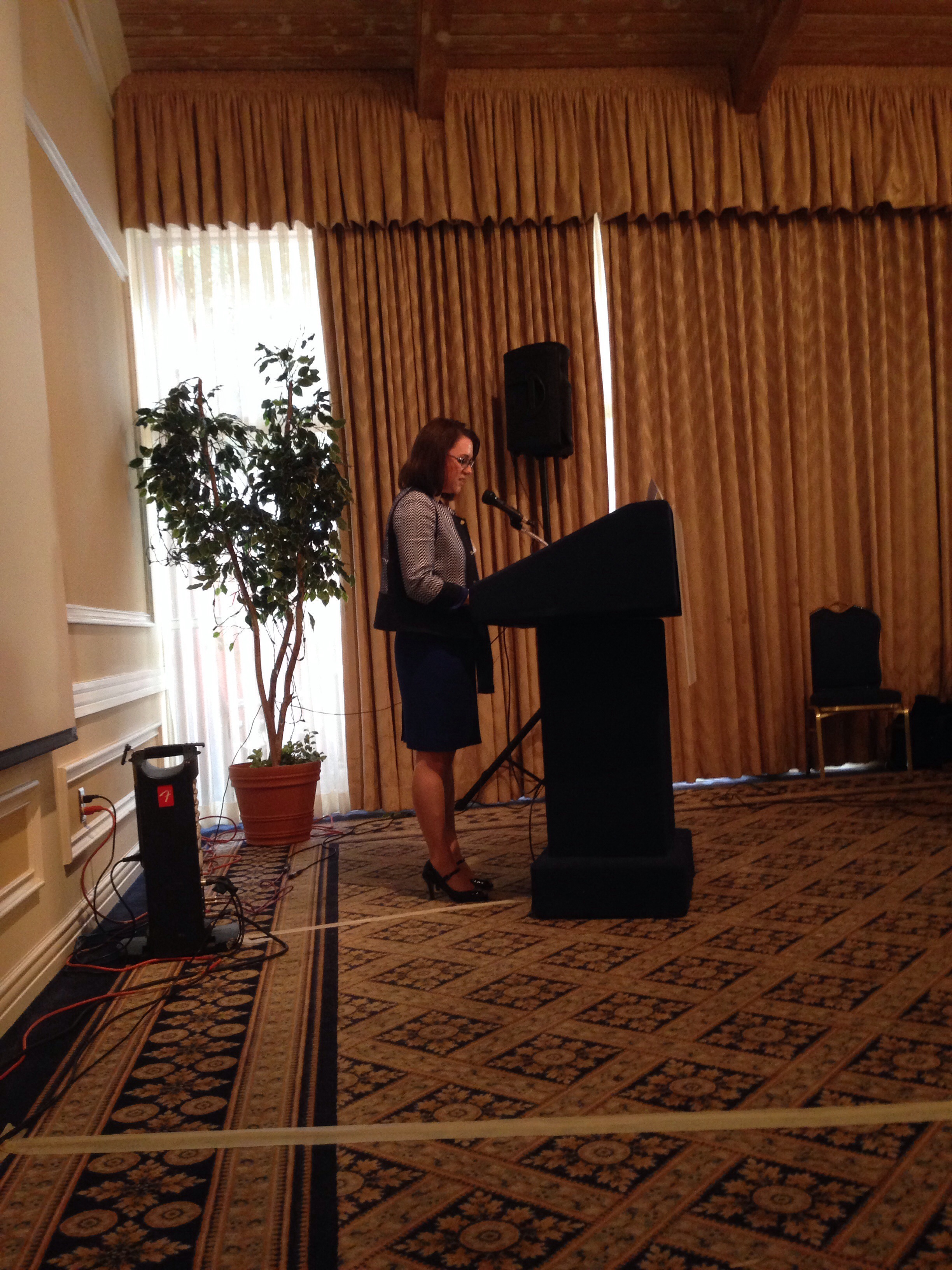
UCLA Indian Law and Order Commission Report Symposium

Angela Riley introduction

20140124-113957.jpg

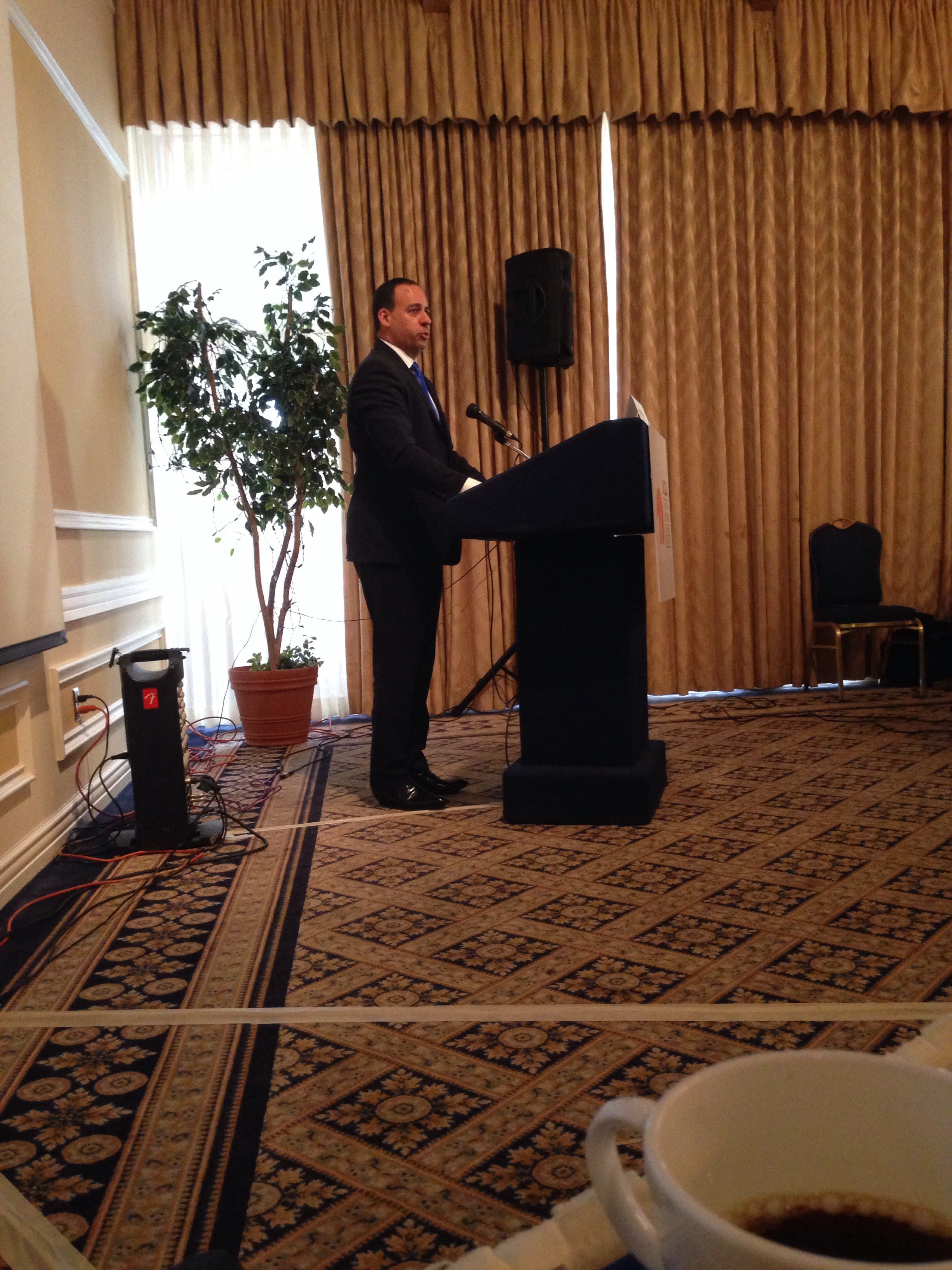
Troy Eid introduction

20140124-114040.jpg

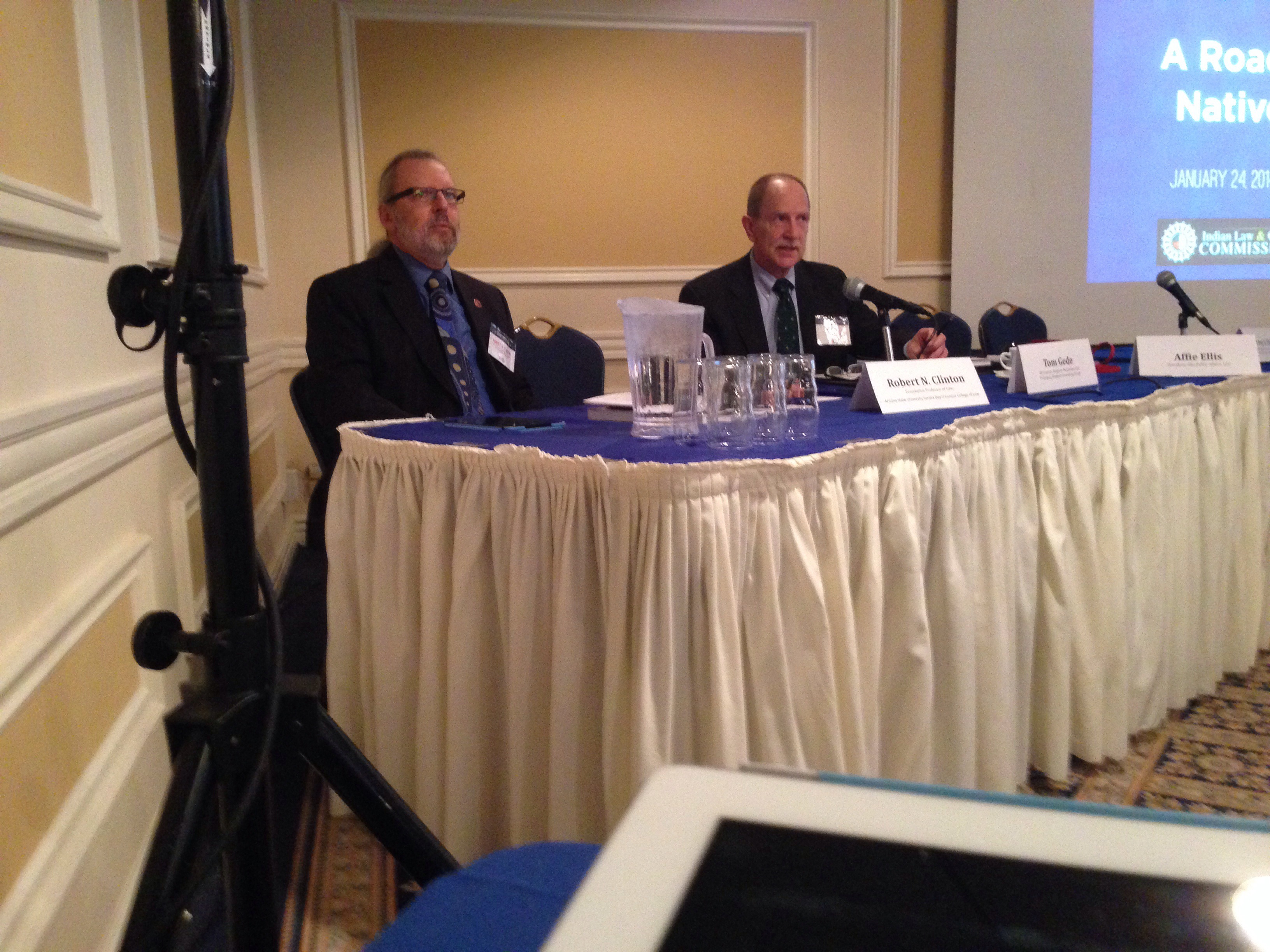
Bob Clinton and Tom Gede

20140124-114152.jpg

First panel — Clinton, Gede, Affie Ellis, and Eid

20140124-114336.jpg

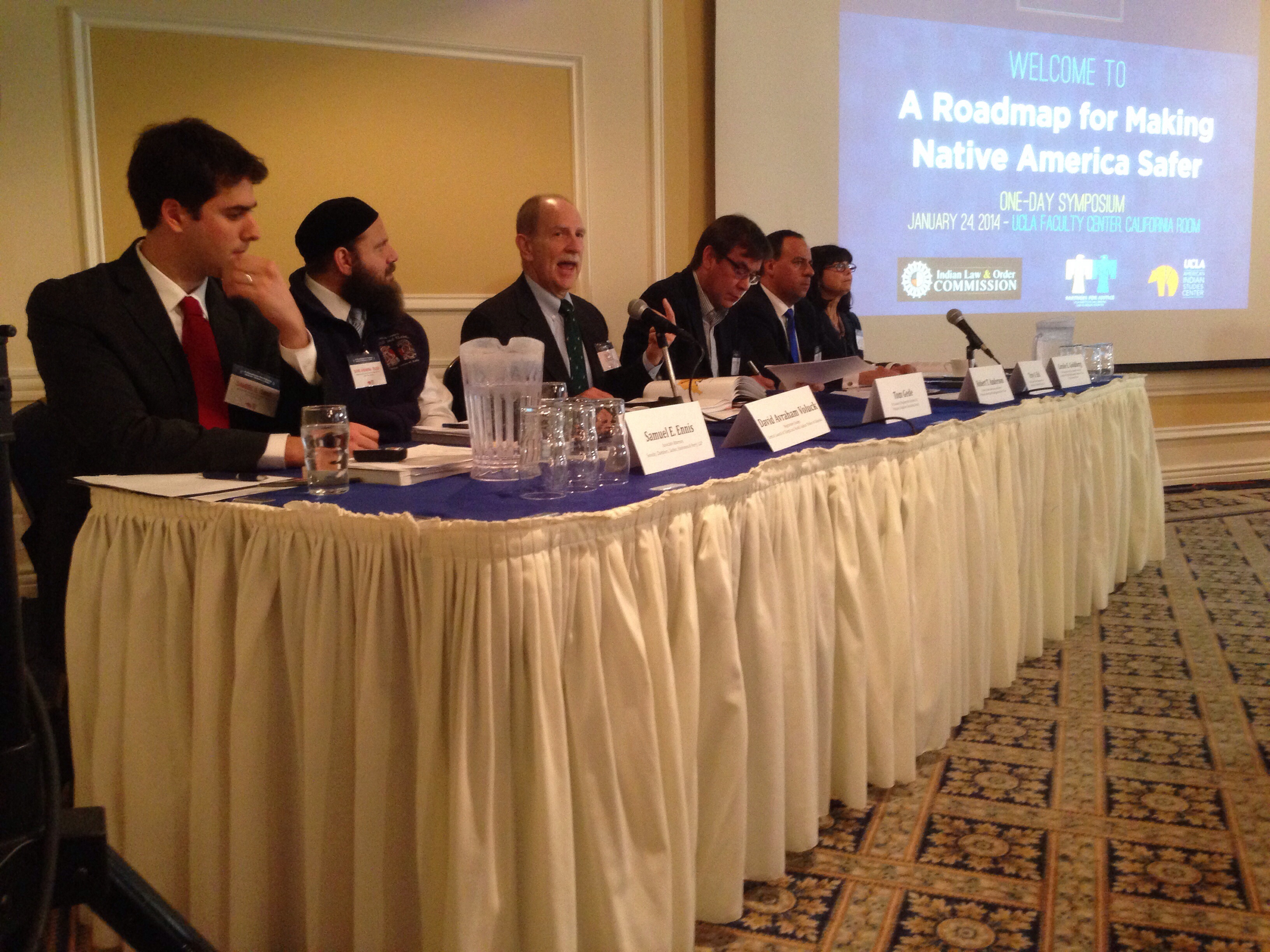
Second panel — Samuel Ennis, David Voluck, Gede, Bob Anderson, Eid, and Carole Goldberg

20140124-114437.jpg

Bruce Duthu Book Talk Yesterday at MSU ILPC

Bruce, Allison Dussias, the commentator, Chris and Chantal, ILPC students, and me

20140124-071713.jpg

Tenth Circuit Issues Prison Sweat Lodge Decision; Religious Freedom Upheld

Here are the materials in Yellowbear v. Lampert:

Yellowbear Brief

Yellowbear Supplemental Brief

Wyoming Brief

Yellowbear Reply

CA10 Opinion

An excerpt:

Andrew Yellowbear will probably spend the rest of his life in prison. Time he must serve for murdering his daughter. With that much lying behind and still before him, Mr. Yellowbear has found sustenance in his faith. No one doubts the sincerity of his religious beliefs or that they are the reason he seeks access to his prison’s sweat lodge — a house of prayer and meditation the prison has supplied for those who share his Native American religious tradition. Yet the prison refuses to open the doors of that sweat lodge to Mr. Yellowbear alone, and so we have this litigation. While those convicted of crime in our society lawfully forfeit a great many civil liberties, Congress has (repeatedly) instructed that the sincere exercise of religion should not be among them — at least in the absence of  a compelling reason. In this record we can find no reason like that.


Fletcher Brownbag Talk at Arizona State: “A Unifying Theory of Tribal Civil Jurisdiction” — Feb. 13, 2014

Here:

Fletcher Flyer

Paper here.

Media Release on “Off the Rez” — Doc about the Schimmel Sisters

FilmBuff Presents

OFF THE REZ

Release Date: Friday, January 24
iTunes Pre-Order Available Now: bit.ly/1i2R33O
VOD Platforms: iTunes, Amazon Instant Video, Google Play, Xbox Video, Sony Playstation, Cinemanow and Vudu.
Watch the Trailer Here: http://www.youtube.com/watch?v=5gYAIvdv9ko

Written & Directed by: Jonathan Hock

Executive Produced by: Kelly Ripa and Mark Consuelos

Starring: Shoni Schimmel, Ceci Moses, Rick Schimmel, Jude Schimmel, Delores Moses, Lillian Moses and more…
Continue reading →

New Scholarship by Ann Piccard: “Death by Boarding School”

Ann Piccard has published Death by Boarding School: “The Last Acceptable Racism” and the United States’ Genocide of Native Americans, 49 Gonz. L. Rev. 137 (2014).

A summary:

There is a special kind of racism in this country against Native Americans, and it is the “last acceptable racism.” The author of that poignantly accurate description of most Americans’ attitudes towards Native Americans, who is both a Native American and a Jew, noted,

Not that long ago, white administrators of Indian boarding schools told our children that the “Indian in you shall die.” This kind of treatment and forced thinking has a lasting generational effect. It can be difficult to break through that type of programming.  Many of our people, however, have shaken off these forced ideological shackles to speak the truth and demand long overdue respect. Our voice is getting louder.

Our words are being said with more frequency and emphasis. But people need to hear us. Societal racism should no longer be an ad hoc affair, which is routinely accepted when directed against a certain group. It should be universally condemned. Perpetuating past wrongs and dehumanizing concepts hurts everyone.

This last acceptable racism is rarely mentioned in the U.S. However, one day in a very small town in northern Minnesota, in an area that has been economically depressed ever since the decline of the taconite and iron ore mining industry several decades ago, I watched two Native American men park a pickup truck in front of the local pawn shop.

I could tell the young men were Native Americans only because of the Bois Forte Band license plate on their truck; other than that, they looked, sounded, and acted like most of the other men in that rural north woods town. Upon reflection, of course, I realized that their skin was slightly darker than most residents of the town; I also began to notice that I did not see dark-skinned people working or shopping in any of the town’s stores. My eye was untrained, a fact that I attribute to my upbringing in the Deep South,6 where I was in a small minority of white children who were raised by our parents to see and to protest (and refuse to accept) the prevailing racism toward African-Americans. The subtle differences in appearances between the Native Americans and the “whites” in Minnesota had gone unnoticed by my Southern eyes. But as we watched the young men take their chain saws into the pawnshop that day, my husband remarked that men in northern Minnesota who hock their chain saws must be in pretty bad shape, because how could they survive, let alone make a living, without such tools?