News coverage here.
The order referenced in the article is here:
353 SCT Order Dismissing Counterclaim against Wells Fargo
And materials:
News coverage here.
The order referenced in the article is here:
353 SCT Order Dismissing Counterclaim against Wells Fargo
And materials:
Here is the complaint in GlaxoSmithKline LLC v. Cherokee Nation (D. Mass.):
An excerpt:
By filing suit in the Tribal Court for conduct relating to the marketing, sale and promotion of Avandia, the Cherokee Nation breached the Avandia Settlement Agreement in three ways. First, the Avandia Settlement Agreement clearly specifies that the exclusive jurisdiction and venue over disputes under the Avandia Settlement Agreement are vested in the United States District Court for the District of Massachusetts. Filing suit in the Tribal Court was a breach of this exclusive jurisdiction and venue provision. Second, the Cherokee Nation’s suit runs afoul of the Avandia Settlement Agreement because it asserts claims that were released under the Avandia Settlement Agreement. Third, the suit purports to seek relief under the “statutory, common, and decisional laws of the Cherokee Nation,” notwithstanding that disputes under the Settlement Agreement are “governed under the laws of the United States.”
Elizabeth Kronk Warner has posted “Tribal Renewable Energy Development Under the Hearth Act: An Independently Rational, But Collectively Deficient Option,” forthcoming in the Arizona Law Review, on SSRN.
The abstract:
Increased domestic energy production is of enhanced importance to the United States. Given the growing focus on domestic energy development, many, including tribal governments, have increasingly looked to Indian country for potential energy development opportunities. Such attention is warranted, as abundant alternative and renewable energy sources exist within Indian country. Many tribes are increasingly exploring possible opportunities related to alternative and renewable energy development. Despite this interest, large alternative and renewable energy projects are virtually absent from Indian country. This article explores why, despite the great potential for alternative and renewable energy development in Indian country and strong tribal interest in such development, such little development is occurring.
Congress enacted the Helping Expedite and Advance Responsible Tribal Homeownership Act (HEARTH Act) in July 2012 to address one of the obstacles to alternative and renewable energy development in Indian country — federal approval for leases of tribal lands. In brief, the HEARTH Act allows tribes with tribal leasing provisions pre-approved by the Secretary of the Interior to lease tribal land without Secretarial approval required for each individual lease.
To fully understand the potential implications of the HEARTH Act, this Article explores obstacles to effective energy development in Indian country, what the HEARTH Act is and how it supposedly addresses those obstacles, and some significant problems associated with enactment of the HEARTH Act — specifically, the mandatory environmental review provisions and waiver of federal liability, and the impact of the liability waiver on the federal government’s trust responsibility to federally recognized tribes. The article ends with some concluding thoughts on how the HEARTH Act and potential future reforms to the existing federal regulatory scheme applicable to energy development in Indian country might better address tribal sovereignty and the federal trust responsibility to Indian country.
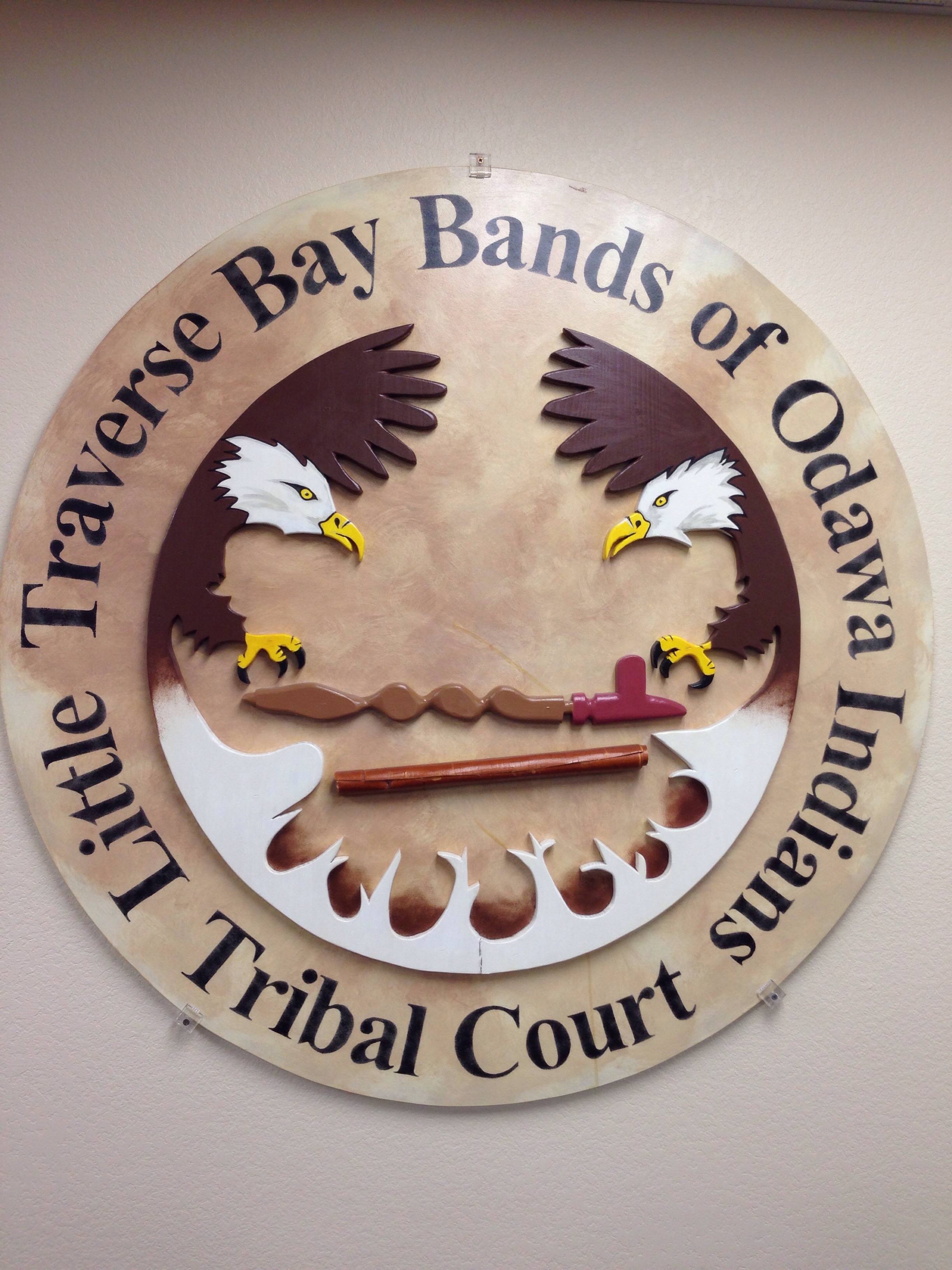
WS in meetings with LTBB tribal court. Here’s our boys’ favorite beach today.

You may recall the same beach from a few months ago.
Lighthouse covered in ice.

Tribal court seal
Here are the updated materials in St. Germaine v. Kelly (Nooksack Tribal Court):
St Germain v. Kelly TRO Motion
St Germain v. Kelly Declaration of Michelle Roberts
St Germain v. Kelly Declaration of Rudy St. Germain
St Germain v. Kelly Order on Motion for Temporary Restraining ORder
The complaint is here.
Here is the brief in Chickasaw Nation v. NLRB (10th Cir.):
Chickasaw Brief and Addendum FILED
And here is the brief in Saginaw Chippewa Indian Tribe v. NLRB (6th Cir.):
Here is the opinion:
Here.
Adoptive Couple v. Baby Girl: At the Intersection of Family Law, Indian Law, and Civil Rights
On June 15, 2013, the Supreme Court decided Adoptive Couple v. Baby Girl, its first case on the Indian Child Welfare Act in 24 years. The case raises conflicting visions of child welfare, race, adoption, fatherhood, and the status of Indian tribes. The 5-4 decision turns on divided views of the statute, with a controlling interpretation that may decimate the rights of birth fathers in ICWA cases and even the scope of ICWA itself. Conflicting amicus briefs from the National Council for Adoption (the trade group for private adoption agencies) and the 18 leading child welfare organizations in the country raise equally divided questions of the connection between the law and the best interests of children. Finally, with claims by the adoptive couple and their amici of race-matching and equal protection concerns, and claims by the birth father and Indian tribes of an adoption industry illegally preying on Indian children, perspectives on the role of race in adoptions and even the constitutional status of Indian tribes are placed in conflict as well. This panel explores these questions with scholars of federal Indian law, family law, constitutional law, and critical race theory.
Panelists:
Kathryn Fort (Michigan State University-College of Law)
Solangel Maldonado (Seton Hall Law School)
Gerald Torres (University of Texas Law School; Visiting Cornell Law School)
Bethany Berger (University of Connecticut School of Law)
Thanks to Bethany for sending this along.
Here are the materials in Warrior v. United States/Harvest Institute Freedmen Federation v. United States:


You must be logged in to post a comment.