Here.
Briefs are here.
Here are the materials in Hall v. Mooretown Rancheria (E.D. Cal.):
DCT Order Dismissing Complaint, Granting Leave to Amend
The interesting twist is the court’s treatment of Maxwell v. County of San Diego:
Pro se pleadings are liberally construed. … Unless it is clear that no amendment can cure the defects of a complaint, a pro se plaintiff proceeding in forma pauperis is entitled to notice and an opportunity to amend before dismissal. … The court is unable to determine a jurisdictional basis for this action as presently written. Defendants Mooretown Rancheria, Feather Falls Casino, Gary Archuleta, and Francine McKinley are immune from this suit due to Mooretown Rancheria’s soverign immunity, or extension thereof. Also, any allegation made by plaintiff against defendant Rasmussen is wholly insubstantial and frivolous.
However, in the recent case of Maxwell v. County of San Diego, 697 F.3d 941, 954-955 (9th Cir. 2012), the Ninth Circuit refused to extend Cook v. AVI Casino to actions against tribal officials in their individual capacity. It is possible, although doubtful when viewing the present allegations, that plaintiff could amend the complaint to state individual actions.
Because the court lacks jurisdiction over the action as presently pled, the undersigned will not at this time reach any alternative arguments on the merits as if it had jurisdiction.
Nicholas James Reo and Angela K. Parker have published “Re-Thinking Colonialism to Prepare for the Impacts of Rapid Environmental Change” in Climatic Change. Highly recommended.
Here is the abstract:
This essay demonstrates how key concepts from ecology can be applied within historical analyses in order to gain insights regarding contemporary environmental change. We employ a coupled human and natural systems conceptual framework in a nascent historical analysis of rapid societal and environmental change in colonial New England, where European colonization led to stark and rapid transformations. Introduced diseases reduced indigenous communities to a fraction of their pre-contact levels. European agriculture and associated pest species, deforestation and overharvest of ecologically influential species were among key aspects of the rapid changes in colonial New England. Cross-continental biotic introductions initiated reinforcing feedback loops that accelerated the transition of human and natural systems into novel states. Integrating colonial history and ecology can help identify important interactions between human and natural systems useful for contemporary societies adjusting to environmental change.
Here:
The initial response to the motions to dismiss is here.
The Science, Practice & Art of Restoring Native Ecosystems Conference
Where: Kellogg Center in East Lansing, MI
When: Friday and Saturday, January 17 and 18, 2014
The 2014 Science, Practice & Art of Restoring Native Ecosystems conference will focus on Field and Place Based Conservation – Applying Techniques That Work at the Community Level.
Field and Place Based Conservation can make real and sustainable positive changes in our natural world. We must set the goals for our conservation actions by standards that are meaningful and significant to our local communities. Building our work around established social, cultural and economic goals makes caring for our natural resources a plan that’s easier to support, whether through time, dollars, votes, or goodwill. Furthermore, it’s by bringing together different people and multiple organizations in collaborative conservation at a local level that we facilitate the global adoption of community-based action, resulting in widespread improvement to lands and waters we all care about.
http://www.stewardshipnetworkconference.org/site/c.biKRJ8NPInI4F/b.8527791/k.3E52/2014_Overview.htm
Chi-miigwetch Bruce! And congrats!
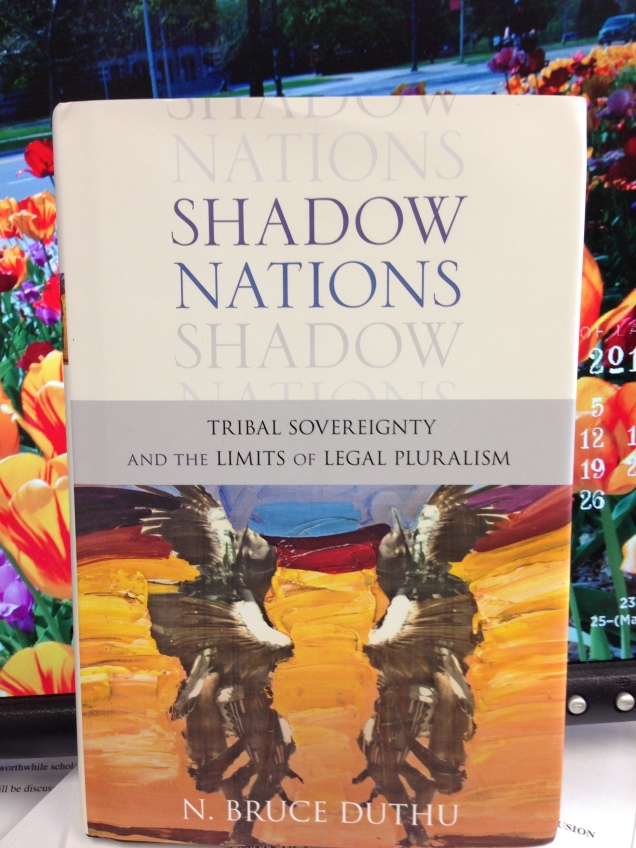
Here.
Conference Proposal: Alternative Sovereignties
Call For Papers
“Alternative Sovereignties: Decolonization Through Indigenous Vision and Struggle”
To be held at the University of Oregon, May 9, 2014.
The concept of “sovereignty” as both an international political norm and expression of cultural distinctiveness and political autonomy is central to American Indian and First Nations discourse in the United States and Canada. Yet this language is often an imperfect reflection of the goals that tribal nations seek to pursue, suggesting rigid political and social boundaries around and within indigenous nations. This stands in stark contrast to political relationships based in tribal epistemologies that acknowledge social flexibility, interdependence, reciprocity and non-coercive, respectful relationships between and within national communities.
This conference will explore both “alternative sovereignties” and “alternatives to sovereignty” that might better meet the political, cultural and social aspirations of American Indian and First Nations communities. We are especially interested in the relationship between vision and struggle. “Vision” theorizes alternative forms of sovereignty that might better reflect the social and political goals of American Indian and First Nations. “Struggle” interrogates the rhetorical, representational and discursive strategies necessary to pursue these visions within adversarial cultural and political environments still defined by colonial power.
Potential questions for investigation the following: What might visions of “alternative sovereignties” or “alternative to sovereignty” look like? What values, hopes and aspirations would they express? In what ways do such visions align or exist in tension with contemporary expressions of the nation, sovereignty, self-determination and human rights both in Indian Country and beyond? What forms of contemporary political and social struggle will best allow Native peoples to develop and advance tribal visions that might substantively revise or intervene in non-tribal fields of power and knowledge? Finally, what are the theoretical and practical relationships between “vision” and “struggle,” and what role does Indigenous cultural and intellectual production serve in advancing these efforts? Reflecting the interdisciplinarity of Native Studies, the conference is committed to conversation across historical periods and academic and institutional boundaries, including literature, law, philosophy, cultural studies, political science, education, anthropology, history and the arts.
Please send brief proposals of no more than 300 words to alternative.sovereignties@gmail.com by September 1, 2013. Also include brief biographical information, including for example academic affiliation, primary area of research, and relevant experience. Applications from the broader Northwest or dealing with issues relevant to Northwest indigenous nations are especially welcomed. For questions, please contact the conference organizers at the address above.
This position will function as the Chief Executive Officer of Tribal Government under the direction of the Nottawaseppi Huron Band of the Potawatomi Tribal Council. The incumbent ensures effective and efficient management of governmental functions and programs, acts as a governmental liaison with other agencies and performs all other duties delegated by the Council in order to accomplish administrative and organizational goals. Manages business growth, new operational and business initiatives, programs, projects, financial objectives, cultural changes and business goals for government operations as defined by the Tribal Council.
Here:


You must be logged in to post a comment.