Jay Wexler Visits the National Eagle Repository in the Green Bag 2d

Here is the article, a description of the inside of the National Eagle Repository.

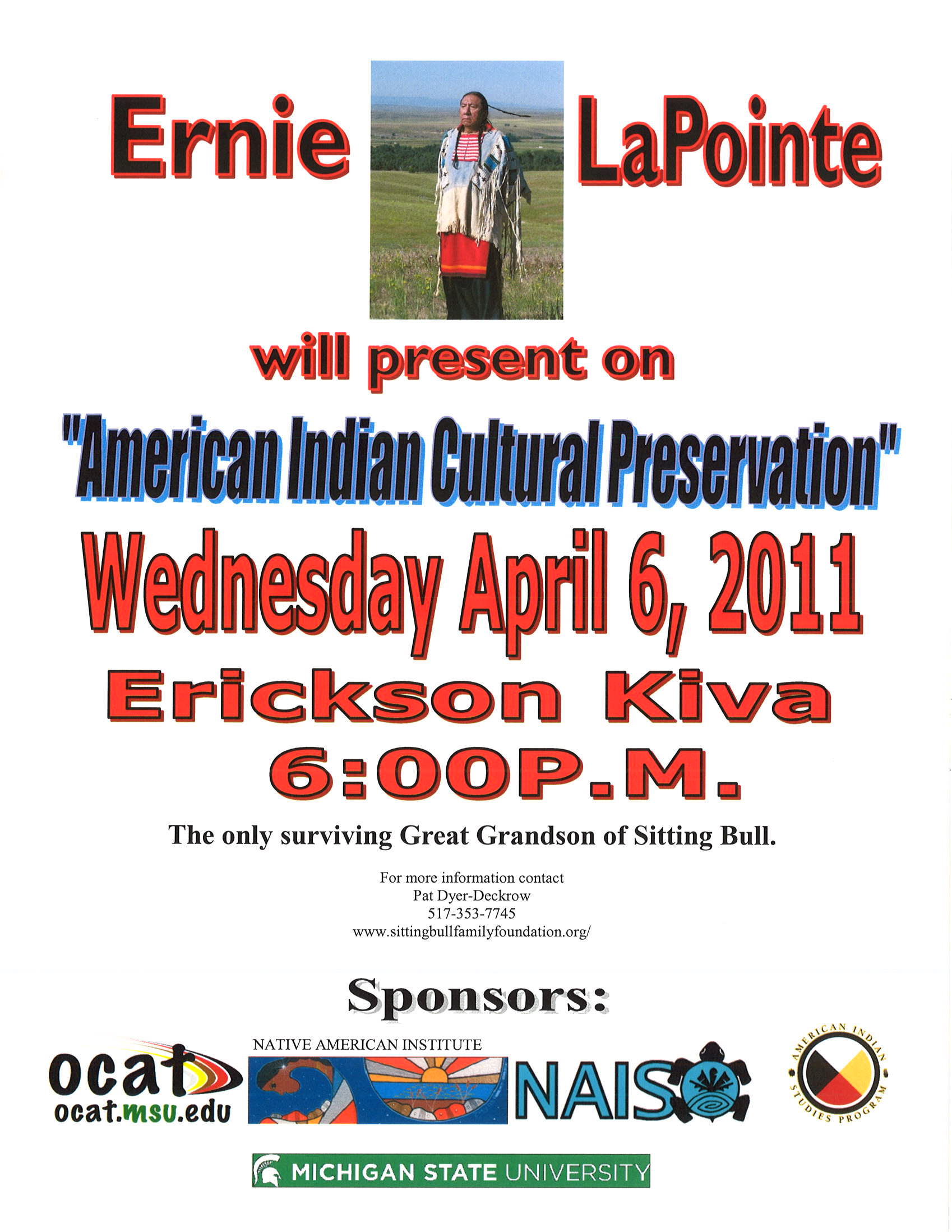
Ernie LaPointe on American Indian Cultural Preservation at MSU This Wednesday

MSU NALSA Event Today at Noon

The Native American Law Students Association invites you to lunch and  a panel discussion on Native American freedom of religion and the law.

Castle Board Room12:00p.m.Monday, March 28th, 2011

The discussion will focus on the James Arthur Ray Sweat Lodge Trial;  and the Declaration of War Against Exploiters of Lakota Spirituality.

The panelists include Clarence Syrette, and Professors Frank Ravitch  and Matthew Fletcher.

Clarence Syrette will be speaking about the traditional significance  of Native American spiritual ceremonies from his perspective as a  medicine man.

Professor Frank Ravitch and Professor Matthew Fletcher will be sharing  their insights on the American Indian Religious Freedom Act and other  laws as they apply to the case.

Karuk Motion for Summary Judgment against USFS in Sacred Sites Case

Here is that pleading:

Karuk Motion for Summary Judgment

The case is captioned Karuk Tribe v. Kelley (N.D. Cal.).

Update in Utah Stolen Indian Artifacts Case — Defendants’ “Expert” Allowed to Testify on Value of Objects

Here is an interesting development in United States v. Smith, the criminal case in Utah regarding the theft of Indian artifacts and other objects.

The defendants’ proposed expert witness (Dace Hyatt) on the value of the materials collected allegedly in violation of federal law will be allowed to testify, despite having no formal training on anthropology, archaeology, or anything else (not to mention lying in an affidavit about reviewing evidence in person when that evidence is locked away deep in the bowels of the BLM). Assuming the defendants still use this expert, cross-examination at trial will be very interesting. His testimony is that each object is valued at slightly less than $500, the jurisdictional minimum.

Here are the materials:

DCT Order on Daubert Motion

US Motion to Exclude Expert Testimony

US Second Motion to Exclude Expert Testimony

Defendants Opposition to Motion


WSJ (and NYTs) Article about Museum Displays

Edited to Add:  The WSJ is not the only publication in fits about modern Native art on display.  The NYT review of the Brooklyn Museum’s display is equally muddled.  It’d be nice if the art reviews were of the art, rather than criticizing it for not being old:

Also in this section is a blue-and-white carved wood piece called “Horse Head Effigy Stick,” by Butch Thunder Hawk, of the Hunkpapa Lakota. A casual viewer might mistake it for a war club, with a horse-head-shaped business end, used in the 19th century when intertribal warfare was a way of life. It turns out that it was made in 1998, which, if you think about it, raises puzzling — but here unanswered — questions. What is the relationship of this rather slick modern object to the historic artifacts? And what about the buffalo-horn ladle with a glossy cube pattern imitating the 20th-century Dutch illusionist M. C. Escher that Kevin Pourier, a member of the Oglala Lakota, created in 2009?

The display suggests that there is no important difference between the old and the new. But how can that be so? The Plains Indian culture that gave rise to these kinds of objects was practically destroyed by the United States government’s campaign to clear land for settlement by white people over a century ago.

Wouldn’t one relationship between the old and the new be to demonstrate that the culture was not actually destroyed by the United States government, hard as it might have tried?

The Wall Street Journal published an article about museum displays of Native art and artifacts today.  It is accessible here.  The article is odd, with a title (“Shows That Defy Stereotypes”) indicating the article might be positive, but is instead full of sideways insults.  For example, the author writes about the Denver Art Museum’s attempt to include contemporary Native art in its installation, and a display of two different shirts:

One of Denver’s great masterpieces is a 1720s Eastern Sioux deerskin shirt embellished with painted abstract designs, possibly representing birds. The curators invite its comparison to a nearby 2010 fringed “war shirt” commissioned from Bently Spang, the suddenly ubiquitous Northern Cheyenne artist whose designs, which are meant to be seen, not worn, are also on view in Manhattan and Brooklyn.

The author does not seem to think the more contemporary shirt is at the same level as the old shirt, nor am I sure why she describes the artist who made it as “suddenly ubiquitous,” but the tone indicates the author doesn’t think he ought to be.

Continue reading

Emerald Ash Borer Black Ash Basketry Symposium, April 6th

Here is the information on the Black Ash Symposium which will be held April 6th at the Comfort Inn Conference Center in Plainwell, MI.  The registration materials are here and schedule is here.

This Conference will bring together Native Nations from the North Eastern US and Canada to discuss what is happening in their communities and what we can do to work together to sustain the tradition of Black ash basketry for all of our people for centuries to come.

Black ash basket weavers from Native communities in Michigan, Maine, Minnesota, New York and Canada will present important information and share what work their communities have been doing to prepare for EAB, and preserve basketry in their communities. Working together we can make a difference!

Irony of the Year (So Far): Redskins’ Owner Sues Newspaper over Anti-Semitic Statements

Here is the complaint filed by Daniel Snyder alleging that the Washington City Paper “employ[ed] lies, half-truths, innuendo and anti-Semitic imagery to smear, malign, defame, and slander a prominent member of the community in order to generate reader interest and maintain its circulation.”

Snyder Complaint

Without making a judgment on Snyder’s claim (which may be perfectly legitimate), it is nevertheless ironic that the owner of a professional sports franchise that employs a racial epithet to identify itself.

Federal Court Enjoins Massive Solar Power Project for Failure to Consult with Quechan Tribe

Here are the materials in Quechan Indian Tribe v. DOI (S.D. Cal.):

Order Granting Preliminary Injunction

Quechan Motion for PI

USA Opposition to Quechan Motion

Quechan Reply

OSG Invitation Brief in Thunderhorse v. Pierce

From SCOTUS blog:

Yesterday the Acting Solicitor General filed an invitation brief in Iron Thunderhorse v. Pierce (09-1353), recommending that the Court deny certiorari or, in the alternative, grant certiorari and summarily reverse and remand the Fifth Circuit’s ruling for application of the correct legal standard.  At issue in the case is whether the court of appeals misinterpreted the Religious Land Use and Institutionalized Persons Act to require only a minimal showing that a prison grooming rule which concededly imposes a substantial burden on religious exercise is the “least restrictive means of furthering [a] compelling governmental interest.”  The Acting Solicitor General’s brief is available here.

An excerpt, where the OSG argues that the Fifth Circuit made a gross error:

But petitioner in this case raised arguments and evidence not addressed in Diaz or Longoria: that other prison systems (including the federal Bureau of Prisons)permit long hair, and that TDCJ enforces its grooming policy in an inconsistent manner. Id. at 10a n.3. Thecourts below, however, never required respondents to explain why the alternative, less restrictive practices utilized in other prison systems would not work in the Polunsky unit. Nor did they require prison administrators to explain why the previous inconsistent application of the grooming policy to petitioner and to others (including Texas’’s female inmate population) did not indicatethat a less restrictive alternative was appropriate. See ibid. Although respondent acknowledges (Br. in Opp. 14-15 (citing Odneal, supra)) that the Fifth Circuit requires prison officials to justify application of a challenged policy under the facts of a particular case, respondent notably does not even attempt to justify the court of appeals’’ refusal to hold officials to that standard in this case.

The petition stage materials are here.