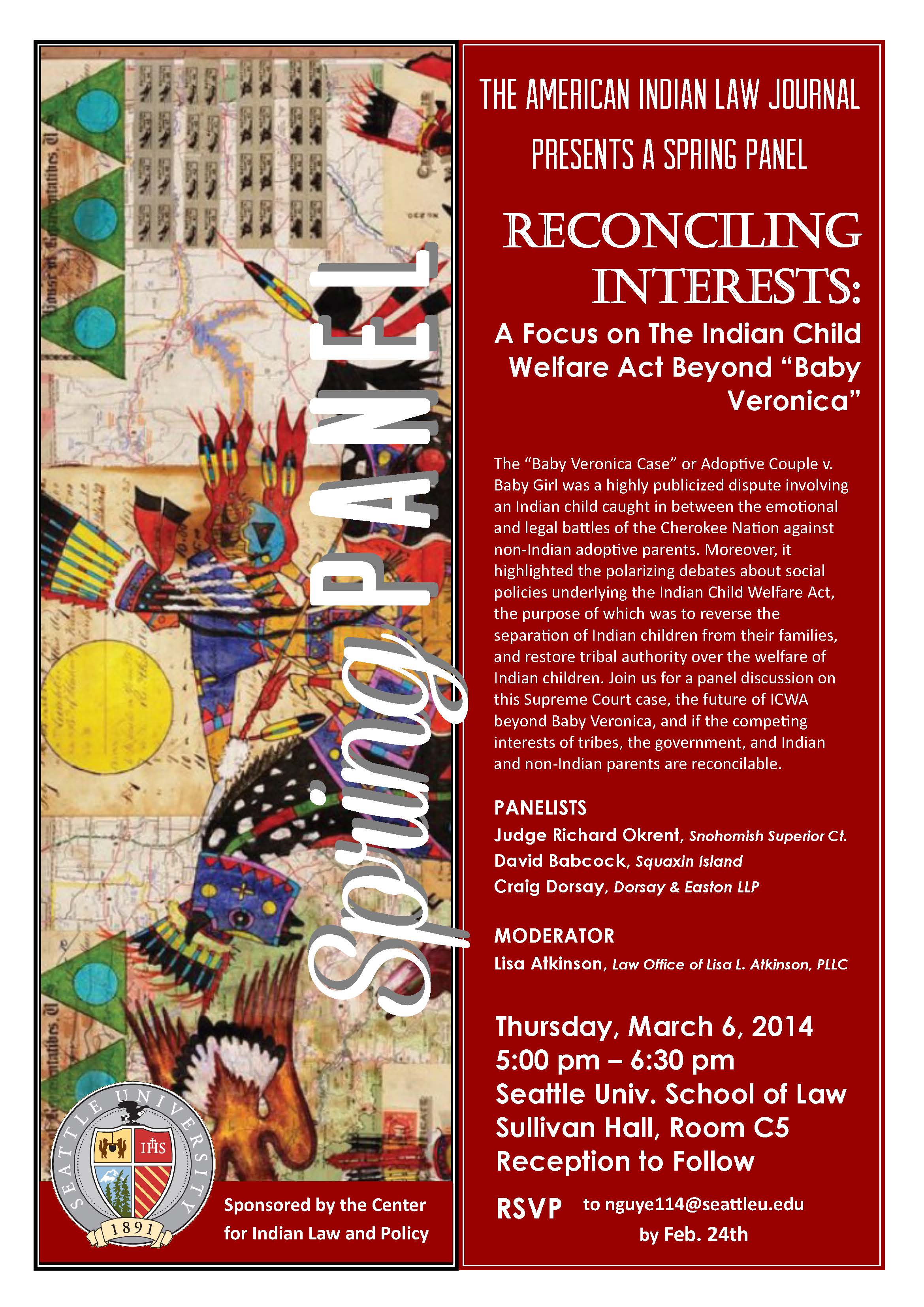
March 21, 2014 at American University Washington College of Law
Further information available here.
Both a live and archived webcast will be available.
March 21, 2014 at American University Washington College of Law
Further information available here.
Both a live and archived webcast will be available.
Here is the opinion in Public Employees for Environmental Responsibility v. Beaudreu (D.D.C.):
The Wampanoag Tribe of Gay Head (Aquinnah) was part of this suit as well.
Here is the amicus brief in Knight v. Thompson:
Lower court materials are here.
Pokagons Honor Co-Editor of Cohen’s Handbook
DOWAGIAC, Mich. — March 10, 2014 — The Pokagon Band of Potawatomi honored Dean Nell Jessup Newton of the Notre Dame Law School at a dinner Thursday, March 6 for her work in editing Cohen’s Handbook of Federal Indian Law, a preeminent resource used throughout Indian Country. The dinner was held at the Morris Inn on the campus of Notre Dame.
In the photos:

Jason S. Wesaw, a Pokagon artist, describes his work for Dean Newton. His pottery piece shown was commissioned to be gifted to the Dean for her important legal work with Native Americans. Wesaw also began the evening with an honor song for Dean Newton.

The group gathered after the dinner below a photo of the Notre Dame Golden Dome: left to right: Ed Williams (Pokagon Potawatomi), general counsel of the Pokagon Band, Stephen Rambeaux, court administrator of the Pokagon Tribal Court, Matt Martin (Pokagon Potawatomi), VP of security at Four Winds Casino Resort , Judy Winchester (Pokagon Potawatomi),Chairman John Warren of the Pokagon Band, Acting Treasurer Tom Topash of the Pokagon Band, Dean Newton, Michaelina Magnuson-Martin (Pokagon Potawatomi), Andrea Topash-Rios (Pokagon Potawatomi) associate professional specialist at Notre Dame, Paul Shagen (Bay Mills), associate general counsel of the Pokagon Band and adjunct law instructor at Notre Dame, Tim Sexton, associate VP of Public Affairs at Notre Dame, Jason S. Wesaw (Pokagon Potawatomi).
About The Pokagon Band of Potawatomi Indians
The Pokagon Band of Potawatomi Indians’ sovereignty was reaffirmed under legislation signed into law by President Clinton in September of 1994. The Pokagon Band is dedicated to providing community development initiatives such as housing, education, family services, medical care and cultural preservation for its approximately 4,800 citizens. The Pokagon Band’s ten county service area includes four counties in Southwestern Michigan and six in Northern Indiana. Its main administrative offices are located in Dowagiac, Mich., with a satellite office in South Bend, Ind. More information is available at www.pokagonband-nsn.gov.
Media Contacts: Paige Risser, (269)462-4283, Paige.Risser@pokagonband-nsn.gov # # #
Kristen Carpenter and Lorie Graham have posted a very compelling and powerful paper about the Supreme Court’s decision in Adoptive Couple v. Baby Girl. It is required reading for anyone interested in the case, and is destined to be the definitive paper on the international human rights aspects of the case.
The article is titled Human Rights to Culture, Family, and Self-Determination: The Case of Adoptive Couple v. Baby Girl. Here is the abstract:
The well-being of indigenous children is a subject of major concern for indigenous peoples and human rights advocates alike. In 2013, the U.S. Supreme Court decided in Adoptive Couple v. Baby Girl that the Indian Child Welfare Act did not prevent the adoption of a Cherokee child by a non-Indian couple. This occurred over the objections of her Cherokee biological father, extended family, and Tribal Nation. After the decision, Baby Girl’s father and the adoptive couple contested the matter in a number of proceedings, none of which considered the child’s best interests as an Indian child. The tribally-appointed attorney for Baby Girl, as well as the National Indian Child Welfare Association and National Congress for American Indians, began examining additional venues for advocacy. Believing that the human rights of Baby Girl, much like those of other similarly situated indigenous children, were being violated in contravention of the United Nations Declaration on Indigenous Peoples Rights, and other instruments of international law, they asked us to bring the matter to the attention of the United Nations Special Rapporteur for Indigenous Peoples Rights (“UNSR”). We prepared a “statement of information” to alert the UNSR of the human rights violations occurring in the case. With the permission of the attorneys and organizations involved, this chapter introduces the Baby Girl case, contextualizes the claims in international human rights law, and then reproduces the statement of information, and portions of the UNSR’s subsequent public statement. It concludes with an update on the Baby Girl case and broader discussion about the potential for using international law and legal forums to protect the human rights of indigenous children.

 Turtle Talk
You must be logged in to post a comment.