Update in Sault Tribe Lansing Casino Proposal — Update to the Update

The City transferred the land to the Sault Tribe (here). Nothing all that terribly exciting — a chance to show off before the cameras.

In anticipation of today’s 11AM press conference at the Lansing Center (Casino Project Moves Forward – ADVISORY), casino opponents have issued the following preemptive comments:

Attribute the following statement to James Nye, coalition spokesman, for the Saginaw Chippewa Indian Tribe and Nottawaseppi Huron Band of Potawatomi:

“For over a decade, the Sault Ste. Marie Tribe has unsuccessfully pursued off-reservation casinos hundreds of miles from its reservation. These efforts have been rejected by the U.S. Congress, the State of Michigan, and the U.S. Department of Interior.

“People should not be fooled; this latest effort to build a casino in Lansing is just another loser. The Sault Tribe has argued that under the Michigan Indian Land Claims Settlement Act it can build a casino anywhere in the United States. That conflicts with federal law, and it violates the Tribe’s state gaming compact.

“We will continue to aggressively fight this ill-conceived casino at the federal and state level, and in the courts. We are very confident that this effort will fail just like the Tribe’s past efforts.”

Release: Third Collective Bargaining Agreement Signed at Little River Band of Ottawa Indians

Third Collective Bargaining Agreement Signed under Tribal Law

The Little River Casino Resort and the United Steelworkers Union have entered into a collective bargaining agreement covering the Resort’s EVS Bargaining Unit.  This is the third collective bargaining agreement entered into by the Resort and the Union under tribal law.

“We are proud of our Tribe’s success in governing labor and employment relations,” said Larry Romanelli, the elected Ogema of the Little River Band of Ottawa Indians.  “These three collective bargaining agreements between the Resort and the USW are concrete examples of tribal sovereignty at work.”

In 2007, the Band enacted a law governing labor unions and collective bargaining modeled on public sector labor relations laws.  The law allows collective bargaining within the Band’s public sector, which includes its gaming operations at the Little River Casino Resort.  It requires unions to hold a license from the Band, and it provides a structure for union elections, bargaining rules, and the resolution of unfair labor practice charges.  “We found much to learn from the way state governments regulate collective bargaining,” said Stephen Parsons, the elected Speaker of the Band’s Tribal Council, which enacted the law. “In the end, however, this law reflects the unique values of our Ottawa community.”

Few Indian nations have laws governing collective bargaining. The short list includes the Navajo Nation and the Mashantucket Pequot Tribal Nation.

Arizona Appeals Court Affirms Denial of Worker’s Comp Jurisdiction over Tribal Gaming Insurer

Here is the memorandum opinion in Carter v Arizona Industrial Commission (Ariz. App.).

Michigan Files Cert Petition in Dispute over BMIC’s Vanderbilt Casino

Here is the petition:

Petition for a Writ of Certiorari MI v BMIC

Better pdf here: Michigan v Bay Mills Cert Petition

Questions Presented:

1. Whether a federal court has jurisdiction to enjoin activity that violates IGRA but takes place outside of Indian lands.

2. Whether tribal sovereign immunity bars a state from suing in federal court to enjoin a tribe from violating IGRA outside Indian lands.

Sixth Circuit materials here.

My earlier views on why this petition isn’t going anywhere are here. I would add now that since Bay Mills, as I understand it, hasn’t re-opened the casino, and since the State filed an amended complaint way back when, there doesn’t seem to be much pressure to grant this particular petition. Also, if this is really an IGRA fight over an allegedly illegal casino, it’s really the federal government’s fight. In fact, NIGC already referred the matter to the federal prosecutors … a while back. Michigan is trumping up an alleged compact violation that might not even exist. There might be a compact violation, or not, but the State in its petition doesn’t even point to which provision in the compact BMIC is violating (maybe they did, but I didn’t see it).

Ninth Circuit Decides Gaming Case — Blackjack Card Counters Beware!

Here is the opinion in LAURIE TSAO V. DESERT PALACE, INC.

Final Panel: Gaming and the National Landscape

L-R

Lael Echo-Hawk, Victoria Sweet

L-R, Andrew Adams III, Elizabeth Homer

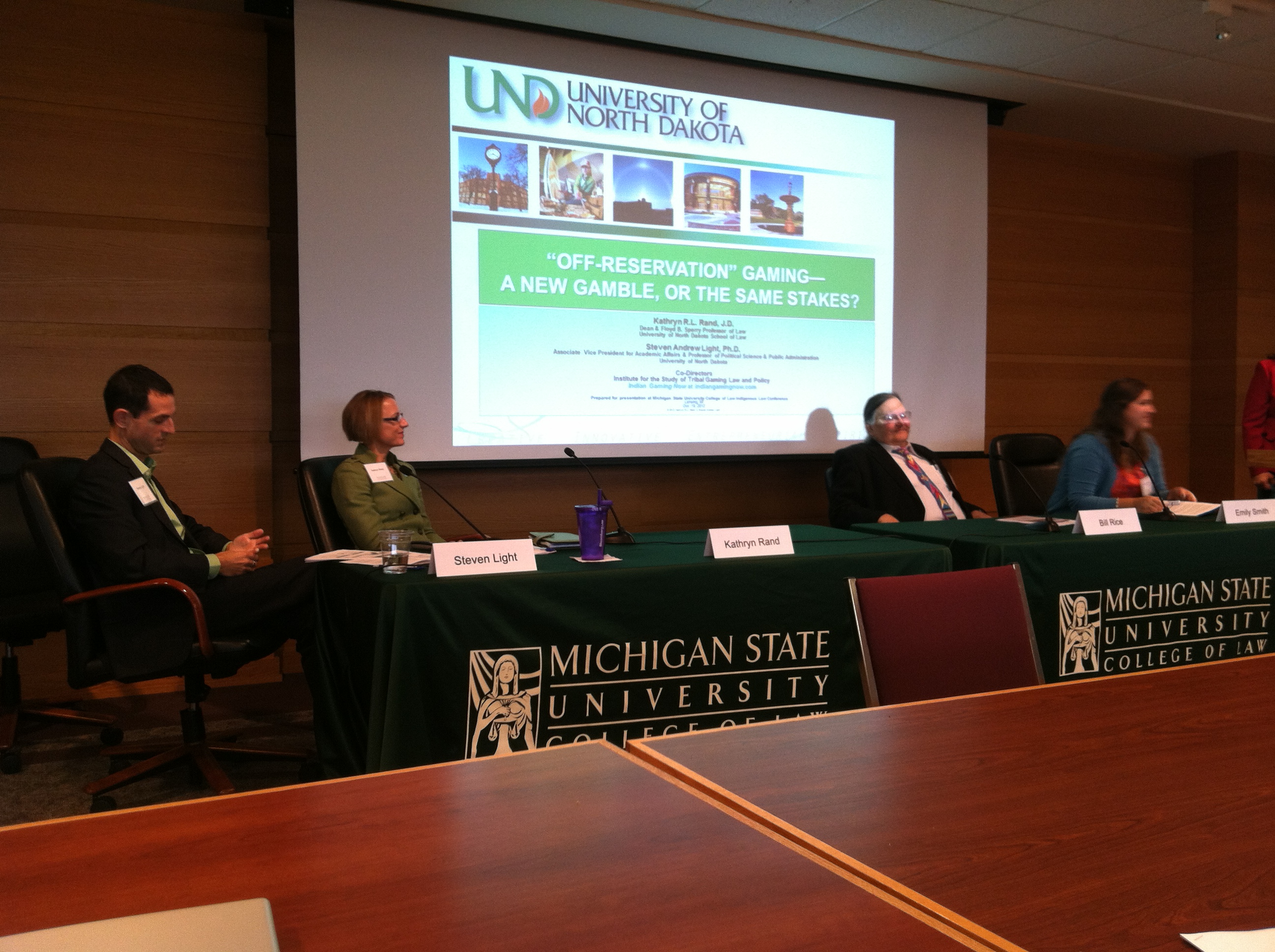
Scholarship and Gaming Panel

L-R: Steven Light, Kathryn Rand, Bill Rice, and moderator Emily Smith


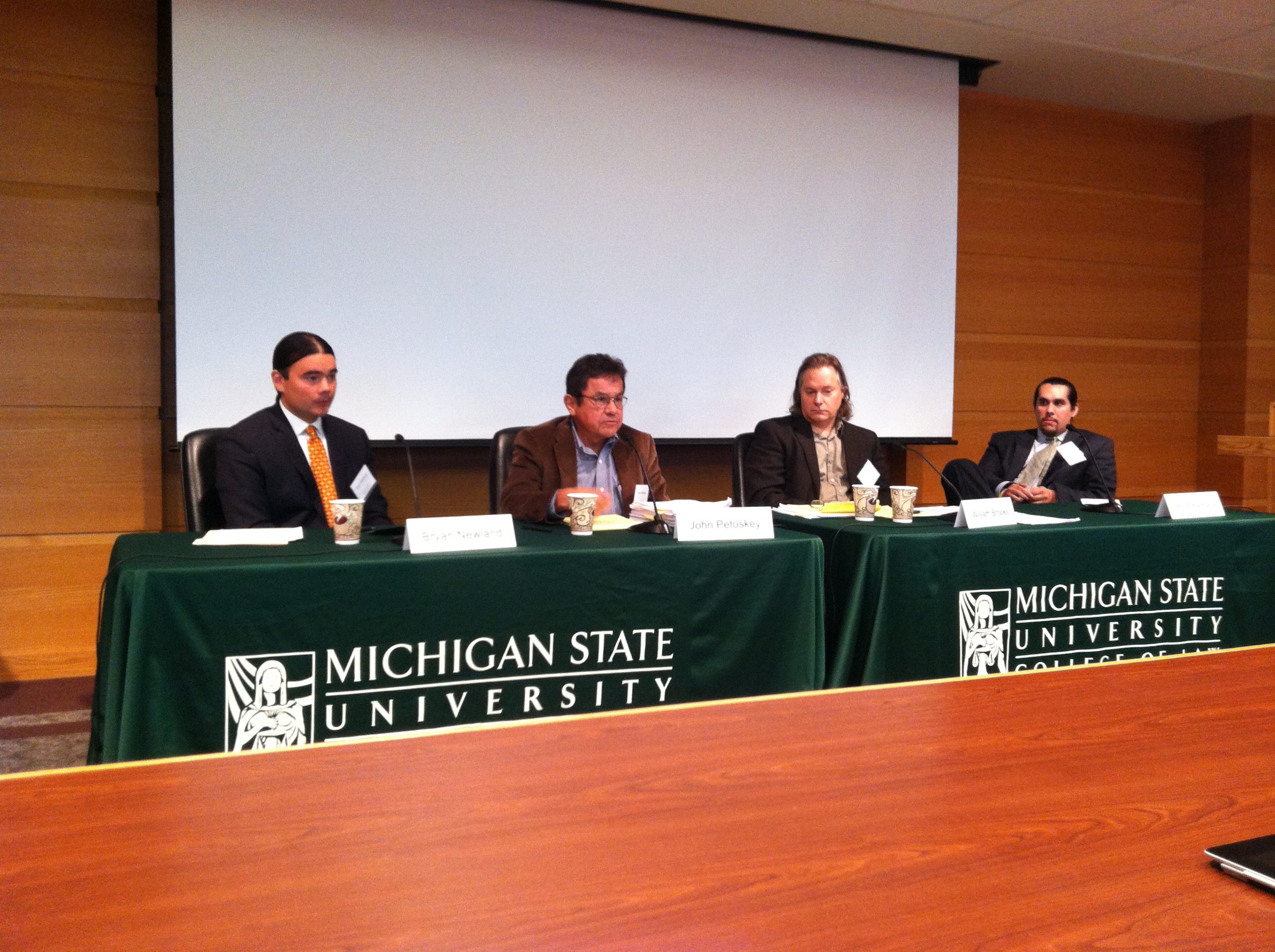
First Panel: Gaming Landscape in Michigan

L-R, Brian Newland, John Petoskey, Bill Brooks, and moderator John Simermeyer

Michigan Radio Story on Latest Regarding Lansing Casino

Apropos of our conference tomorrow.

Here.

The proposed $245 million casino project involves a complicated business and land deal between the city of Lansing, private developers and an indian tribe from the Upper Peninsula.

So complicated those involved were not able to reach an agreement on the various aspects of the project by an August deadline.   So they gave themselves an extension until November 1st.

But with two weeks before the extended deadline there’s still no final agreement.

John Wernet is an attorney for the Sault Ste Marie Tribe of Chippewa Indians.   He says they are “on track to close on the purchase by November 1, though the amount of work….is a bit daunting.”

Connecticut Appellate Court Decides Wrongful Death/Worker’s Comp Case Involving Mohegan Sun Casino

Here is the opinion in Lubrano v. Mohegan Sun Casino (Conn. App.):

Lubrano v Mohegan Sun Casino

An excerpt:

The defendants, Mohegan Sun Casino and Safety National Casualty Corporation, appeal from the decision of the workers’ compensation review board (board) affirming the decision of the workers’ compensation commissioner for the second district (commissioner) denying the defendants’ request to review their claim challenging the allocation of certain third party settlement proceeds between the plaintiff, Joseph Lubrano, and his wife, Jill Lubrano. On appeal, the defendants claim that (1) the board improperly affirmed the commissioner’s finding that the  [6] workers’ compensation commission (commission) lacked jurisdiction to review the amount of a spouse’s recovery from a third party claim for loss of consortium when determining the appropriate moratorium due to the defendants, (2) “the commissioner erred in finding, and the board erred in affirming, that the [defendants] had waived reimbursement of workers’ compensation benefits paid” and (3) “the commissioner erred in finding, and the board erred in affirming, that the [defendants’] moratorium was only $2,190,056.3.” We affirm the decision of the board.