The potential case concerns wild rice gathering and hunting off reservation and will likely include a habitat protection component. The Minnesota Public Radio article is here.
Great Lakes
Michigan Radio on the Proposed Lake Huron Nuclear Waste Site
Here.
Includes a brief quote from Vernon Roote, Saugeen First Nation Chief.
Fond du Lac Families fight forced autopsies
Here.
D.C. District Court Overturns Decision to Remove Gray Wolf from Endangered Species List
Memorandum and Opinion (111 pages) and Order.
ORDERED that, because the rule Revising the Listing of the Gray Wolf (Canis lupus) in the Western Great Lakes (the “Final Rule”), 76 Fed. Reg. 81,666 (Dec. 28, 2011), is arbitrary and capricious and violates the Endangered Species Act of 1973, as amended, 16 U.S.C. §§ 1531
et seq., the Final Rule is VACATED and SET ASIDE; and it is further ORDERED that the rule in effect prior to the Final Rule vacated by this Order, namely, the rule regarding Reclassification of the Gray Wolf in the United States and Mexico, with Determination of Critical Habitat in Michigan and Minnesota, 43 Fed. Reg. 9607 (Mar. 9, 1978),
is REINSTATED to govern management of gray wolves in the nine states affected by the vacated Final Rule, pursuant to the Endangered Species Act;
Freep coverage here.
Michigan Court of Appeals Affirms Mining and Groundwater Discharge Permits at Eagle Mine
Mining Permit decision here.
This case reflects the attempt to balance the potentially conflicting imperatives of exploiting a great economic opportunity and protecting the environment, natural resources, and public health. At issue is appellee Kennecott Eagle’s proposal to develop an underground mine to extract nickel and copper from the sulfide ores beneath the headwaters of the Salmon Trout River in the Yellow Dog Plains in Marquette County.
Groundwater Discharge permit decision here.
The court found the balance on the side of the underground mine. The state decision makers have managed to find at least three alternative grounds for not considering Eagle Rock a place of worship.
News article here.
News Coverage of Honor the Earth Arguing For a Voice in Pipeline Route in Front of Minnesota ALJ
Here.
Attorneys for the company contend that the commission has no business
deciding the meaning of federal treaties. Even so, much of the two-hour discussion before Judge Eric Lipman focused on 10 treaties signed between 1825 and 1864 by Minnesota Indian tribes.
“It would represent a dramatic departure from the commission’s precedent and would significantly impact not just pipeline projects but all large energy projects sited in northern Minnesota,” said Christine Brusven, an attorney for the Calgary-based pipeline company that’s proposing to build the 610-mile pipeline to carry North Dakota oil.
Headed for the courts?
Lipman, who is overseeing the regulatory review of the pipeline, is expected to rule on the treaty rights question, but the final decision rests with the Public Utilities Commission. The issue ultimately could land in federal court.
H/T Jean O’Brien
Big Questions: 1855 Treaty and Treaty Rights
Half hour show on the 1855 Treaty and treaty rights generally.
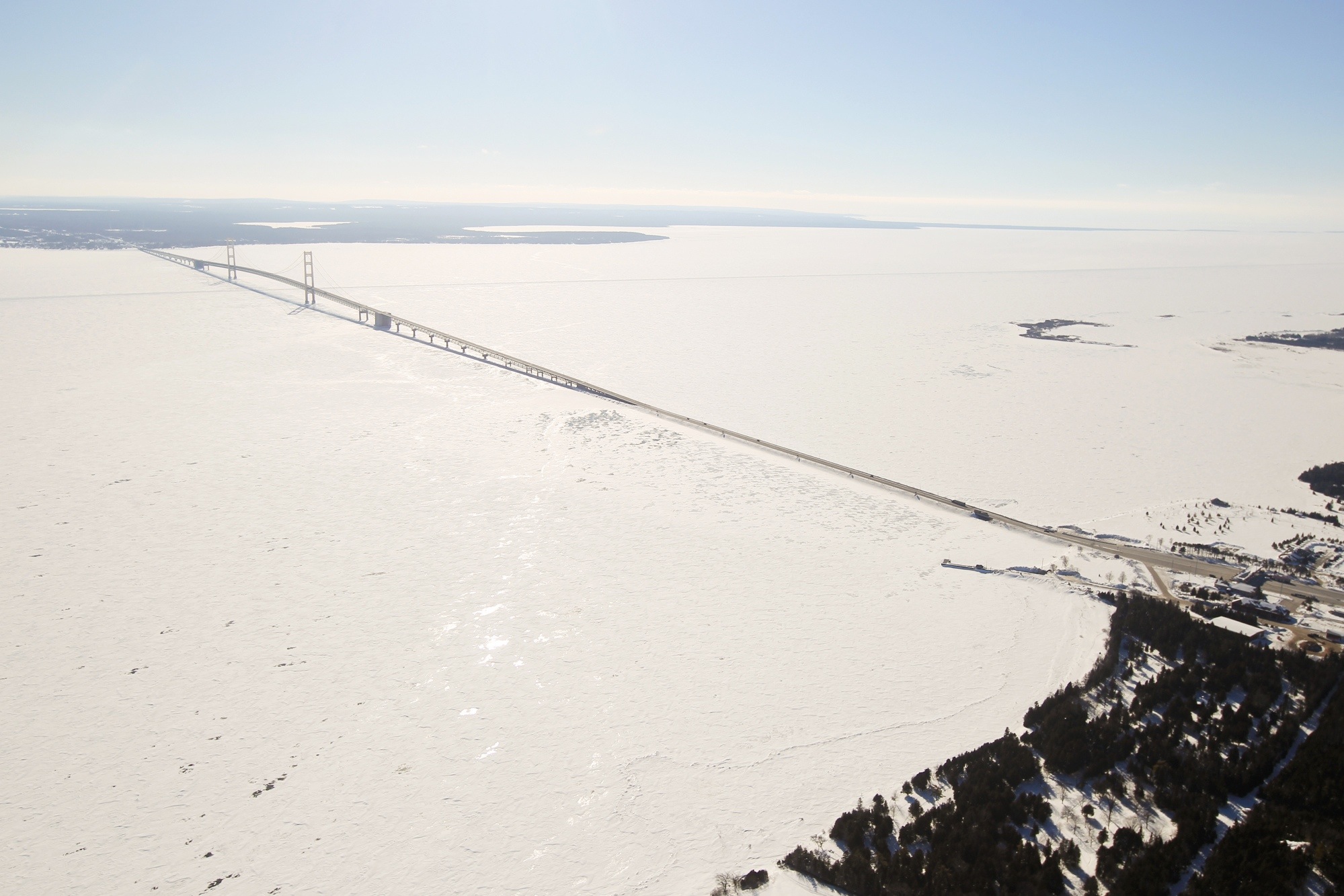
Great Lakes Ice Cover Nears Record
A CLOSER LOOK AT GAMING COMPACT NEGOTIATIONS IN MICHIGAN PART I: The history of Michigan’s first gaming compacts
The Bay Mills Indian Community’s pending Supreme Court case has sucked a lot of the oxygen out of the room here in Michigan. And it has definitely overshadowed an impending showdown between the State of Michigan and seven six* tribes over the negotiation of new Class III gaming compacts.
The negotiation of new tribal-state gaming compacts here in Michigan will offer a unique case study in how the Indian Gaming Regulatory Act’s compact provisions affect the negotiation of “second generation” gaming compacts – compacts that follow, rather than extend, a tribe’s previous compact.
We’re going to take a closer look at these negotiations in upcoming posts. But, first, it is important to understand how the current agreements – approved in 1993 – came into effect. WARNING: Marathon Blog Post.
THE HISTORY
As in other parts of the country, a number of Michigan tribes were already operating Class III gaming when IGRA was enacted in 1988. In enacting IGRA, Congress required tribes to negotiate a gaming compact with states to engage in Class III gaming – even for those tribes that were already operating such games. Congress also required states to negotiate these agreements in “good faith.”
Six Michigan tribes sought to negotiate Class III gaming compacts with the State of Michigan almost immediately after IGRA’s enactment. Then-Governor Jim Blanchard refused to negotiate over Class III slot machines, and ultimately refused to enter into a compact.
In 1990, those six tribes filed a lawsuit against the State of Michigan in the U.S. District Court for the Western District of Michigan, alleging that the State violated IGRA’s requirement to negotiate in good faith, and seeking a declaratory judgment that Class III slot machines would be permissible to include in the Compact.
In 1992 – 4 years before the Supreme Court’s decision in Seminole – the Western District of Michigan ruled in that lawsuit (Sault Ste. Marie Tribe v. Engler) that the Tribes’ lawsuit was barred by sovereign immunity.
After an unsuccessful appeal, the Tribes amended their lawsuit to name then-Governor John Engler as the defendant in an Ex parte Young action. That case – Sault Ste. Marie Tribe of Chippewa Indians, et al. v. Engler – ended through a negotiated settlement agreement. That agreement was entered by the U.S. District Court for the Western District of Michigan as a Consent Judgment in 1993. That Consent Judgment included several key provisions that will impact ongoing compact negotiations:
- The seven tribes that were party to the litigation agreed to pay 8% of the net win from electronic games of chance to the State of Michigan’s “Strategic Fund” – provided that the Tribes “collectively enjoy the exclusive right to operate electronic games of chance in the State of Michigan.” (Sections 6 and 7 of the 1993 Stipulation)
- The Tribes also agreed to pay 2% of the net win from electronic games to “any local units of state government in the immediate vicinity of each tribal casino.” Importantly, the Tribes were permitted to determine which local units of government would receive the payments (Section 8 of the 1993 Stipulation).
- Section 5 of the Consent Judgment expressly states that the Tribes are only obligated to make revenue sharing payments to the state “only so long as there is a binding Class III compact in effect between each tribe and the State of Michigan…and then only so long as the tribes collectively enjoy the exclusive right to operate” electronic games of chance in Michigan.
- Section 8 of the Consent Judgment states that both the Stipulation and the Consent Judgment may be modified or rescinded “only in the above captioned case, and only by the mutual written consent of all parties and with the Court’s concurrence.”
Concurrent with the Western District of Michigan’s entry of the Consent Judgment, the seven Tribes and the State of Michigan entered into separate Class III gaming compacts that were identical to one another. Those gaming compacts were approved by the Department of the Interior in 1993.
Each of those compacts stated that they would remain in effect “for a term of twenty (20) years from the date it becomes effective[.]” In other words, they would remain in effect until November 2013.
But those compacts also included language that has created some…(ahem) room for interpretation:
[12(B)] At least one year prior to the expiration of twenty (20) years after the Compact becomes effective, and thereafter at least one year prior to the expiration of each subsequent five (5) year period, either party may serve written notice on the other of its right to renegotiate this Compact.
2013 Healing Circle Run/Walk, July 13-19, 2013
From the Great Lakes Indian Fish & Wildlife Commission:
The 2013 Healing Circle Run/Walk will occur from July 13-19, 2013. The run/walk will connect eight Ojibwe reservations in northern Wisconsin, Michigan, and Minnesota (see map) starting at the Lac Courte Oreilles Reservation and ending at Lac du Flambeau on July 13 (Day 1), then ending at Mole Lake on July 14 (Day 2), at Lac Vieux Desert on July 15 (Day 3), at Bad River/Red Cliff on July 16 (Day 4), at Fond du Lac/Black Bear Casino on July 17 (Day 5), at St. Croix on July 18 (Day 6), and at Lac Courte Oreilles on July 19 (Day 7).
For more information or if you are interested in participating as a core runner, or having a group of runners from your reservation participate, please contact Jenny Krueger, Sue Lemieux, or Neil Kmiecik at GLIFWC at (715) 682-6619. All participants must assume personal liability, as well as responsibility for their own transportation and expenses.
Map.
GLIFWC site.
I participated in this event for a few days in 2011 and had a wonderful experience. Participants range from young children to elders and both walkers and runners. Some people go for only one day and others for the whole week. I hope to join this event again one of these summers.
 Turtle Talk

You must be logged in to post a comment.