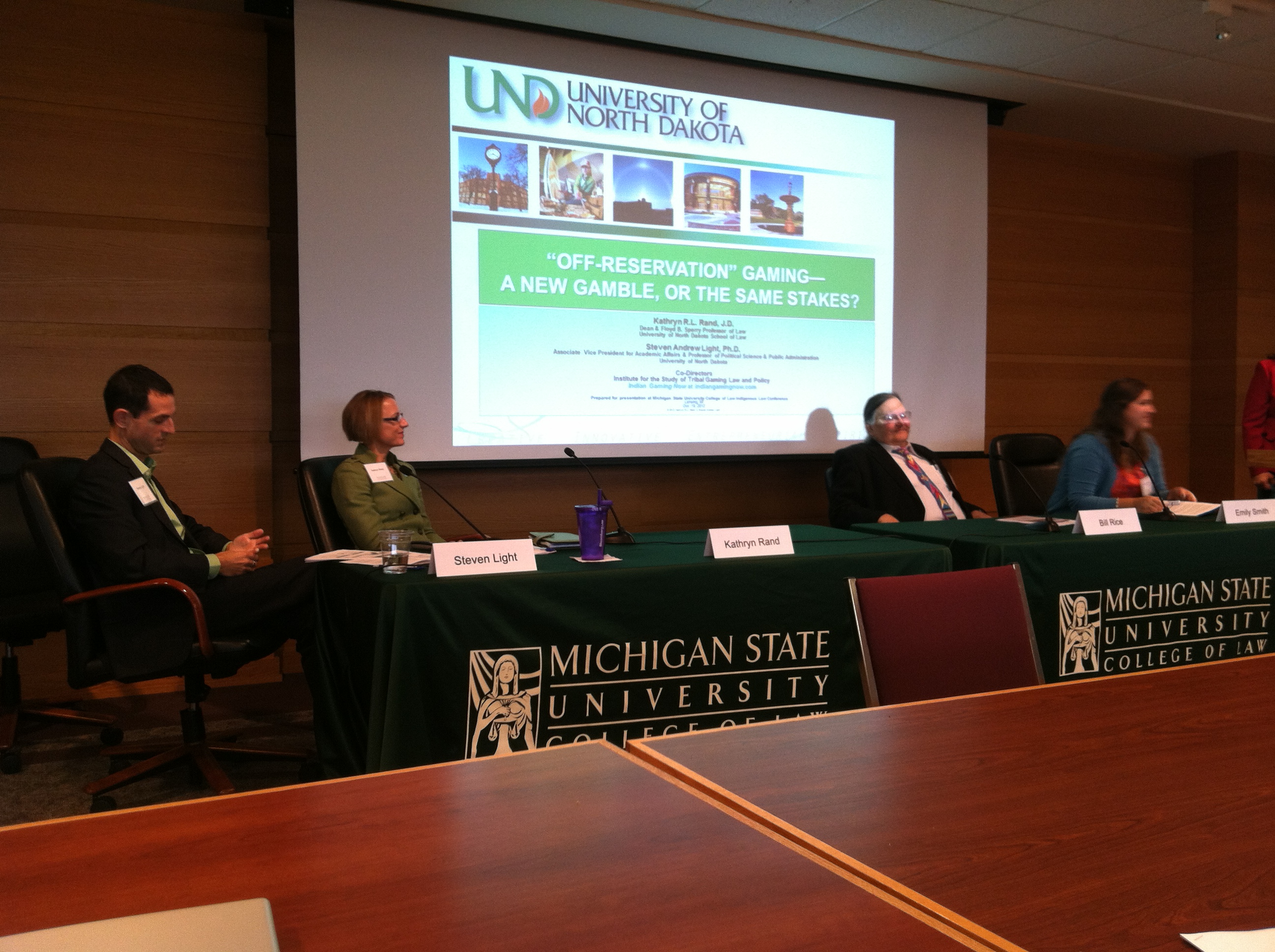
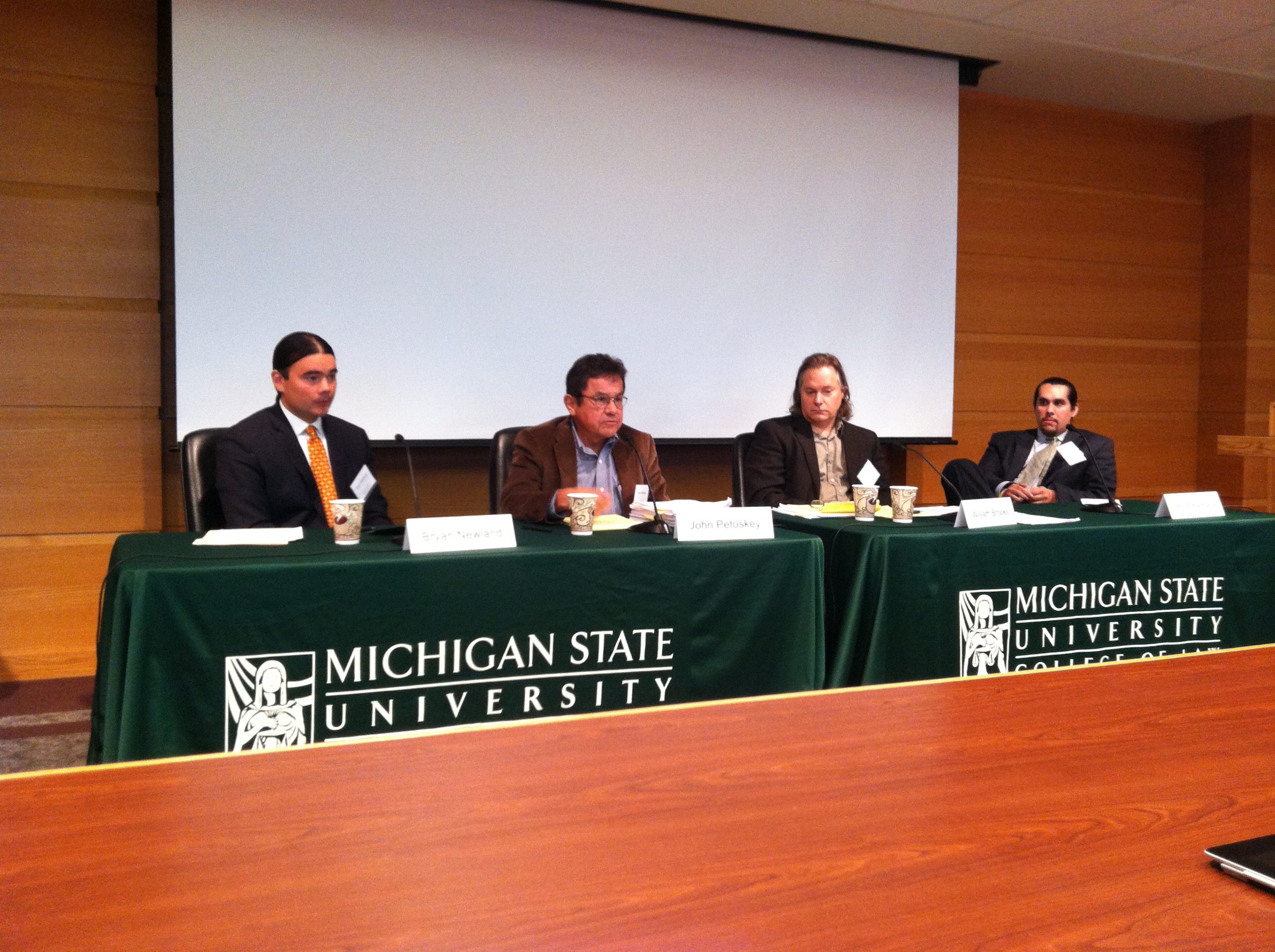
L-R, Brian Newland, John Petoskey, Bill Brooks, and moderator John Simermeyer
IGRA
State of Michigan Sues Sault Tribe over Lansing Casino Proposal
Here are the materials in State of Michigan v. Sault Ste. Marie Tribe of Chippewa Indians (W.D. Mich.):
Gov. Brown Concurs in Two 2-Part Determinations
Governor Brown Concurs with U.S. Department of the Interior Decision, Signs Compact with North Fork Rancheria http://gov.ca.gov/news.php?id=17700
Governor Brown Concurs with U.S. Department of the Interior Decision, Signs Compact with Enterprise Rancheria http://gov.ca.gov/news.php?id=17699
Fletcher on IPR re: Michigan v. Bay Mills Indian Community Decision
Here.
Wells Fargo v. Cabazon Band — Enforcement of Trust Indenture
Cabazon Band has removed the state court complaint to federal court (Wells Fargo Bank NA v. Cabazon Band of Mission Indians (C.D. Cal.)):
Cabazon Notice of Removal [notice only]
Cabazon Notice of Removal Part 1 [notice plus attachments, each are 100+ page docs]
Cabazon Notice of Removal Part 2
Cabazon Notice of Removal Part 3
Cabazon Notice of Removal Part 4
Cabazon Notice of Removal Part 5
An excerpt from the notice:
5. This action “seeks to specifically enforce certain covenants of the Tribe under the Trust Indenture[.]” Exh. “A” (Complaint) ¶ 1. This dispute potentially involves claims under Indian Gaming Regulatory Act (“IGRA”), 25 U.S.C. §§ 2701-2721, and, accordingly, invokes federal jurisdiction. For example, the U.S. District Court for the Eastern District of Wisconsin held last year that federal subject matter jurisdiction was established on the face of the complaint because a claim against a Tribe for breach of a Trust Indenture is not a routine contract dispute, and involved potential application of IGRA:Wells Fargo’s claim for breach of the Indenture does not present a routine contract dispute, but rather a specific issue under a highly regulated area of federal law. See Gaming World, 317 F.3d at 848. (“since this case raises issues under the extensive regulatory framework of IGRA, it is not a routine contract dispute.”). Wells Fargo’s action on the Indenture and Bonds necessarily raise federal questions concerning whether the Indenture is a management contract within the meaning of the IGRA and, if so, whether the Tribe’s waiver of sovereign immunity is valid. Wells Fargo’s complaint therefore invokes federal jurisdiction[.]
Wells Fargo Bank, N.A. v. Sokagon Chippewa Community, 787 F. Supp. 2d 867, 875 (E.D. Wis. 2011).
Does Michigan v. Bay Mills Create a Circuit Split with Mescalero v. New Mexico over Whether IGRA Waives Tribal Immunity?
Well, maybe, but it probably doesn’t matter because of State of Michigan’s amended complaint below.
Yesterday the Sixth Circuit held the Indian tribal immunity survives the enactment of the Indian Gaming Regulatory Act for cases in which a non-federal party with standing sues the tribe for alleged violations of the Act. The court criticized the Tenth Circuit’s holding Mescalero Apache Tribe v. New Mexico (PDF) that IGRA does waive tribal immunity:
Mescalero offers virtually no analysis in support of its contrary reading of § 2710(d)(7)(A)(ii)—a point which the State, to its credit, concedes here; and to the extent the opinion does offer any analysis, it mistakenly cites waiver cases rather than abrogation ones. We agree with the Eleventh Circuit, therefore, that Mescalero’s reasoning is “muddled” rather than persuasive.
The CA6 cited the CA11, also critical of the Tenth Circuit’s holding. In Florida v. Seminole Tribe (PDF), the court also criticized the Mescalero holding:
As an initial matter, we find that Mescalero provides no support for the State’s argument. The Mescalero panel, in discussing section 2710(d)(7)(A)(ii), claimed that a majority of courts agree that “IGRA [abrogated] tribal sovereign immunity in the narrow category of cases where compliance with IGRA’s provisions is at issue and where only declaratory or injunctive relief is sought.” 131 F.3d at 1385. In actuality, however, the cases that the panel cited in support of its claim addressed an entirely different matter, to wit: whether a tribe voluntarily waives its own sovereign immunity by engaging in gaming under IGRA. See infra part II.A.2 (discussing tribal waiver of immunity). In light of this absence of supporting authority, we find the Mescalero panel’s claim difficult to credit.
So one circuit has held that IGRA waives tribal immunity, and two circuits expressly disagree with the first circuit. Circuit split, right? Get ready for Michigan v. Bay Mills Indian Community in the Supreme Court?
Well, probably not. If the Tenth Circuit’s decision is so patently wrong (and mind you, it didn’t have the benefit of any other cases upon which to rely), it probably doesn’t matter. If confronted with the same question again, one could predict the Tenth Circuit going the other way. This is why the Supreme Court doesn’t take questions of first impression very often. They like to let things percolate in the lower courts. Whether IGRA waives tribal immunity is still percolating. The Tenth Circuit is looking like an obvious outlier decision that won’t be repeated. I’d guess, if anyone made the effort, that a Supreme Court cert petition would be denied.
IPR on Vanderbilt Casino Ruling
Here.
An excerpt:
A written statement from Bay Mills Chair Kurt Perron says the tribe ultimately plans legal victory, and to move forward with its “planned developments.” The tribe did not immediate elaborate on the statement’s meaning.
If Bay Mills is ultimately victorious, the tribe would likely be allowed to build casinos anywhere it wants, without state approval, as long as it buys the land with a specific pool of funds.
“Probably the biggest implication (of today’s ruling) in the long run is just to highlight exactly how difficult it is to shut down a casino opened by an Indian tribe under these circumstances,” says Matthew Fletcher, of MSU’s Indigenous Law Center.
The Vanderbilt Casino is widely regarded as a test site for its Upper Peninsula owner. The tribe has expressed interest in building in Port Huron, and perhaps elsewhere.
It’s not clear what implications this case might have for another Upper Peninsula tribe’s plans to build a casino in downtown Lansing.
Sixth Circuit Vacates Injunction against Bay Mills’ Vanderbilt Casino
Here is today’s opinion (PDF).
Here are the briefs:
BMIC Opening Brief in CA6 Appeal
State of Michigan Appellee Brief
BMIC Motion to Strike Appellee Briefs
Lower court materials here.
Here is the casino:

Guess they can take this sign down now:

Update in Broken Arrow Casino Litigation: Reconsideration Denied; Injunction Modified
Here are the additional materials in State of Oklahoma v. Hobia (N.D. Okla.):
Hobia Motion for Reconsideration
Oklahoma Opposition to Reconsideration Motion
Hobia Reply in Reconsideration Motion
DCT Order Denying Motion for Reconsideration
DCT Order Granting Modification of Injunction
Our prior post on this case is here.
First Circuit Remands Equal Protection Challenge to Mass. Gaming Law; Remands for Trial on Merits (and Carcieri)
The opinion is here.
Excerpts:
Given this situation, the lack of clear answers on questions of both state and federal law, the shifting of the nature of the injury to KG, and the apparent attempt to allow some time for the IGRA process to work (including any Carcieri fix), we cannot say there was an abuse of discretion in the denial of preliminary injunctive relief. “An injunction is an exercise of a court’s equitable authority, to be ordered only after taking into account all of the circumstances that bear on the need for prospective relief.” Salazar v. Buono, 130 S. Ct. 1803, 1816 (2010). “Equitable relief is not granted as a matter of course, and a court should be particularly cautious when contemplating relief that implicates public interests.” Id. (citations omitted).
And:
The district court’s dismissal of the complaint is another matter. We simply cannot say that KG’s equal protection claim as to § 91 fails to state a claim on which relief may be granted, or that the issuance of equitable relief may not be appropriate at some future date.
We also affirm the dismissal with prejudice of KG’s claims as to the $5 million appropriation, the advisory committee seat, and the preemption challenge to § 91. We dismiss KG’s state-law claims without prejudice. We remand the case for further proceedings consistent with this opinion.

You must be logged in to post a comment.