Donia Center [UMich] Panel on Indigenous Language Rights on April 11 @ 4PM

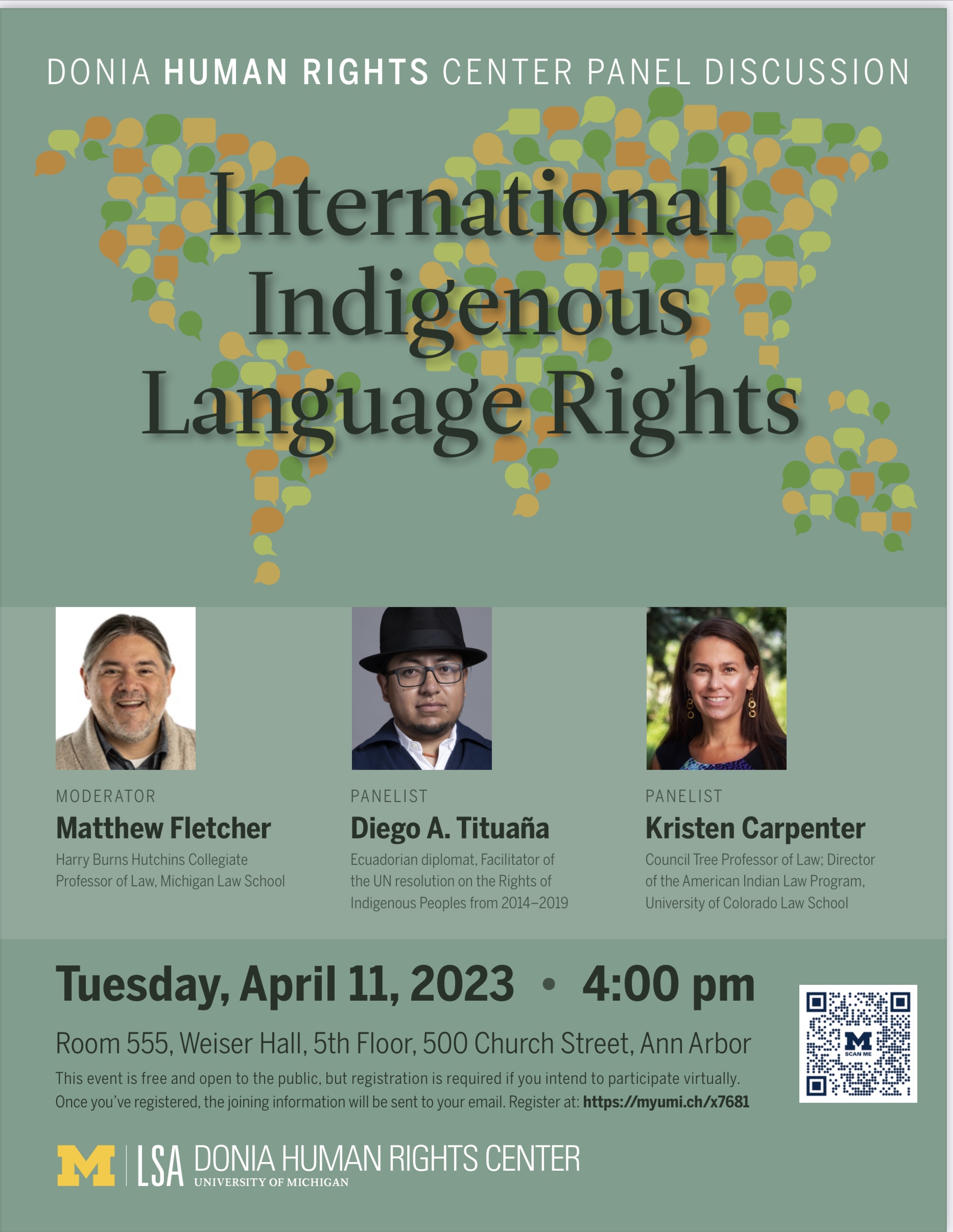
Panel Discussion: International Indigenous Language Rights
April 11 @ 4 PM, 555 Weiser Hall

Panelists: Diego A. Tituaña, Ecuadorian diplomat, Facilitator of the UN resolution on the Rights of Indigenous Peoples from 2014-2019, and Kristen Carpenter, Council Tree Professor of Law; Director of the American Indian Law Program, University of Colorado Law School; Moderator: Matthew Fletcher, Harry Burns Hutchins Collegiate Professor of Law & Professor of American Culture, University of Michigan

Law Review Article Published Entirely in ʻōlelo Hawaiʻi (Hawaiian)

Sabrina Rose Kamakakaulani Gramberg has published, in the Asian & Pacific Law & Policy Journal, an article written entirely in ʻōlelo Hawaiʻi (Hawaiian).

Here is a link to a press release (May 13, 2020) from Univ. of Hawaiʻi about it.

Here is a link to the article.

On page 38, Sabrina gives a short description of the article in English that states:

Enshrined in Hawaiʻi’s constitution, the legal foundation for Hawaiian language rights awaits statutory implementation. In the gap between legal justification and practical operation, speakers of Hawaiʻi’s indigenous language are once again being compelled to express themselves in English to access essential government programs. The State of Hawaiʻi has a role and responsibility in redressing the government actions that forced Hawaiʻi’s language shift. The reluctance of elected officials to develop a comprehensive plan to operationalize the constitution stands in direct contravention to the intent and mandate of Article XV, Section 4 of the Hawaiʻi State Constitution. As an official but critically endangered language, a statutory infrastructure for Hawaiian language access would support revitalization efforts and provide long- awaited mechanisms to obtain translation and interpretation services statewide.

And here is a link to Ka Huli Ao’s blog post about the article.


The Atlantic: “The Alaska Native Teacher Upending the Legacy of Colonial Education”

Here.

Materials in Navajo Nation, et al. v. Reagan – Voting Rights Litigation

Here are the materials in Navajo Nation, et al. v. Reagan, et al. No. CV-18-08329-PCT-DWL (Ariz. D. Ct. 2019).

The Amended Complaint sought:

[D]eclaratory and injunctive relief, compelling the Defendants to (a) allow early voters who do not sign their ballot affidavit to have the same opportunity to cure the ballot deficiency that is provided to voters with a mismatched signature, (b) allow early voters who do not sign their ballot affidavit to have the same chance to cure their ballot as voters who vote by conditional provisional ballots, (c) provide translators certified as proficient in the Navajo language for all future early voting and election-day polling sites, (d) provide translation of instructions for casting an early ballot in Navajo over the radio for the 30 days leading up to an election, (e) establish additional in-person voter registration sites, and (f) establish additional early voting sites on the Reservation for all future elections that are open for consistent hours (at a minimum, each Monday through Friday from 8 a.m. until 6 p.m. with no interruption during the lunch hour) during the 30 days leading up to the election. This relief is sought on the grounds that failure to provide the requested relief is a denial of the equal right to vote.

The lawsuit was settled, and the Settlements can be seen here:

NYTs: “Maori Language, Once Shunned, Is Having a Renaissance in New Zealand”

Here.

ILADA Blog [McGill Law]: Seasonal Thematic Contributions by Indigenous Legal Scholars

Here:

Season 1:  Law Through Language (2018)

Our first season focuses on language as law: within the context of language revitalization, how do Indigenous laws pronounce themselves through language? How can Indigenous laws be strengthened, given the impact of colonialism on Indigenous languages? And can the changes required to revitalize—funds, experts, and the privileging of resources—create additional inequities? This season seeks to answer these questions among others.

This season aims first and foremost to address the crucial relationship between language and law: in particular, the role Indigenous languages play in articulating Indigenous laws. Writing about the Navajo people, Anishinaabe scholar Matthew Fletcher emphasizes, “for many tribal communities, the law is encoded right into the language – and the stories generated from the language.”1 Because most Indigenous communities historically expressed (and continually express) their customs and laws orally, this statement applies to Indigenous groups broadly.2 This season features contributors who explore expressions of law and answer questions about how language deepens and complicates protocols, interpretations and worldviews.

We recognize inherent challenges in this exercise: communities experience “law” in different forms and may not identify practices and behaviours as law in the same way that they are identified in Western legal normativity. What one group claims as “law” may be something entirely different to another; and not everything is translatable into English or French—nor should it be. As John Borrows stated, “context should not be stripped from the practice of Indigenous law.”3 Often, that context is language. Our contributors this season help to tease out how Indigenous languages limit and liberate, stymie and enable, and generally complicate the articulation of Indigenous law.


The State of Canada’s Indigenous Languages by Katsi’tsakwas Ellen Gabriel

Indonaakonigewininaan – Toward an Anishinaabe Common Law by Matthew L.M. Fletcher

Language and Anishinaabe Consultation Law by John Borrows


1 Matthew Fletcher, “Rethinking Customary Law in Tribal Court Jurisprudence” (2007) 13 Mich J Race & L 57 at 21.

2 Ibid at 41, “Indian cultures (often) were and are oral cultures.”

3 Borrows, John, “Foreword: Indigenous Law, Lands, and Literature,” (2016) 33 Windsor YB Access to Just v at ix.
WaPo News Profile on Saving Native Languages

Here is “A Native American ‘Sesame Street’ could help save dying languages.

Slate Podcast: New Life for Dying Languages

Here.

2017 Canoe Journey Blog

The Northwestern Tribes’ Canoe Journey wrapped up this past weekend in Campbell River. Here’s Matika Wilbur’s beautiful blog documenting the Journey. I was privileged to attend the Muckleshoot landing.

Muckleshoot Canoe Landing © Ann Tweedy


HuffPo on 13 Issues Facing Native Peoples Beyond Mascots & Casinos

Here’s the article by Julian Brave NoiseCat. Thanks to E.E. for the link.