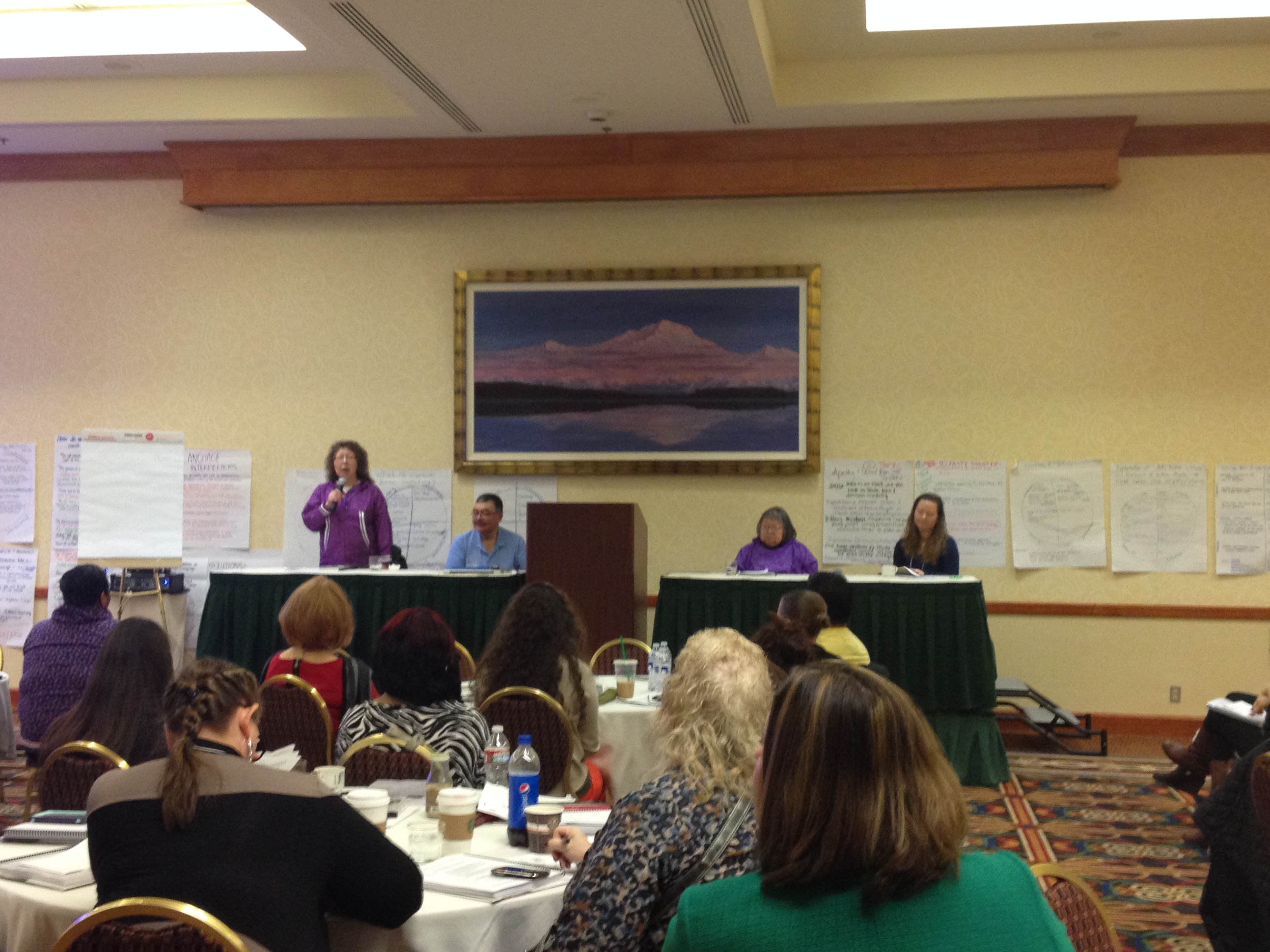
Yup’ik Translation/Access to Justice Panel, Rural and Safety Justice Conference

This panel explained the difficulties in finding accurate words in the Yup’ik language for court terminology, particularly in cases of sexual assault and domestic violence.

IMG_2277

Pictured above: Sophie Alexie, Instructor of Yup’ik Eskimo, University of Fairbanks, Kuskokwim Campus; Oscar Alexie, Assistant Professor Yup’ik Eskimo, University of Fairbanks, Kuskokwim Campus; Mary Beaver, Elder Advocate, Irniamta Ikayurviat-Children’s Advocacy Center at Tundra Women’s Coalition in Bethel; Kari Robinson, Language Access & Rural Domestic Violence Attorney with the Alaska Institute for Justice

Previous coverage here.

Non-Profit Organization Works to Train Interpreters for Yup’ik Speakers in Alaska Courts

In some areas of Alaska many elders and even middle-aged community members grew up with Yup’ik as their first language. The resulting language gap for these individuals has created problems when they are involved in court hearings. To combat these problems, the Alaska Institute for Justice is heading up an effort to train Yup’ik interpreters specifically to work in courts, medical facilities, and other institutions. The experts involved with this training are working to create a Yup’ik legal glossary with an emphasis on words that describe problems such as: sexual assault, child sexual abuse, domestic violence, and parental neglect and abuse.

“Our goal is to make sure that all Alaskans have access to the services that they need regardless of their ability to speak English,” said Robin Bronen, executive director of the justice institute.

Full article available here.


Navajo Nation Supreme Court Decision in Tsosie v. Deschene

Opinion here.

Based on the foregoing, by majority decision, the Court hereby enters a Permanent Writ of Mandamus against the Respondents. Under its administrative duties to implement the Election Code, the NEA is ordered to comply with 11 N.N.C. 44. The ballots are to be immediately reprinted without the name of the disqualified candidate, Christopher C. Deschene. It is unavoidable that the November 4, 2014 election must be postponed as agreed to by the Chief Legislative Counsel, and as permitted by 11 N.N.C. 3 to ensure a valid election.

Briefs posted here.

Navajo SCT Dismisses Chris Deschene Appeal on Procedural Grounds

Here is the opinion.

NYTs Article on Controversy over Navajo Fluency Requirement for Political Candidates

Here is “Presidential Candidate in Navajo Nation Protests a Language Requirement.

NYTs Web Documentary: ‘Who Speaks Wukchumni?’

Here.

Al Jazeera: “Alaska ballots fraught with issues for Yup’ik speakers”

Here.

NPR Segment Profiles Ojibwe.net

NPR has “For Rare Languages, Social Media Provide New Hope” here.

An excerpt:

The creators and contributors of Ojibwe.net — a website that seeks to preserve Anishinaabemowin, an endangered Native American language from Michigan — use Facebook in a similar manner.

Ojibwe.net contributor Margaret Noodin is an assistant professor of English and American Indian Studies at the University of Wisconsin-Milwaukee. The language has 8,000-10,000 speakers, she says. But most of the native speakers are over 70 years old, placing the language under threat.

“That’s the most dangerous thing. There are very few young kids that are growing up in a fluent environment,” Noodin says.

Article Recognizing the Contribution of Choctaw Code Talkers in WWI

Full Article Here

In the autumn of 1918, US troops were involved in the Meuse-Argonne Offensive on the Western Front. It was one of the largest frontline commitments of American soldiers in WW1, but communications in the field were compromised. The Germans had successfully tapped telephone lines, were deciphering codes and repeatedly capturing runners sent out to deliver messages directly.

“It was a huge problem and they couldn’t figure out a way around it,” says Matt Reed, curator of American Indian Collections at the Oklahoma History Center, the headquarters of the Oklahoma Historical Society.

The solution was stumbled upon by chance, an overheard conversation between two Choctaw soldiers in the 142nd Infantry Regiment. The pair were chatting in camp when a captain walked by and asked what language they were speaking. Realising the potential for communication, he then asked if there were other speakers among the troops. The men knew of Choctaw soldiers at company headquarters. Using a field telephone the captain got the men to deliver a message in their native tongue which their colleagues quickly translated back into English. The Choctaw Telephone Squad was born and so was code talking. . . .

But at the same time,the Choctaw language was under pressure back in the US. It was a time of cultural assimilation. Government attempts to “civilise” American Indians involved putting their children in state-run boarding schools, where they were often severely punished for speaking in their native tongue.

“You had this crazy situation where the Choctaw language was being used as a formidable weapon of war, yet back home children were being beaten at school for using it,” says Judy Allen, senior executive officer of tribal relations with the Choctaw Nation of Oklahoma. “The two soldiers who were overheard by the officer probably thought they were in trouble rather than about to provide the answer to the army’s communication problems.”
Anishinabe and English Road Signs in St. Louis County, MN

Bilingual road signs, to be paid for by the Fond du Lac Tribe, have been granted preliminary approval by St. Louis County. The signs will be posted on county roads within the reservation. More here.