Here:
Complaint here.
Here:
Filed right before the decision in Michigan v. Bay Mills came out, so it doesn’t take that case’s outcome into consideration.
Tribal Attorney
Serve as a Tribal Attorney responsible for assisting with legal advice and services for the Grand Traverse Band Tribal Council on a wide range of legal issues. This position will be a regular full-time, in-house position, assisting the GTB Legal Staff. Detailed knowledge of Federal Indian Law and Tribal Law preferred. Native American preference will apply. Submit cover letter, resume and references to: Grand Traverse Band of Ottawa & Chippewa Indians, Human Resources, 2605 NW Bay Shore Drive, Suttons Bay, MI 49682 or email: mike.teeple@gtbindians.com
Qualifications: Recent Graduate from an accredited law school or an Attorney with 1-2 years of experience.
Salary: $55,000 – Recent Graduate
$60,000 – Upon passing the Bar Exam
$65,000 – $70,000 with 1-2 years of experience
Response Deadline: June 30, 2014
Kate Fort and Carrie Garrow organized a nice group of fabulous Indian law scholars, if we don’t say so ourselves, for the 2014 Law & Society meeting. Please join us!
Carrie Garrow, Syracuse University College of Law
Kathryn Fort, Michigan State University College of Law
Kirsten Carlson, Wayne State University Law School
Matthew Fletcher, Michigan State University College of Law
Stephen Gasteyer, Michigan State University
Colette Routel, William Michell College of Law
Wenona Singel, Michigan State University College of Law
Victoria Sweet, Michigan State University College of Law
There are also other great panels at L&S:
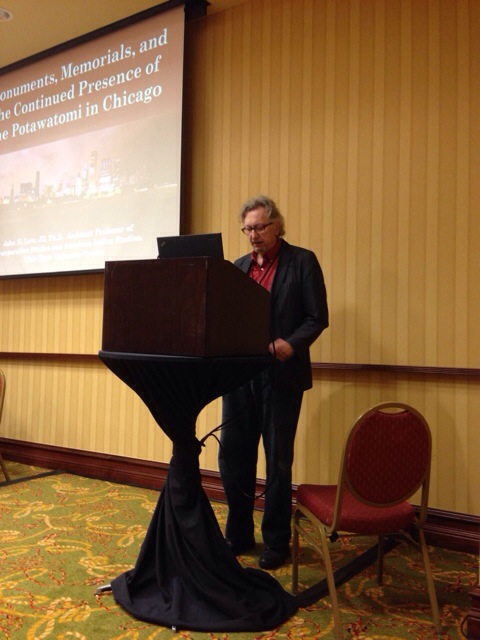
John Low, a Pokagon Band member, opened it up
MSU Press is here displaying Simon’s novel

Here is the unpublished opinion in United States v. Pego.This one is Samuel John Pego. We posted on the earlier appeal by Waylon Pego here.
Here. Second story in the newscast.
Here, “Opinion details: Victory for Native American tribes . . . for now?”
An excerpt:
The Court acknowledged the “apparent anomaly” in the law: although states can sue tribes for illegal gaming activity on Indian lands, they cannot sue them for the same activity off Indian lands. “But,” the Court continued, “this Court does not revise legislation . . . just because the text as written creates an apparent anomaly as to some subject it does not address.” And – significantly – even if the state can’t sue a tribe for off-reservation illegal gaming, it still “has many other powers over tribal gaming that it does not possess (absent consent) in Indian territory.” Most state laws will apply to Indians off reservation, for example: Michigan “could, in the first instance, deny a license” for an off-reservation casino; if the tribe went ahead with the project anyway, it could sue tribal officials to stop the gaming activity and, if necessary, invoke its criminal laws. Moreover, states also could seek a waiver to allow lawsuits for off-reservation gaming activity as part of its compact with the tribe regarding on-reservation gaming.
The Bay Mills Indian Community and the rest of Indian country dodged a very large bullet aimed by the State of Michigan at a core principle of inherent tribal sovereignty and tribal governance with today’s opinion by Justice Kagan. The stakes were incredibly high for tribal interests, and may remain so for the foreseeable future as more sovereign immunity cases work their way through the pipeline. In fact, Justice Kagan pointed out that several possible fact patterns that might justify serious reconsideration (“special justification”) are not before the Court:
We need not consider whether the situation would be different if no alternative remedies were available. We have never, for example, specifically addressed (nor, so far as we are aware, has Congress)whether immunity should apply in the ordinary way if a tort victim, or other plaintiff who has not chosen to deal with a tribe, has no alternative way to obtain relief for off-reservation commercial conduct. The argument that such cases would present a “special justification” for abandoning precedent is not before us. Arizona v. Rumsey, 467 U. S. 203, 212 (1984).
Slip op. at 16 n. 8.
Turning away from the statutory and common law immunity analyses for a moment, it remains to be seen what Bay Mills has won here. Justice Kagan’s opening paragraph concludes with this phrase:
Michigan must therefore resort to other mechanisms, including legal actions against the responsible individuals, to resolve this dispute.
Slip op. at 1.
Later, she elaborates on the mechanisms Michigan might employ to defeat the underlying issue here — whether Bay Mills can open an off-reservation casino on lands acquired under the Michigan Indian Land Claims Settlement Act. Michigan has many advantages, it would appear, stemming from the tribe’s movement off the reservation:
And the resulting world, when considered functionally,is not nearly so “enigma[tic]” as Michigan suggests. Reply Brief 1. True enough, a State lacks the ability to sue a tribe for illegal gaming when that activity occurs off the reservation. But a State, on its own lands, has many other powers over tribal gaming that it does not possess (absent consent) in Indian territory. Unless federal law provides differently, “Indians going beyond reservation boundaries” are subject to any generally applicable state law. See Wagnon v. Prairie Band Potawatomi Nation, 546 U. S. 95, 113 (2005) (quoting Mescalero Apache Tribe v. Jones, 411 U. S. 145, 148 (1973)). So, for example, Michigan could, in the first instance, deny a license to Bay Mills for an off-reservation casino. See Mich. Comp. Laws Ann. §§432.206–432.206a (West 2001). And if Bay Mills went ahead anyway, Michigan could bring suit against tribal officials or employees (rather than the Tribe itself) seeking an injunction for, say, gambling without a license. See §432.220; see also §600.3801(1)(a) (West 2013) (designating illegal gambling facilities as public nuisances). As this Court has stated before, analogizing to Ex parte Young, 209 U. S. 123 (1908), tribal immunity does not bar such a suit for injunctive relief against individuals, including tribal officers, responsible for unlawful conduct. See Santa Clara Pueblo, 436 U. S., at 59. And to the extent civil remedies proved inadequate, Michigan could resort to its criminal law, prosecuting anyone who maintains—or even frequents—an unlawful gambling establishment.See Mich. Comp. Laws Ann. §§432.218 (West 2001),750.303, 750.309 (West 2004). In short (and contrary to the dissent’s unsupported assertion, see post, at 11), the panoply of tools Michigan can use to enforce its law on its own lands—no less than the suit it could bring on Indian lands under §2710(d)(7)(A)(ii)—can shutter, quickly and permanently, an illegal casino.
Slip op. at 12-13.
I count several state law mechanisms; however, all are untested. Michigan has teed up a suit against tribal officials for injunctive relief. I guess we move there next, unless BMIC pays up and settles for a large percentage of off-reservation gaming revenues.
Also, the majority highlights two mechanisms expressly endorsed by counsel for the tribe at oral argument that I imagine most tribal leaders, perhaps even Bay Mills’, are not happy about: suing tribal officials for injunctive relief and utilizing state criminal laws. In this respect, the opinion (from the perspective of tribal interests) is tainted.
In the end, perhaps the biggest winner will be the Sault Ste. Marie Tribe of Chippewa Indians, which is making similar arguments as Bay Mills in favor of a Lansing MI casino, but has a somewhat stronger argument under the terms of the Michigan Indian Land Claims Settlement Act. Expect to see a denial of Michigan’s cert petition in the fall.
Finally, an most importantly, this is a lesson to Indian country on what kinds of cases are winnable, if not all the time (see Adoptive Couple) — statutory interpretation cases. Cases with common law aspects that can be argued as statutory interpretation cases like Bay Mills should be argued that way if at all possible.
 Turtle Talk
You must be logged in to post a comment.