Governor Whitmer Signs Executive Directive to Strengthen Tribal-State Relations

Here is the Executive Directive.

Press release:

Governor Whitmer Signs Executive Directive to Strengthen Tribal-State Relations  

EDbuilds upon and strengthens process of tribal consultation 

MT. PLEASANT, Mich. —Today, during a summit of Michigan’s tribal leaders, Governor Gretchen Whitmer signed Executive Directive 2019-17. The executive directive reaffirms and extends Michigan’s commitment to recognize the sovereignty and right of self-governance of Michigan’s federally-recognized Indian tribes and orders each state department and agency to adhere to these principles. 

“As Michiganders, we must ensure that our tribalcommunitiesare treated with dignity and respect,” said Governor Whitmer.“It’s important to me that each tribe has aseat at the table in my administration to contribute their perspectives, and I’m committed to working closely with our tribal leaders to protect the health, safety, and welfare of their communities. 

Executive Directive 2019-17 also details a process of tribal consultation designed to ensure meaningful and mutually beneficial communication and collaboration between these tribes and the departments and agencies on all matters of shared concern. It’s also the firstexecutivedirectivein Michigan history to require training on tribal-state relations for all state department employees who work on matters that have direct implications for tribes. 

Governor Whitmer has shown a deep commitment to ensuring members of Michigan’s federally recognized tribes have a seat at the table in state government. She appointed Wenona Singel, a citizen of Little Traverse Bay Bands, as her advisor on tribal-state affairs, the first tribal citizen to hold this position in Michigan history. 

Tribal members that Governor Whitmer has appointed to Michigan state boards and commissions include Chris Swartz on the UP Energy Task Force, General Counsel Whitney Gravelle on the Michigan Women’s Commission, Natural Resources Department Director Evelyn Ravindran on the Committee on Michigan’s Mining Future, and Councilor Emily Proctor on the Census Complete Count Committee. 
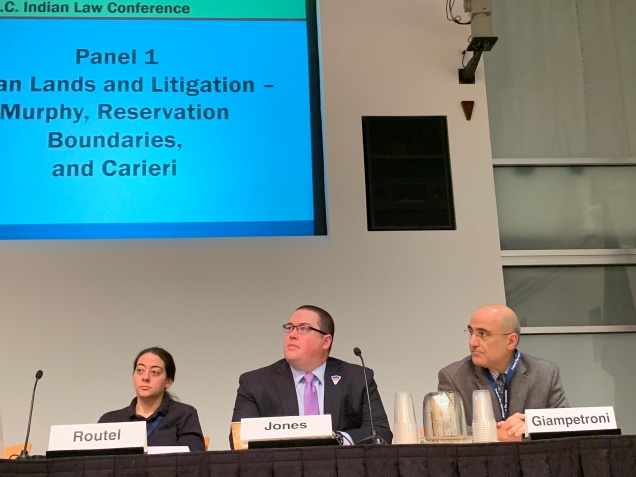
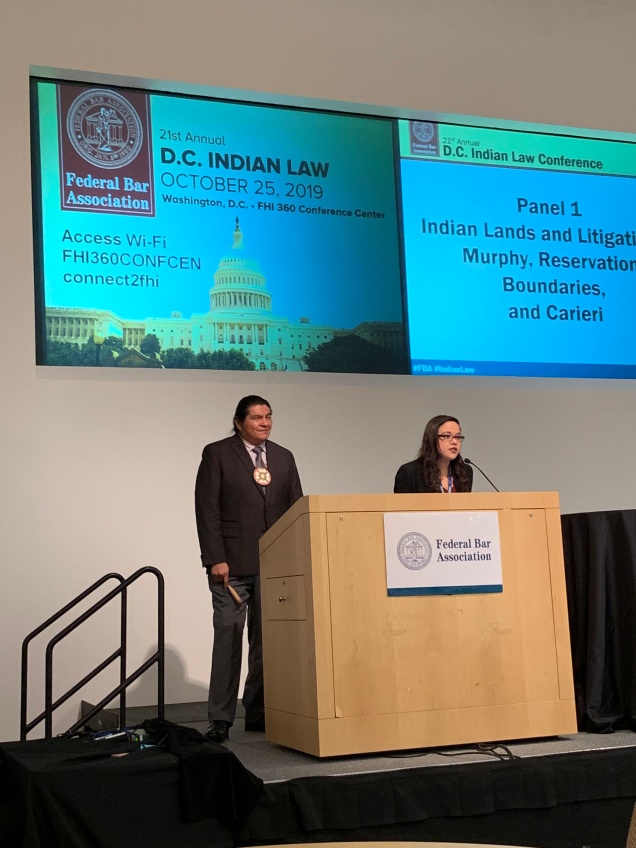
FBA’s D.C. Indian Law Conference

Colette Routel, Ethan Jones, and David Giampetroni discussing Indian Lands and Litigation
Lance Fisher and Conference Co-Chair Rose Petoskey at the start of the Conference.

Rosalie Fish presenting on MMIW at TEDxYouth@Seattle

Newsy: “ A Broken Trust: Sexual Assault And Justice On Tribal Lands”

Here.

NYTs: “Fed Up With Deaths, Native Americans Want to Run Their Own Health Care”

Here.

HCN: “The U.S. stole generations of Indigenous children to open the West”

Here, by Nick Estes.

Sen. Heitkamp speaks at U. South Dakota on MMIW

Here.

Big Island Video News: “Prosecutor Goes Before Ethics Board On Alleged Mauna Kea Conflict”

Here.

Inforum: “Swedish activist Greta Thunberg brings climate message to Standing Rock Sioux Nation”

Here.

D.C. Council to Consider Indigenous Peoples’ Day

From David Grosso, D.C. Council Member:

For Immediate Release
October 7, 2019

Contact
Matthew Nocella, 202.724.8105
mnocella@dccouncil.us


It’s time to honor Indigenous Peoples’ Day in D.C.
Washington, D.C. –  The following is a statement from Councilmember David Grosso ahead of tomorrow’s legislative meeting of the Council of the District of Columbia, where he will propose legislation to rename the holiday celebrated on the second Monday in October to “Indigenous Peoples’ Day”:

“For at least five years now legislation supported by a majority of the Council that would honor our native populations and rename Columbus Day to Indigenous Peoples’ Day has been stalled by Chairman Mendelson without any public input or hearing.

“Tomorrow, along with Councilmembers Cheh, Bonds, Nadeau, Trayon White, and Robert White, I will put forth legislation that will force a vote of the full Council to finally do the right thing by ending the celebration of the misleading narrative of Christopher Columbus on the second Monday in October.

“This move is not controversial. Maine, New Mexico, Vermont, North Carolina, Alaska, South Dakota, Oregon, and at least 130 cities and towns have now renamed the holiday, according to the New York Times.

“This is not just a movement in other areas of the country—I feel it right here in the District of Columbia every single day. I get letters from students requesting the name change; I know many schools use the holiday to honor Indigenous People instead of Christopher Columbus; and frankly, it’s an accident of history that Columbus is honored in this way.

“Columbus Day was officially designated as a federal holiday in 1937 despite the fact that Columbus did not discover North America, despite the fact that millions of people were already living in North America upon his arrival in the Americas, and despite the fact that Columbus never set foot on the shores of the current United States.

“Columbus enslaved, colonized, mutilated, and massacred thousands of Indigenous People in the Americas.

“We cannot continue to allow this history to be celebrated as a holiday in the District of Columbia. The government of the District of Columbia is clear that we are a government that values equality, diversity, and inclusion. Continuing to observe a holiday built on the celebration of oppression runs counter to those values.

“Already a majority of the Council has indicated their support to re-designate the second Monday in October through previous bills. It is my hope that we can come together tomorrow and honor Indigenous People and their rich history and cultural contributions with a ‘yes’ vote ahead of October 14.”

Office of Councilmember David Grosso

1350 Pennsylvania Avenue, NW

Suite 402

Washington, Dc 20004 Continue reading