Here are the orders in Little Traverse Bay Bands of Odawa Indians v. Whitmer (W.D. Mich.):
554 dct order on defendants’ motion
555 dct order on tribe’s motion
Materials here.
Here are the orders in Little Traverse Bay Bands of Odawa Indians v. Whitmer (W.D. Mich.):
554 dct order on defendants’ motion
555 dct order on tribe’s motion
Materials here.
The National Council of Juvenile and Family Court Judges (NCJFCJ) is pleased to invite applicants from state and tribal dependency court(s) to apply to participate in the Implementation Site Project.
The NCJFCJ, with funding from the Office of Juvenile Justice and Delinquency Prevention (OJJDP), has been partnering with courts across the country since 1992 to improve outcomes for abused and neglected children and their families. The NCJFCJ will be selecting six (6) sites to participate in the project. There is no direct funding available to participating sites. However, the six sites that are selected will receive training, technical assistance, and support from NCJFCJ staff. The six courts will join 21 other state and tribal jurisdictions that are currently part of the project.
The six (6) selected implementation sites will receive individualized assessments, training, and technical assistance as they seek to implement the principles and recommendations set forth in the Enhanced Resource Guidelines and work toward improving practices and outcomes. As part of this effort, the new Implementation Sites will be expected to be “laboratories for change” as they will be participating in an ongoing assessment of their performance and they will be expected to share their results with the NCJFCJ and other sites in order to inform and sustain a larger system improvement effort.
For more information and to apply, see the call for applications.
Here.
Here:
Questions presented:
1. Whether the Ninth Circuit erred in holding that the Yakama Treaty must include express exemptive language” to create an exemption from a federal tax or fee.
2. Whether the Ninth Circuit erred in holding that the federal tobacco excise tax, 26 U.S.C. § 5701-5703, and the Fair and Equitable Tobacco Reform Act (“FETRA”), 7 U.S.C. § 518-519, apply to the Yakama Indians even though (1) the Yakama Treaty creates a right to travel in order to protect the Yakama Indians’ ability to trade and (2) these taxes and fees are triggered by the transport of goods – rather than by sale or manufacture.
Lower court materials here. Case tag here.
Update:
Here:
UPDATE:
Question presented:
Does sovereign immunity bar the federal courts’ consideration of a declaratory judgment action to determine whether Respondent Tribes can exercise regulatory/taxing authority over real property owned in fee by Petitioners non-Indians, pursuant to allotments that were authorized by the Tribes’ treaty with the United States?
Lower court materials here.
Here is the unpublished opinion in Agua Caliente Band of Cahuilla Indians v. Riverside County. An excerpt:
In Agua Caliente Band of Mission Indians v. County of Riverside, 442 F.2d 1184 (9th Cir. 1971), we held that this very tax is permissible. Plaintiff argues that our cursory preemption analysis there is clearly irreconcilable with White Mountain Apache Tribe v. Bracker, 448 U.S. 136 (1980), and therefore not controlling. See Miller v. Gammie, 335 F.3d 889, 893 (9th Cir. 2003) (en banc) (permitting a three-judge panel to depart from circuit precedent if, but only if, that precedent is clearly irreconcilable with a later Supreme Court or en banc decision). We disagree.
Materials are here.
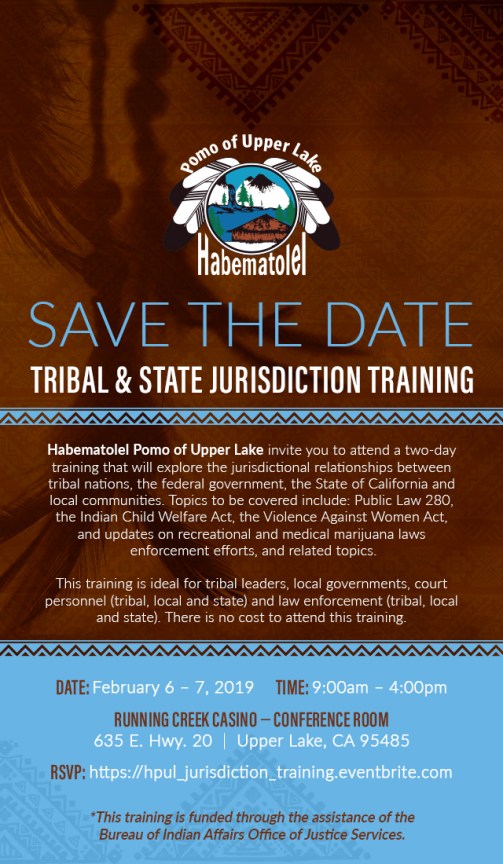
Click here for an agenda overview.
Here are the materials so far in Ute Indian Tribe v. McKee (D. Utah):
Update (5/6/19):
39-tribe-motion-for-default.pdf
Here is the opinion in Goodman v. Davis (S.D. Tex.):
 Turtle Talk
You must be logged in to post a comment.