Two Recent ICWA Articles

Here are two relatively recent law review articles on the Indian Child Welfare Act. First, Prof. Solangel Madonado published “Race, Culture, and Adoption: Lessons from Mississippi Band of Choctaw Indians v. Holyfield” in the Columbia Journal of Gender & Law. Prof. Maldonado is also the author of a chapter on Holyfield in Family Law Stories, from West. Here is an excerpt:

While the idea of allowing individuals to choose their racial, ethnic, or cultural identity based on their activities rather than biology has a certain appeal, it is difficult to imagine a court telling a person of African American descent that she is not really African American simply because she does not live in an African American neighborhood, have African American friends, or show interest in political issues that concern the African American community. Although political pundits and private citizens have suggested that Justice Clarence Thomas is “not really Black,” it is quite another thing for lawmakers to imply the same. Instead, we allow individuals to self-identify regarding race and ethnicity, regardless of their contact with the relevant community.

And another:

The willingness of Congress in enacting ICWA and the Court in Holyfield to consider social prejudices might also signal that antidiscrimination norms are much weaker in cases involving tribal Indians. The Supreme Court has held that, while societal biases might cause children emotional harm, the law cannot consider these biases when determining children’s best interests. However, ICWA’s drafters and the Holyfield court might have unwittingly given effect to such biases when they considered white communities’ rejection of Native American children and the potential psychological harm as a reason to keep them in Indian communities.

Another paper, by Daniel Albanil Adlong, called “The Terminator Terminates Terminators: Governor Schwarzeneggar’s Signature, SB 678, and How California Attempts to Abolish the Existing Indian Family Exception and Why Other States Should Follow“, published in the Appalachian Journal of Law, also discusses ICWA. Here is an excerpt:
Continue reading

Blumm and Steadman on the Judge Martinez Treaty Fishing Decision

Michael Blumm and Jane Steadman have posted “Indian Treaty Fishing Rights and Habitat Protection: The Martinez Decision Supplies a Resounding Judicial Reaffirmation” on SSRN. Here is the abstract:

In the mid-nineteenth century, as the pace of American westward expansion accelerated and tension between white settlers and indigenous tribes mounted, the federal government convinced many Pacific Northwest tribes to enter into treaties that would facilitate white settlement. In exchange for cession of millions of acres of their homeland, the tribes retained the right of taking fish at all usual and accustomed places in common with white settlers. In the 1905 case United States v. Winans, the United States Supreme Court explained that the treaty fishing right constitutes a “servitude upon every piece of land.” We have described this servitude as a “piscary profit,” a familiar property right at common law that must be exercised free from unreasonable interference. While the universally shared assumption at the time the treaties were signed was that the salmon resource was inexhaustible, in fact the salmon have been in precipitous decline since the late-1800s. This scarcity bred conflicts, which have forced the tribes to enforce their treaty fishing right in the courts for over a century.

Continue reading

Student Comment on Adam Walsh Act and Tribal Sovereignty

Brian Dimmer published “How Tribe and State Cooperative Agreements Can Save the Adam Walsh Act from Encroaching upon Tribal Sovereignty” in the Marquette Law Review. Here is an excerpt:

This Comment proposes that because the AWA threatens the tribal sovereignty of both non-Public Law 280 and Public Law 280 tribes, Congress should amend the AWA to require tribe and state cooperative agreements to carry out AWA sex offender registration and notification functions.

Federal Indian Law in Other Indian Country General Law Reviews

Here’s the last list promised. This is the same criteria applied to the rest of the general law reviews that are geographically linked to Indian Country, excluding the general law reviews in the top 75, which appears in the earlier list here:

  1. North Dakota (26) — Halldin (2008), Zuger (2007), Weber (2007), Martell and Deer (2005), Miller (2004), Leeds (2000), Bradford (2000), King (1999), Jones (1999), Stoner (1999), Scafidi (1999), Strommer & Jacobson (1999), Holcomb (1999), Jensen (1999), Wastewin (1999), Hakansson (1999), Jones (1997), Hakansson (1997), Rice (1996), Garnett (1996), Dineen (1994), Davis (1993), J. Jensen (1992), Jones (1992), Laurence (1992), Norgren (1988). 52 sympossium pieces and student notes.
  2. South Dakota (17) — Garry (2008), Kunesh (2007), Spruhan (2006), Leach (2005), Gardner (2002), Parsons and Woodward (1999-2000), Royster (1998), Marx et al. (1998), Zellmer (1998), Singer (1995-1996), Piersol (1995), Pacheco (1994), Duffy (1994), Pommersheim (1991), Gover et al. (1991), Lux (1991), Jeffrey (1990). 24 symposium pieces and student notes.
  3. Idaho (12) — McClatchey (2006), Miller (2005), Bluemel (2005), Echohawk (2004), Nash (2002), Wood (2000), Blumm (2000), Gunter (1998), Wilkinson (1998), McCarthy (1998), Randall (1995), Laurence (1991-1992). 9 student papers and symposium pieces.
  4. Montana (10) — Hanlon (2008), Meyring (2006), Struve (2000), Jensen (1999), Poore (1998), Pommersheim (1997), O’Brien (1995), Dumontier-Pierre (1995), Simpson (1993), Brown (1991). 6 symposium pieces and student papers.
  5. Tulsa (8) — Zimmerman (2005), Deer & Tatum (2003), Seielstad (2002), Schlosser (2001), Marsh (1997), Royster (1994), Chandler (1994), Bell (1984). Plus, 85 or more symposium pieces and student notes.
  6. Oklahoma City (6) — Fletcher (2006), Creel (2002), Wilkins (2000), Byram (2000), Arrow (1989), Arrow (1987). 27 student papers and symposium articles.
  7. UMKC (6) — Ragsdale (2003), Ragsdale (2001), Ragsdale (2000), Ragsdale (2000), Ragsdale (1996), Ragsdale (1990). 7 symposium pieces and student notes.
  8. Gonzaga (5) — McCann (2005-2006), Fletcher (2004-2004), Prince (1997-1998), Joranko (1993-1994), Oringer (1984-1985). 5 symposium pieces.
  9. Hamline (4) — Laughlin (2007), Kim (2002), Jarboe (1994), Lenertz (1994). 10 student notes and symposium pieces.
  10. William Mitchell (4) — Wahl (2000), Beach (2000), Jones (1998), Zehnder (1996). 6 symposium pieces, notes, and book reviews. Continue reading

Federal Indian Law in Top Specialized Journals

At the recommendation of some commentators on the post on general law reviews, here is a list of how often Federal Indian Law appears in articles published by top tier specialized journals (journals published by the top 15 law schools).

  1. Michigan Journal of Race & Law (7) — Fletcher (2007), Maillard (2007), Ray (2007), Gilden (2007), Grijalva (2006), Ragsdale (2004), Clarkson (2002). 5 student notes and 1 symposium piece (Tsosie 2005).
  2. Columbia Human Rights Law Review (6) — Idelman (2004), Fletcher (2003), Riley (2002), Dougherty (1998), Porter (1997), Pearce (1991). 2 student notes.
  3. Harvard Human Rights Journal (5) — Graham (2008), Anaya (2001), Duthu (2000), Weissner (1999), Berkey (1992)
  4. Univ. of Michigan Journal of Law Reform (4) — Fletcher (2005), Porter (1998), Pinkham (1997), Barsh (1993). 6 student notes.
  5. Stanford Environmental Law Journal (4) — Carpenter (2008), Wood (2008), O’Neill (2000), Harbison (1995). 2 symposium piece, 1 student note, and 1 book excerpt.
  6. Harvard Environmental Law Review (4) — Wood (2008), King (1994), Pacheco (1991), Ragsdale (1986). 1 student note.
  7. Yale Human Rights & Development Law Journal (3) — Cowan (2006), Porter (2002), Anaya (1998)
  8. Virginia Journal of Social Policy and the Law (3) — Rand/Light (2006), Rose (1999), Rand (1997).
  9. Cornell Journal of Law & Public Policy (2) — Hopkins (2004), Burton and Ruppert (1999). 4 symposium pieces.
  10. Harvard Journal on Legislation (2) — Fletcher (2007), Williams (1985). 1 student paper (Porter, 1990) Continue reading

Federal Indian Law in General Law Reviews

What are the chances, statistically, of an article focusing on Federal Indian Law being accepted and published by a general law review? Which law reviews published the most articles about Federal Indian Law in the last 30 years (at least according to WESTLAW, which goes back further for some journals than others)?

Here are the results of this not-so-scientific survey. The first list is of the top 75 or so law reviews (plus New Mexico and Geo. Mason, who can pretty strong claims to the top 75, even if their law reviews aren’t there yet), using the Wash & Lee current “combined” stats, ranked by the number of articles, published that are predominantly about Federal Indian Law, and using symposium pieces, book reviews, and student notes as a tie-breaker.

The number before the law review name is the W&L ranking, the number following the name is the number of stand-alone articles published, and the rest should be self-explanatory.

Top 75

  1. (62) Arizona State (25) — Miller (2008), Berger (2005), Washburn (2004), Nakai (2003), Goldberg (2003), Hannah (2003), Zellmer (2000), Pearson (2000), O’Melinn (1999), LaVelle (1999), Pommersheim (1999), Suagee (1999), Tsosie (1999), Epps (1998), Koehn (1997), Meteer (1996), Miller (1996), Royster (1995), Joranko (1994), Limas (1994), Zion (1993), Trope (1992), Marsh (1992), R. Johnson (1992), Strickland (1992). 31 other pubs.
  2. (132) New Mexico (11) — Kunesh (2007), Smith (2005), Laurence (1998), Lee (1998), Reynolds (1997), Alexander (1997), Strickland (1996), Rice (1996), Klein (1996), Limas (1996), Luna (1996). 27 student papers and symposium papers. and 1 postscript.
  3. (65) Oregon (9) — Rosser (2008), Wildenthal (2007), Krakoff (2004), Braveman (2003), Miller (2001), Cross (2000), Ansson (1999), King (1998), Laurence (1990). 9 other pubs.
  4. (48) Washington (8) — Riley (2005), R. Johnson (1992), R. Johnson (1991), Royster (1989), Wilkinson (1989), Canby (1987), Barsh (1984), Barsh (1981). At least 20 student pubs, and 9 symposium pieces and book reviews.
  5. (41) Arizona (7) — Rosser (2005), Dussias (2001), Laurence (2000), Cross (1998), Winslow (1996), Vetter (1994), Clinton (1990). Five student pubs. Seven symposium pieces and book reviews.
  6. (42) Colorado (6) — Pommersheim (2000), Blumm (1998), Mergen (1997), Smith (1990), Royster (1988), Getches (1988). Six student pubs. Ten symposium pieces and book reviews.
  7. (16) Minnesota (6) — Washburn (2008), Getches (2001), Atwood (1999), Frickey (1996), Joranko (1993), Worthen (1990), Three student pubs.
  8. (24) North Carolina (6) — Clarkson (2007), Washburn (2006), Dussias (1999), Reynolds (1995), Worthen (1993), Reynolds (1984). One student note.
  9. (67) Nebraska (6) — Fletcher (2006), Dussias (2005), Pollman (2004), Snowden (2001), Atwood (2000), Brietzke and Klein (1999). 2 student pubs.
  10. (13) UCLA (5 soon to be 6) — Carpenter (2005), Goldberg (2002), Coker (1999), Goldberg (1997), Atwood (1989). Berger has one article forthcoming in 2009. Five student pubs. Five symposium pieces and replies. Continue reading

New Book: Unearthing Indian Land — Living with the Legacies of Allotment

Kristin T. Ruppel (Montana State) has published “Unearthing Indian Land: Living with the Legacies of Allotment” from the University of Arizona Press. Here’s the blurb:

Unearthing Indian Land offers a comprehensive examination of the consequences of more than a century of questionable public policies. In this book, Kristin Ruppel considers the complicated issues surrounding American Indian land ownership in the United States.

Under the General Allotment Act of 1887, also known as the Dawes Act,individual Indians were issued title to land allotments while so-called “surplus”Indian lands were opened to non-Indian settlement. During the forty-seven years that the act remained in effect, American Indians lost an estimated 90 million acres of land—about two-thirds of the land they had held in 1887. Worse, the loss of control over the land left to them has remained an ongoing and insidious result.

Unearthing Indian Land traces the complex legacies of allotment, including numerous instructive examples of a policy gone wrong. Aside from the initial catastrophic land loss, the fractionated land ownership that resulted from the act’s provisions has disrupted native families and their descendants for more than a century. With each new generation, the owners of tribal lands grow in number and therefore own ever smaller interests in parcels of land. It is not uncommon now to find reservation allotments co-owned by hundreds of individuals.Coupled with the federal government’s troubled trusteeship of Indian assets,this means that Indian landowners have very little control over their own lands.

Illuminated by interviews with Native American landholders, this book is essential reading for anyone who is interested in what happened as a result of the federal government’s quasi-privatization of native lands.

It has one of the best lines I’ve ever read on allotment — “on the whip end of someone else’s crazy” — a Judge Sally Willett quotation.

Student Paper on Gaming and Environmental Law

The Boston College Environmental Affairs Law Review has published “Betting the Rancheria: Environmental Protections as Bargaining Chips Under the Indian Gaming Regulatory Act,” by Matthew Murphy. You can access the article here, but it begins on page 171 of the pdf, which takes some time to download. Here is the abstract:

In 2005, the State of California and the Big Lagoon Rancheria American Indian Tribe reached an agreement whereby the tribe agreed to forego development plans for a casino on environmentally sensitive lands in exchange for the right to build a casino in Barstow, California. In January 2008, the Department of the Interior denied the Rancheria’s land-into-trust application for land in Barstow based on the Department’s newly issued “commutable distance” memorandum. This denial represents a missed opportunity to allow California and the tribe to cooperate in fashioning a workable tribal-state compact. The Department should abandon the guidance memorandum and allow tribes to pursue off-reservation gaming in appropriate instances where the proposed development enjoys political support at the local level. In exchange, states should be afforded greater deference under the Indian Gaming Regulatory Act to achieve some level of regulatory control to address the off-reservation impacts of casino development.

“Factbound and Splitless” Today at UC-Berkeley Law School

I’ll be presenting “Factbound and Splitless” today at UC-Berkeley Law School. Here’s a taste….

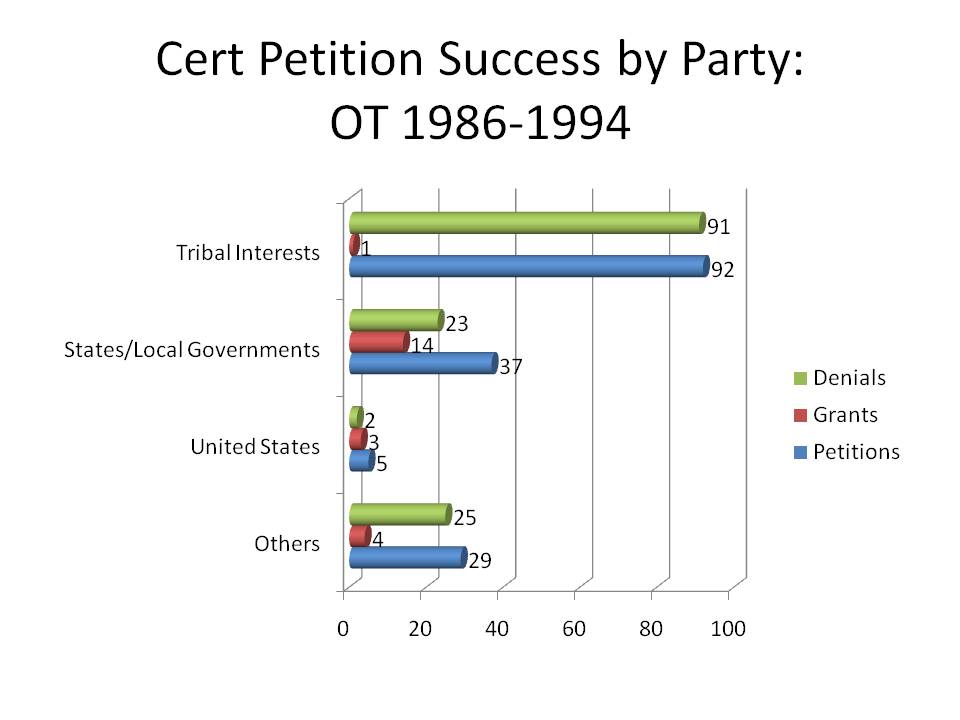
Cert Petition Success by Party -- OT 1986-1994

Tiya Miles on The Narrative of Nancy, a Cherokee Woman

Tiya Miles (University of Michigan) has published “The Narrative of Nancy, a Cherokee Woman” in the recent issue of Frontiers: A Journal of Women’s Studies (H/T Legal History Blog). From the intro:

On November 24, 1801, Nancy, “by appearance an Indian woman,” gave testimony at Fort Southwest Point, a garrison in eastern Tennessee established in 1792 to defend white settlements against Indian attack.1 In a statement recorded under the title “The Narrative of Nancy, A Cherokee Woman,” Nancy claimed that she had been wrongfully held as a slave in Virginia since the year 1778. At the time of her testimony, Nancy was approximately thirty one years old and living with a white man named, incredibly, Captain John Smith. Smith had purchased Nancy from John Fulton, who had bought her from William Kennedy. Nancy described the crime of her capture in graphic detail in the narrative, testifying that

[S]he was taken when a child from her mother, that the white people afterwards boasted that they held their guns over her mother’s head to frighten her when they took her away: that sometime afterwards she was carried a great way on horseback to a place where there were a number of houses . . . that she had two masters before Mr. Fulton bought her, that she had brothers and sisters when she was taken away from her mother, that she never saw any waters larger than the Tennessee and Clinch Rivers.

Continue reading