Federal Indian Law in Other Indian Country General Law Reviews

Here’s the last list promised. This is the same criteria applied to the rest of the general law reviews that are geographically linked to Indian Country, excluding the general law reviews in the top 75, which appears in the earlier list here:

  1. North Dakota (26) — Halldin (2008), Zuger (2007), Weber (2007), Martell and Deer (2005), Miller (2004), Leeds (2000), Bradford (2000), King (1999), Jones (1999), Stoner (1999), Scafidi (1999), Strommer & Jacobson (1999), Holcomb (1999), Jensen (1999), Wastewin (1999), Hakansson (1999), Jones (1997), Hakansson (1997), Rice (1996), Garnett (1996), Dineen (1994), Davis (1993), J. Jensen (1992), Jones (1992), Laurence (1992), Norgren (1988). 52 sympossium pieces and student notes.
  2. South Dakota (17) — Garry (2008), Kunesh (2007), Spruhan (2006), Leach (2005), Gardner (2002), Parsons and Woodward (1999-2000), Royster (1998), Marx et al. (1998), Zellmer (1998), Singer (1995-1996), Piersol (1995), Pacheco (1994), Duffy (1994), Pommersheim (1991), Gover et al. (1991), Lux (1991), Jeffrey (1990). 24 symposium pieces and student notes.
  3. Idaho (12) — McClatchey (2006), Miller (2005), Bluemel (2005), Echohawk (2004), Nash (2002), Wood (2000), Blumm (2000), Gunter (1998), Wilkinson (1998), McCarthy (1998), Randall (1995), Laurence (1991-1992). 9 student papers and symposium pieces.
  4. Montana (10) — Hanlon (2008), Meyring (2006), Struve (2000), Jensen (1999), Poore (1998), Pommersheim (1997), O’Brien (1995), Dumontier-Pierre (1995), Simpson (1993), Brown (1991). 6 symposium pieces and student papers.
  5. Tulsa (8) — Zimmerman (2005), Deer & Tatum (2003), Seielstad (2002), Schlosser (2001), Marsh (1997), Royster (1994), Chandler (1994), Bell (1984). Plus, 85 or more symposium pieces and student notes.
  6. Oklahoma City (6) — Fletcher (2006), Creel (2002), Wilkins (2000), Byram (2000), Arrow (1989), Arrow (1987). 27 student papers and symposium articles.
  7. UMKC (6) — Ragsdale (2003), Ragsdale (2001), Ragsdale (2000), Ragsdale (2000), Ragsdale (1996), Ragsdale (1990). 7 symposium pieces and student notes.
  8. Gonzaga (5) — McCann (2005-2006), Fletcher (2004-2004), Prince (1997-1998), Joranko (1993-1994), Oringer (1984-1985). 5 symposium pieces.
  9. Hamline (4) — Laughlin (2007), Kim (2002), Jarboe (1994), Lenertz (1994). 10 student notes and symposium pieces.
  10. William Mitchell (4) — Wahl (2000), Beach (2000), Jones (1998), Zehnder (1996). 6 symposium pieces, notes, and book reviews. Continue reading
Federal Indian Law in Top Specialized Journals

At the recommendation of some commentators on the post on general law reviews, here is a list of how often Federal Indian Law appears in articles published by top tier specialized journals (journals published by the top 15 law schools).

  1. Michigan Journal of Race & Law (7) — Fletcher (2007), Maillard (2007), Ray (2007), Gilden (2007), Grijalva (2006), Ragsdale (2004), Clarkson (2002). 5 student notes and 1 symposium piece (Tsosie 2005).
  2. Columbia Human Rights Law Review (6) — Idelman (2004), Fletcher (2003), Riley (2002), Dougherty (1998), Porter (1997), Pearce (1991). 2 student notes.
  3. Harvard Human Rights Journal (5) — Graham (2008), Anaya (2001), Duthu (2000), Weissner (1999), Berkey (1992)
  4. Univ. of Michigan Journal of Law Reform (4) — Fletcher (2005), Porter (1998), Pinkham (1997), Barsh (1993). 6 student notes.
  5. Stanford Environmental Law Journal (4) — Carpenter (2008), Wood (2008), O’Neill (2000), Harbison (1995). 2 symposium piece, 1 student note, and 1 book excerpt.
  6. Harvard Environmental Law Review (4) — Wood (2008), King (1994), Pacheco (1991), Ragsdale (1986). 1 student note.
  7. Yale Human Rights & Development Law Journal (3) — Cowan (2006), Porter (2002), Anaya (1998)
  8. Virginia Journal of Social Policy and the Law (3) — Rand/Light (2006), Rose (1999), Rand (1997).
  9. Cornell Journal of Law & Public Policy (2) — Hopkins (2004), Burton and Ruppert (1999). 4 symposium pieces.
  10. Harvard Journal on Legislation (2) — Fletcher (2007), Williams (1985). 1 student paper (Porter, 1990) Continue reading

Federal Indian Law in General Law Reviews

What are the chances, statistically, of an article focusing on Federal Indian Law being accepted and published by a general law review? Which law reviews published the most articles about Federal Indian Law in the last 30 years (at least according to WESTLAW, which goes back further for some journals than others)?

Here are the results of this not-so-scientific survey. The first list is of the top 75 or so law reviews (plus New Mexico and Geo. Mason, who can pretty strong claims to the top 75, even if their law reviews aren’t there yet), using the Wash & Lee current “combined” stats, ranked by the number of articles, published that are predominantly about Federal Indian Law, and using symposium pieces, book reviews, and student notes as a tie-breaker.

The number before the law review name is the W&L ranking, the number following the name is the number of stand-alone articles published, and the rest should be self-explanatory.

Top 75

  1. (62) Arizona State (25) — Miller (2008), Berger (2005), Washburn (2004), Nakai (2003), Goldberg (2003), Hannah (2003), Zellmer (2000), Pearson (2000), O’Melinn (1999), LaVelle (1999), Pommersheim (1999), Suagee (1999), Tsosie (1999), Epps (1998), Koehn (1997), Meteer (1996), Miller (1996), Royster (1995), Joranko (1994), Limas (1994), Zion (1993), Trope (1992), Marsh (1992), R. Johnson (1992), Strickland (1992). 31 other pubs.
  2. (132) New Mexico (11) — Kunesh (2007), Smith (2005), Laurence (1998), Lee (1998), Reynolds (1997), Alexander (1997), Strickland (1996), Rice (1996), Klein (1996), Limas (1996), Luna (1996). 27 student papers and symposium papers. and 1 postscript.
  3. (65) Oregon (9) — Rosser (2008), Wildenthal (2007), Krakoff (2004), Braveman (2003), Miller (2001), Cross (2000), Ansson (1999), King (1998), Laurence (1990). 9 other pubs.
  4. (48) Washington (8) — Riley (2005), R. Johnson (1992), R. Johnson (1991), Royster (1989), Wilkinson (1989), Canby (1987), Barsh (1984), Barsh (1981). At least 20 student pubs, and 9 symposium pieces and book reviews.
  5. (41) Arizona (7) — Rosser (2005), Dussias (2001), Laurence (2000), Cross (1998), Winslow (1996), Vetter (1994), Clinton (1990). Five student pubs. Seven symposium pieces and book reviews.
  6. (42) Colorado (6) — Pommersheim (2000), Blumm (1998), Mergen (1997), Smith (1990), Royster (1988), Getches (1988). Six student pubs. Ten symposium pieces and book reviews.
  7. (16) Minnesota (6) — Washburn (2008), Getches (2001), Atwood (1999), Frickey (1996), Joranko (1993), Worthen (1990), Three student pubs.
  8. (24) North Carolina (6) — Clarkson (2007), Washburn (2006), Dussias (1999), Reynolds (1995), Worthen (1993), Reynolds (1984). One student note.
  9. (67) Nebraska (6) — Fletcher (2006), Dussias (2005), Pollman (2004), Snowden (2001), Atwood (2000), Brietzke and Klein (1999). 2 student pubs.
  10. (13) UCLA (5 soon to be 6) — Carpenter (2005), Goldberg (2002), Coker (1999), Goldberg (1997), Atwood (1989). Berger has one article forthcoming in 2009. Five student pubs. Five symposium pieces and replies. Continue reading

New Book: Unearthing Indian Land — Living with the Legacies of Allotment

Kristin T. Ruppel (Montana State) has published “Unearthing Indian Land: Living with the Legacies of Allotment” from the University of Arizona Press. Here’s the blurb:

Unearthing Indian Land offers a comprehensive examination of the consequences of more than a century of questionable public policies. In this book, Kristin Ruppel considers the complicated issues surrounding American Indian land ownership in the United States.

Under the General Allotment Act of 1887, also known as the Dawes Act,individual Indians were issued title to land allotments while so-called “surplus”Indian lands were opened to non-Indian settlement. During the forty-seven years that the act remained in effect, American Indians lost an estimated 90 million acres of land—about two-thirds of the land they had held in 1887. Worse, the loss of control over the land left to them has remained an ongoing and insidious result.

Unearthing Indian Land traces the complex legacies of allotment, including numerous instructive examples of a policy gone wrong. Aside from the initial catastrophic land loss, the fractionated land ownership that resulted from the act’s provisions has disrupted native families and their descendants for more than a century. With each new generation, the owners of tribal lands grow in number and therefore own ever smaller interests in parcels of land. It is not uncommon now to find reservation allotments co-owned by hundreds of individuals.Coupled with the federal government’s troubled trusteeship of Indian assets,this means that Indian landowners have very little control over their own lands.

Illuminated by interviews with Native American landholders, this book is essential reading for anyone who is interested in what happened as a result of the federal government’s quasi-privatization of native lands.

It has one of the best lines I’ve ever read on allotment — “on the whip end of someone else’s crazy” — a Judge Sally Willett quotation.

Student Paper on Gaming and Environmental Law

The Boston College Environmental Affairs Law Review has published “Betting the Rancheria: Environmental Protections as Bargaining Chips Under the Indian Gaming Regulatory Act,” by Matthew Murphy. You can access the article here, but it begins on page 171 of the pdf, which takes some time to download. Here is the abstract:

In 2005, the State of California and the Big Lagoon Rancheria American Indian Tribe reached an agreement whereby the tribe agreed to forego development plans for a casino on environmentally sensitive lands in exchange for the right to build a casino in Barstow, California. In January 2008, the Department of the Interior denied the Rancheria’s land-into-trust application for land in Barstow based on the Department’s newly issued “commutable distance” memorandum. This denial represents a missed opportunity to allow California and the tribe to cooperate in fashioning a workable tribal-state compact. The Department should abandon the guidance memorandum and allow tribes to pursue off-reservation gaming in appropriate instances where the proposed development enjoys political support at the local level. In exchange, states should be afforded greater deference under the Indian Gaming Regulatory Act to achieve some level of regulatory control to address the off-reservation impacts of casino development.

“Factbound and Splitless” Today at UC-Berkeley Law School

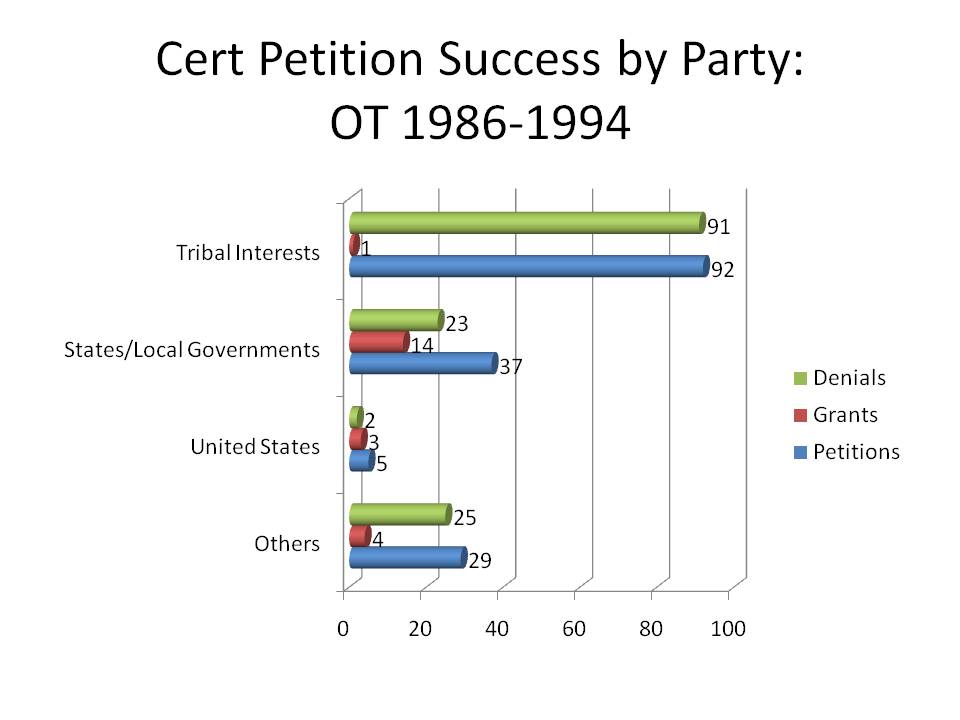
I’ll be presenting “Factbound and Splitless” today at UC-Berkeley Law School. Here’s a taste….

Cert Petition Success by Party -- OT 1986-1994

Tiya Miles on The Narrative of Nancy, a Cherokee Woman

Tiya Miles (University of Michigan) has published “The Narrative of Nancy, a Cherokee Woman” in the recent issue of Frontiers: A Journal of Women’s Studies (H/T Legal History Blog). From the intro:

On November 24, 1801, Nancy, “by appearance an Indian woman,” gave testimony at Fort Southwest Point, a garrison in eastern Tennessee established in 1792 to defend white settlements against Indian attack.1 In a statement recorded under the title “The Narrative of Nancy, A Cherokee Woman,” Nancy claimed that she had been wrongfully held as a slave in Virginia since the year 1778. At the time of her testimony, Nancy was approximately thirty one years old and living with a white man named, incredibly, Captain John Smith. Smith had purchased Nancy from John Fulton, who had bought her from William Kennedy. Nancy described the crime of her capture in graphic detail in the narrative, testifying that

[S]he was taken when a child from her mother, that the white people afterwards boasted that they held their guns over her mother’s head to frighten her when they took her away: that sometime afterwards she was carried a great way on horseback to a place where there were a number of houses . . . that she had two masters before Mr. Fulton bought her, that she had brothers and sisters when she was taken away from her mother, that she never saw any waters larger than the Tennessee and Clinch Rivers.

Continue reading

Brian Sawers on Tribal Land Corporations

Brian Sawers (Harvard Econ) has posted “Tribal Land Corporations: Using Incorporation to Combat Fractionalism” on SSRN. Here is the abstract:

Allotment has not provided individual Indians with economic opportunity; instead it has weakened tribal structures and shrunk the tribal land base. The administrative burden is significant, absorbing Federal monies that could be used elsewhere in Indian Country. In addition, transaction costs inhibit economic development and depress the returns to individual Indians. Congress has attempted to reduce fractionation through regulating devise and descent. Unfortunately, the Supreme Court has set off-limits the quickest mechanism for consolidating land ownership. However, any consolidation program that relies solely on inheritance will take decades to reduce fractionation.

Instead, tribes should rely on the incorporation and eminent domain to consolidate ownership and control of allotted lands in a tribal enterprise. Interests in allotted lands can be exchanged for shares in the TLC, limited the cost of formation. Eminent domain should be used to prevent uneven tender and quickly expand to an efficient scale. Since funds are limited, compensation for the taking of allotted interests should be interest of equivalent value in other parcels. The Rosebud TLE is just such a TLC, although with several structural defects imposed by the OIA. Even with weak shareholder control, the incentives facing the TLC are closer to the individual Indians than the BIA. Economic theory suggests that the TLC should provide better management of trust land.

Very interesting. My recollection is that one of the purposes of an IRA Section 17 corporation was to do exactly this.

Student Note on U.S. v. Washington Culverts Opinion

William Fisher has published “The Culverts Opinion and the Need for a Broader Property-Based Construct” in the Journal of Environmental Law and Litigation (Oregon). Here is a copy of the Culverts Opinion. Here is an excerpt:

The question becomes: Do treaties involve an affirmative duty for states to protect fish habitat and ensure quality fish runs? As discussed herein, a federal court has answered this question narrowly, yet affirmatively, failing to employ a property-based construct that encompasses all the rights reserved under the tribal treaties. Therefore, although the courts have recognized the existence of a duty, they have not yet recognized its entire scope.

Many theories have been advanced for how courts should interpret a state’s duties to protect fish habitat. Generally, treaty-invoked duties are analyzed under a contract-law paradigm. This is not erroneous, as treaties are said to be “contract[s] between sovereign nations.” However, when courts look at treaties only as contracts, they are missing one major aspect of tribal treaties: property rights. Not only are tribal treaties contracts between sovereigns, they are also deeds of property. Therefore, the bodies of law that are invoked by the formation of a tribal treaty include both contract law and property law. However, despite the promising answers property law provides for treaty interpretation, many judges have shown discomfort at the idea of applying property-based constructs to interpret states’ and tribes’ duties and rights under such treaties. Some feel that the formalistic rules of property law do not contain enough elasticity to be molded within the Indian law context. For example, when the Ninth Circuit used a property-law analogy to enforce tribes’ rights to take fish from the Columbia River, Judge Kennedy concurred in the holding but objected to the court’s use of this analogy, arguing that it was not an exact fit. What Judge Kennedy failed to recognize was that courts can and should apply the basic models of a property-based construct to analyze treaty rights, even where every jot and tittle may not line up. Refusing to do so is to turn a blind eye to the fact that treaties are deeds of property, and as such, invoke the rules of property law.

TOMORROW: ILPC February Spring Speakers Event

Justin Richland will be talking about his book, “Arguing with Tradition: The Language of Law in Hopi Tribal Court” with Hon. JoAnne Gasco responding and commenting. The event is tomorrow, February 17th, in the Castle Board Room (third floor of the Law College Building) starting at 11am. Lunch will be served.