New Scholarship on the UNDRIP’s Article 31 on Intellectual Property Rights

The United Nations Declaration on the Rights of Indigenous Peoples: A Human Rights Framework for Intellectual Property Rights, now posted in SSRN, will appear in A Research Handbook on Indigenous Intellectual Property, Edward Elgar (2014).

Here is the abstract:

The UN Declaration on the Rights of Indigenous Peoples (Declaration) establishes, in Article 31, that indigenous peoples ‘have the right to maintain, control, protect and develop their intellectual property over their cultural heritage, traditional knowledge, and traditional cultural expressions.’ In light of the centrality of the Declaration in the realm of indigenous rights, Article 31 represents the reference point for any credible discussion of the interlink between the cultural and intellectual property rights of indigenous peoples. This chapter seeks to contextualize this important provision within the normative framework of the Declaration. The first part of the chapter will examine the legal and political significance of the Declaration, discussing the circumstances surrounding its drafting and adoption as well as its normative content. The second part of the chapter will focus on the key provisions of the Declaration that are closely connected with indigenous peoples’ intellectual property rights, including those on self-determination and land rights. Special attention will be paid to the content of Article 31 of the Declaration, highlighting the progressive character of this provision in relation to the intellectual property rights regime currently in force at the international level.

Reminder: Spring Speakers Series with Bruce Duthu and Allison Dussias Tomorrow

The event is tomorrow at 2pm in the Castle Board Room.

Here.
13-I&P-35 ILPC Spring Speaker Series Flyer (1)

You can read more about Prof. Duthu’s book here.

Barbara Lane Walks On

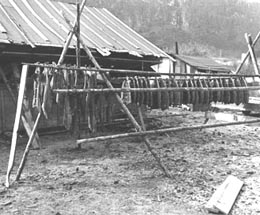
We learned the terrifically sad news that Barbara Lane, the legendary and heroic anthropologist that served as the lead expert witness in the United States v. Washington trial that led to the Boldt decision passed away late last year. Celilo_Village_Salmon

In her honor, we dug up a rare copy of a short article she published in the now-defunct American Indian Journal that summarized some of her written testimony. Here:

Background of Treaty Making in Western Washington

And, of course, the Boldt decision itself:

384_F.Supp._312

UPDATE — we have her obituary now:

Barbara Lane, one of the foremost experts in First Nations anthropology and Native American rights, passed away on December 31, 2013 in Arlington, Washington. Dr. Lane produced exceptional expert reports and testimony in more than 40 court cases, many of which were pivotal in determining the rights of native peoples to access and use natural resources. The United States federal courts that ruled on treaty fishing rights in the Northwest relied heavily on her testimony. Her work was instrumental for the Quinault and other Washington Tribes in numerous treaty fishing rights cases related to the 1974 Boldt Decision (U.S. vs Washington) and for the Quinault in Mitchell vs U.S. in 1977. The United States Supreme Court referenced her findings in affirming the key decision on Northwest treaty rights. (I.e. the “Boldt” Decision.) She also served as an expert witness in cases involving fisheries and land claims of Canadian First Nations. Her work was well known and respected by Indigenous Peoples, the academic community, and legal circles. She was retained as the U.S. Federal Court of Oregon expert in U.S. v. Oregon in 1991.

Barbara was a member of the Society for Applied Anthropology, the Canadian Sociological and Anthropological Association, and the American Ethnological Society. During her illustrious career, she held many research, editorial and administrative positions. Although she authored numerous publications, she often preferred to do her work without seeking public recognition.

She received an A.B. and M.A. from the University of Michigan in the late 1940’s and earned a PhD from the University of Washington in 1953. Barbara held faculty positions at the Universities of Washington, Hawaii, Pittsburg, British Columbia, Victoria and Western Washington University. In 2006, Barbara was awarded an honorary Doctor of Law Degree from the University of Victoria for her expertise and contributions to First Nations anthropology and rights.

Her career took her to far reaches of the world, including Postdoctoral Study at the Australian National University from 1953-1954 and work with Coast Salish peoples, India, and Vanuatu. Much of her early work was done in professional partnership with her Husband, Robert who predeceased her.

As Director for the Quinault Indian Bicentennial Project from 1976-1977, she provided guidance and direction for creating an historical record for the people and culture of the Quinault Nation. This work led to the publication of the Handbook on Legislation and Litigation Affecting the Quinault Reservation and established an invaluable core of records for the Quinault Historical Foundation (now called the Quinault Cultural Center).

Her home and office was located in Victoria, British Columbia for many years. Barbara is survived by a son, two daughters and one grandchild.

New Scholarship on Land Appropriation from Indigenous Peoples and Energy Resources

The Energy Law Journal has published “Land in the Second Decade: The Evolution of Indigenous Property Rights and the Energy Industry in the United States and Brazil” by Danielle C. Davis.


Fletcher & Reo Response Paper to Sanders on the Wisconsin Wolf Hunt

Matthew Fletcher & Nick Reo published a short paper, “Response to Sanders: Ma’Iignan as Property,” at the Wisconsin Law Review Online. Jason Sanders’ excellent law review note that started all this is here.

Here is an excerpt:

American law has long recognized the state as the owner of wild game within a state’s borders, including gray wolves (or “ma’iingan” in Anishinaabemowin), within the States of Wisconsin, Minnesota, and Michigan. However, as Anishinaabe scholar Jason Sanders forcefully demonstrates, the Anishinaabeg—indigenous people of the western Great Lakes known as the Ottawa (Odawa), Potawatomi (Bodewadmi), and Chippewa (Ojibwe)—considered ma’iingan siblings, not property. One does not hunt one’s siblings.
***
Sanders’s paper is a fine example of cutting edge, pragmatic legal scholarship that will allow the stakeholders, in time, to push through the adversarial rhetoric and move into a more useful cooperative mode. Federal Indian law, often through the assertion of American Indian treaty rights, has historically been a powerful engine for change. Treaty rights cases arising from Anishinaabeg treaties often do not result in a winner-take-all outcome, with either tribes or states prevailing over all opponents. Instead, the rule of law as exemplified by Indian treaty rights forces state interests to reckon with the interests of a discrete and insular minority. As such, regulation of hunting, fishing, gathering, and other activities on or near Indian country is an intergovernmental affair, dominated by cooperative fact finding and negotiation.


Fletcher: “A Unifying Theory of Tribal Civil Jurisdiction”

Please see “A Unifying Theory of Tribal Civil Jurisdiction” on SSRN. Here is the abstract:

This paper addresses one of the most dynamic and useful areas of American Indian law. I situate my arguments between two competing and intractable theories dominating the field – the consent theory, which limits tribal jurisdiction to those who expressly consent to tribal governance; and the territory theory, which expands tribal jurisdiction to anyone in Indian country. The consent theory unnecessarily undercuts tribal authority on Indian lands, assuming without evidence that nonconsenters will not receive a fair shake in tribal forums. Meanwhile, the territory theory unnecessarily exposes nonconsenters to Indian authority on non-Indian owned land, where tribal power is weakest and least justified.

I propose a simpler solution that unites the two theories and brings realism to the discussion. Where activities occur on Indian lands, tribal jurisdiction should be presumed subject to a simple fairness test any court could conduct, but that is currently (and ironically) barred by the Supreme Court. The reality is that tribal governments are already successfully exercising this power, but the common law is lax in its recognition of tribal governance, generating unpredictability and confusion.

Substantive comments welcome.

Arctic Law Symposium Articles Available Online

Articles from the 2013 Arctic Law Symposium held at Michigan State University College of Law have been published in the Michigan State International Law Review. Included in this volume are several articles specifically addressing how Indigenous peoples may be impacted by the current changes and developments in the region including:

Closing the Citizenship Gap in Canada’s North: Indigenous Rights, Arctic Sovereignty, and Devolution in Nunavut
Tony Penikett and Adam Goldenberg

Risk, Rights and Responsibility: Navigating Corporate Responsibility and Indigenous Rights in Greenlandic Extractive Industry Development
Rutherford Hubbard

Legal Questions Regarding Mineral Exploration and Exploitation in Indigenous Areas
Susann Funderud Skogvang

Permanent Sovereignty over Natural Resources from a Human Rights Perspective: Natural Resources Exploitation and Indigenous Peoples’ Rights in the Arctic
Dorothée Cambou and Stefaan Smis

Climate Change, Indigenous Peoples and the Arctic: The Changing Horizon of International Law
Sumudu Atapattu

Link to the the full issue here.

Link to previous coverage here.

New Scholarship on Mapping Intergenerational Memories

Robert Hershey, Jennifer McCormack, and Gillian E. Newell have posted “Mapping Intergenerational Memories (Part I): Proving the Contemporary Truth of the Indigenous Past” on SSRN.

Here is the abstract:

How Indigenous communities choose to represent spaces or spatial information is integral to constructing and archiving cultural memory, articulating current environmental use, and dealing with evidentiary issues for title or land claim cases. For Indigenous communities around the world, the legacy of Western (often, colonial) cartography and spatial theory is disconnected from the many distinct narratives of space (and time) in Native communities.

Specifically in legal situations, this disconnect often reflects a power struggle between a Western, Cartesian division of space and time, and a relational, dynamic capitulation of space and time by an Indigenous group. Indigenous communities attempting to utilize Western legal forums for recognition of their rights face evidentiary hurdles caused by the ethnocentrism inherently built into legal systems. Although exceptions exist to hearsay rules, which allow oral history to be admitted as evidence and are common in multiple jurisdictions, fact finders are not comfortable placing conclusive weight on intergenerational memories. This discomfort is based on Western society’s ideas about what constitutes reality and reliability and results in Indigenous communities being held to strictly Western and often overly lineal principles. Indigenous communities need concrete methods to bring their intergenerational memories into Western courtrooms and have lawyers and judges receive and understand these fully and from an Indigenous standpoint.

Fletcher Paper on “Tribal Justice Systems”

I drafted a paper titled “Tribal Justice Systems” for the Allegheny College Undergraduate Conference “Democracy Realized? The Legacies of the Civil Rights Movement” and posted it on SSRN. You can download here.

Here is the abstract:

This short paper is produced for the Allegheny College conference Democracy Realized? The Legacies of the Civil Rights Movement (March 28-29, 2014).

United States Supreme Court Justice Hugo Black, a former member of the Ku Klux Klan, authored the Court’s opinion in Williams v. Lee, a decision hailed as the opening salvo in the modern era of federal Indian law. The Williams decision was the work of the liberal wing of the Court, with important input by Chief Justice Warren and Justices Brennan and Douglas. Williams, a ringing endorsement of inherent tribal governance authority, more specifically endorsed tribal justices systems as embodied in tribal courts. Without Williams and similar cases, it is unlikely that tribal governments and Congress would act to develop tribal justice systems. Williams, and the tribal courts that arose as a result, was a powerful civil rights decision that commentators rightfully have linked to Brown v. Board of Education.

This paper will survey several tribal justice systems in an effort to identify commonalities and complexities. There are hundreds of tribal justice systems in the United States; each of them unique in the details, but many of them similar to other tribal, state, and federal courts.

The paper is divided into three sections. The first two parts include a section on adversarial tribal justice systems and a section on non-adversarial tribal justice systems, often called restorative justice systems. The third part involves greater discussion of the complexities of incorporating tribal customary and traditional law into tribal common law.

In case one wonders, “Representing Justice” by Judith Resnik and Dennis Curtis influenced the paper.


Indian Law Resource Center Report on Tribal Capacity for Enhanced Sentencing

Report here.

The Indian Law Resource Center recently released, Restoring Safety to Native Women and Girls and Strengthening Native Nations ─ A Report on Tribal Capacity for Enhanced Sentencing and Restored Criminal Jurisdiction. The report examines existing literature on the readiness among Indian nations to exercise enhanced sentencing authority under TLOA and fuller criminal jurisdiction over all perpetrators of violent crimes under VAWA 2013 or other future legislation. It also identifies challenges facing Indian nations in exercising such authority and how some Indian nations are moving forward to increase their capacity to safeguard Native women in their communities. The report, available at http://indianlaw.org/content/restoring-safety-native-women-and-girls-and-strengthening-native-nations, concludes with ten recommendations aimed at ending violence against Native women and girls and strengthening the ability of Indian nations to address this crisis. We hope that the report will guide the Center, and perhaps others, in better assisting Indian and Alaska Native nations to make their communities safe places.