New Study: “Indian Tribal Government Access to Tax-Exempt Bond Financing”

Edith Brashares and Siobhan O’Keefe have posted “Indian Tribal Government Access to Tax-Exempt Bond Financing” on SSRN.

Here is the abstract:

While prior research focuses on Federal assistance to Native American tribal governments through spending programs, we examine tax incentive use by tribes. Tribal governments can issue tax-exempt bonds where the interest rates are lower because the Federal government does not tax bondholder on the interest they receive. To provide context, we briefly summarize the tax rules for tax-exempt bonds and describe tribal tax-exempt borrowing between 1987 and 2010. These data have not been published previously. Unlike most studies of tax-exempt bonds that examine how much is borrowed, we start by modeling the decision of a tribal government to borrow using tax-exempt bonds. We find tribes with resources, either gaming income or royalties, but that have members in need are more likely to borrow using tax-exempt bonds. Of those tribes that do borrow, the amount increases with the interest rate spread relative to Treasuries, gaming income and per capita income.

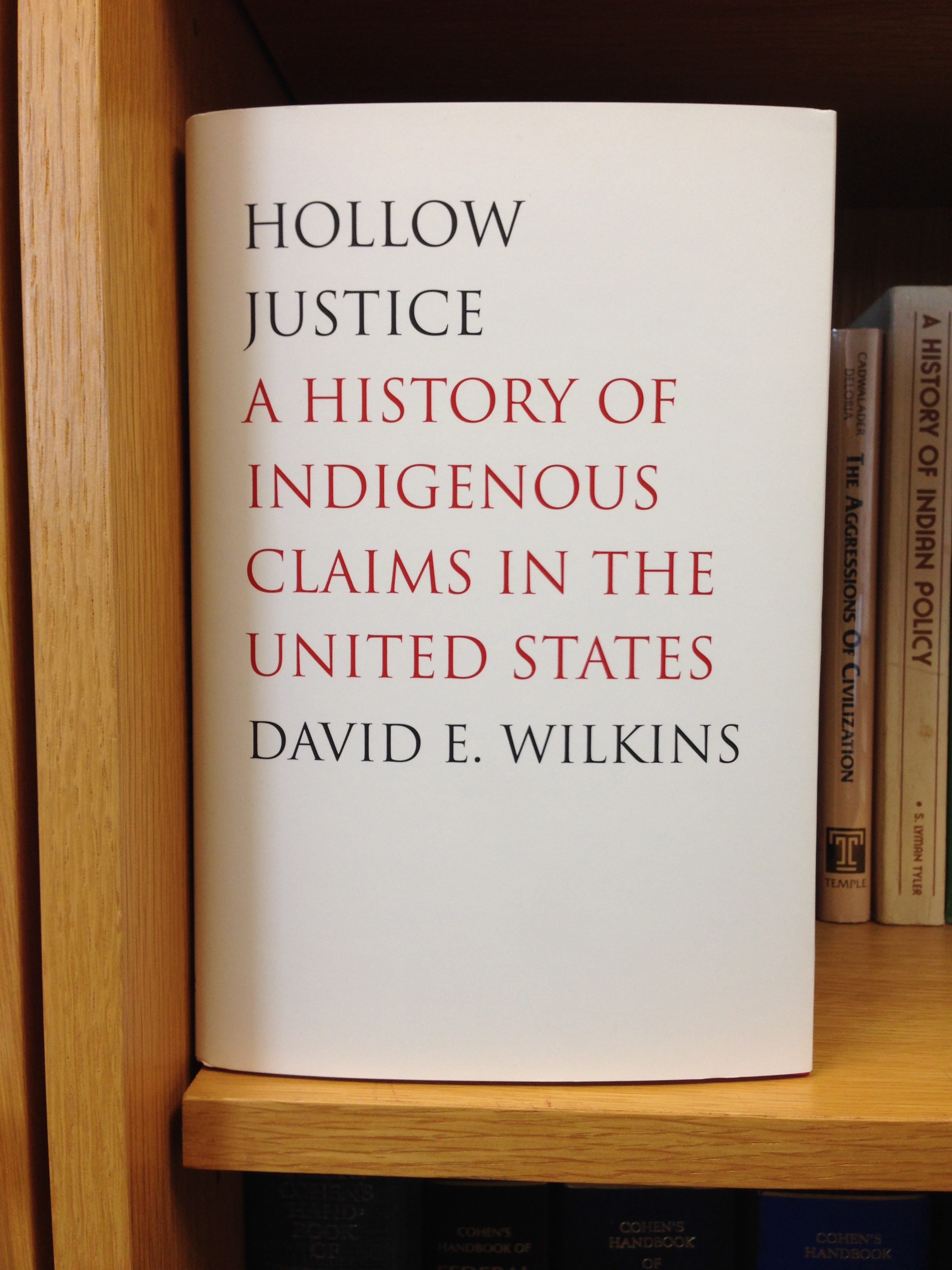
Recommended Winter Break Reading — David Wilkins’ “Hollow Justice”

Good stuff. Here:

Hollow Justice

New Scholarship on Zablocki v. Red Hail

Tonya L. Brito, Raymond Kirk Anderson, and Monica Ashley Wedgewood have posted “Chronicle of a Debt Foretold: Zablocki v. Red Hail, 434 U.S. 374 (1978),” on SSRN. Here is the abstract:

Zablocki v. Red Hail is a canonical case in family law jurisprudence. One of the few Supreme Court decisions addressing the fundamental right to marry, the case involves a successful challenge to Wisconsin’s “permission to marry” statute. However, the conventional understanding of the case addresses only part of the story. The narrative threads uncovered as part of this oral history research study reveal a more multifaceted and complicated story than has been previously appreciated. The story behind Zablocki v. Red Hail spans the 1970s in Milwaukee, a period of great inequality and dynamic social change. It also engages the American Indian experience in the United States, particularly the experience of urban Indians who have been uprooted from their native lands and disconnected from their heritage and history. Finally, although Zablocki v. Red Hail was a significant constitutional victory, the ruling did not secure justice for Roger Red Hail because the pursuit of a rights-based claim left standing an economically unjust (and apparently unending) child support order.

Highly recommended!

Top 10 American Indian Law Articles by 2013 SSRN Downloads

“American Indian law” excludes a lot of great work on the Indigenous peoples of Canada, Australia, New Zealand, and other nations. And counting only 2013 downloads prejudices recent postings. Oh, and this count is from Dec. 20, 2013. Oh well.

‘Whatever Tribal Precedent There May Be’: The (Un)Availability of Tribal Law
Law Library Journal (Forthcoming), Univ. of Wisconsin Legal Studies Research Paper No. 1227
Bonnie J. Shucha
University of Wisconsin Law School
Date Posted: August 13, 2013
Last Revised: November 12, 2013
Accepted Paper Series
306 downloads

The Savage Constitution
Duke Law Journal, Forthcoming
Gregory Ablavsky
University of Pennsylvania Law School
Date Posted: March 09, 2013
Last Revised: April 19, 2013
Accepted Paper Series
191 downloads

Lawyering for Groups: The Case of American Indian Tribal Attorneys
Fordham Law Review, Vol. 81, No. 3085, 2013, U Denver Legal Studies Research Paper No. 13-24
Kristen A. Carpenter and Eli Wald
University of Colorado Law School and University of Denver Sturm College of Law
Date Posted: April 22, 2013
Last Revised: May 01, 2013
Accepted Paper Series
188 downloads

The Vanishing Indian Returns: Tribes, Popular Originalism, and the Supreme Court
St. Louis University Law Journal, Vol. 57, No. 297, 2013, MSU Legal Studies Research Paper No. 11-06
Kathryn Fort
Michigan State University – College of Law
Date Posted: March 21, 2013
Last Revised: April 27, 2013
Accepted Paper Series
123 downloads

The Jurisgenerative Moment in Indigenous Human Rights
California Law Review, Vol. 102, 2014
Kristen A. Carpenter and Angela Riley
University of Colorado Law School and University of California, Los Angeles (UCLA)
Date Posted: March 18, 2013
Last Revised: March 19, 2013
Accepted Paper Series
114 downloads

The Right to Counsel for Indians Accused of Crime: A Tribal and Congressional Imperative
Michigan Journal of Race & Law, Vol. 18, p. 317, Spring 2013
Barbara Creel
University of New Mexico School of Law
Date Posted: May 17, 2013
Accepted Paper Series
113 downloads

Hot Pursuit into Indian Country: What Are the Limits?
University of Utah College of Law Research Paper No. 8
Alexander Tallchief Skibine
University of Utah – S.J. Quinney College of Law
Date Posted: January 14, 2013
Last Revised: March 26, 2013
Working Paper Series
108 downloads

Wolves, Lone and Pack: Ojibwe Treaty Rights and the Wisconsin Wolf Hunt
Jason Sanders
University of Wisconsin Law School
Date Posted: November 03, 2013
Working Paper Series
104 downloads

Creeping Normalcy: Fractionation of Indian Land Ownership
GMU Working Paper in Economics No. 13-28, PERC Research Paper No. 13-9
Jacob W Russ and Thomas Stratmann
George Mason University and George Mason University – Buchanan Center Political Economy
Date Posted: November 13, 2013
Last Revised: December 07, 2013
Working Paper Series
103 downloads

Examining Tribal Environmental Law
Elizabeth Ann Kronk Warner
University of Kansas – School of Law
Date Posted: September 08, 2013
Working Paper Series
101 downloads

Beyond Uniqueness: Reimagining Tribal Courts’ Jurisdiction
California Law Review, Vol. 101, December 2013, UC Davis Legal Studies Research Paper No. 350
Katherine J. Florey
University of California, Davis
Date Posted: February 27, 2013
Last Revised: August 26, 2013
Accepted Paper Series
101 downloads

Well, that’s the top 10 (well, 11 since there was a tie at 101 downloads). Here are a few that didn’t quite make the cut:

Continue reading

Katherine Florey on Tribal Court Jurisdiction

Katherine Florey has published “Beyond Uniqueness: Reimagining Tribal Courts’ Jurisdiction” (PDF) in the California Law Review. The abstract:

If there is one point about tribal status that the Supreme Court has stressed for decades, if not centuries, it is the notion that tribes as political entities are utterly one of a kind. This is to some extent reasonable; tribes, unlike other governments, have suffered the painful history of colonial conquest, making some distinctive treatment eminently justifiable. But recent developments have demonstrated that, for many tribes, uniqueness has its disadvantages. In the past few decades, the Supreme Court has undertaken a near-complete dismantling of tribal civil jurisdiction over nonmembers. Under current law, tribes have virtually no authority to permit nonmembers to be haled into tribal courts-even when nonmembers have significant ties to the tribe and have come onto the reservation for personal gain. Tribal uniqueness has thus come to include tribes’ singular inability to exercise jurisdiction over nonmembers, despite the reality that people and commerce move freely across tribal and nontribal land. 

This is a mistake. Tribal court jurisdiction has much in common with broader notions of personal jurisdiction, and the Court’s failure to recognize this commonality limits and distorts its analysis. Indeed, no good reason exists why current personal jurisdiction doctrines could not be adapted to encompass the issues that tribal court jurisdiction presents; that is true even if one concedes various premises of the Court’s opinions, such as the idea that it is inherently burdensome in most cases for nonmembers to defend in tribal court. Personal jurisdiction doctrine is perfectly suited to addressing the often-complex fact patterns that characterize modern disputes involving Indian country because minimum contacts analysis allows courts to take a nuanced, flexible view of the degree of connection between the defendant and the forum. For these reasons, this Article argues that limitations on tribal court jurisdiction over nonmembers should be recharacterized as limits on personal jurisdiction. This would both harmonize tribal courts’ jurisdiction with that of federal and state courts, and do a better job than current doctrine in balancing the legitimate interests of both tribes and nonmember defendants.

Wisconsin Law Review Publishes Jason Sanders’ “Wolves, Lone and Pack: Ojibwe Treaty Rights and the Wisconsin Wolf Hunt”

Jason Sanders has published “Wolves, Lone and Pack: Ojibwe Treaty Rights and the Wisconsin Wolf Hunt” in the Wisconsin Law Review.

Here is the abstract:

In 2012, Wisconsin authorized the first state hunt of gray wolves. Wisconsin’s interest in wolf depredation is legitimate: the growth in wolf population has exponentially increased human-wolf conflicts and state expense. Yet, Wisconsin shares these wolves; 83 percent of gray wolves reside on Ojibwe reservations or on territory ceded by the Ojibwe, where the Tribes still have resource rights. The Tribes vehemently oppose the wolf hunt. The Ojibwe maintain a strong cultural kinship with wolves and have traditionally prohibited wolf hunting. The Tribes named wolves a “tribally protected species,” asserting a right to protect all the wolves shared with Wisconsin. Historically, the Tribes and the State cooperatively managed shared resources. However, the State initiated the wolf hunt despite tribal protestations, instigating the first break from cooperative management in decades. Both sovereigns have legitimate and conflicting interests and appear to risk their first major treaty rights litigation in decades.

This Comment analyzes the extent of each sovereign’s wolf rights in light of biological research and existing Indian law precedents. The first issue is the scope of the State’s obligation to respect the Tribes’ sovereign rights to protect and perpetuate reservation wolf packs. The second issue is the extent of the Tribes’ rights to protect ceded-territory wolves away from reservations. This Comment argues that the Tribes can protect and perpetuate reservation wolves as a component of inherent sovereignty. Wisconsin must implement a wolf policy that respects that sovereignty, including a hunt-free “buffer zone” of some wolf territory directly adjoining the reservation. However, the Tribes’ claim to protect all shared wolves is untenable, as tribal rights over wolves away from the reservation are much weaker. But the Tribes have rights correlated to those wolves and are entitled, at minimum, to a policy that ensures species survival; additionally, the Tribes can consider other options to protect wolves. Ultimately, this Comment proposes that both sovereigns can and should resolve this conflict through negotiation, continuing the tradition of cooperative management, and avoiding lengthy and expensive litigation.

Nick Reo and myself have a short response to the paper coming out in the online version of the Wisconsin Law Review soon.

New Scholarship on Fracking Near Indian Country

Heather Williams and Hillary M. Hoffman have posted “Fracking Near Indian Country: The Federal Trust Relationship, Tribal Sovereignty, and the Right to Clean Water,” forthcoming in the Wyoming Law Review, on SSRN.

Here is the abstract:

The tortured history of the federal and state governments’ relationships with Native American tribes has created a legal structure in which Native American people are, quite frequently, the recipients of non-native waste generated off of native lands. Traditionally, this has taken the form of solid waste, but in recent years, it has grown to include nuclear waste and wastewater generated by hydraulic fracturing, otherwise known as “flowback fluids”, or “produced water.”

Over the last two years, produced water from four different hydraulic fracturing operations was found being discharged onto dry land and into “streambeds covered in white crystals,” on the Wind River Reservation in central Wyoming. In addition to the open dumping of these fluids, there was also visible oil and foam sheen. Pollution events like these are the result of a regulatory exemption under the Resource Conservation and Recovery Act (“RCRA”), commonly referred to as the “livestock loophole.” The livestock loophole, created in 1979, allows oil and gas operations to discharge hazardous waste fluids generated from fracking operations onto reservation land if they are consumed by livestock and wildlife, or used for agricultural purposes. The EPA, which regulates RCRA and has a fiduciary responsibility toward Indian Tribes, has not set maximum levels for many compounds used in the drilling process, and uses antiquated data to regulate toxics that have been capped. Further, industrial “trade secrets” prohibit the disclosure of additional toxics in drilling fluids under intellectual property laws, making it impossible to regulate pollution limits for surface waters under the Clean Water Act’s National Pollution Discharge Elimination System (NPDES).

The policy behind the livestock loophole is complex. Reports of gushing streams of toxic fracking fluids on reservation land reek of environmental injustice, yet tribes, as sovereign governments, are willing, able, and informed participants in the solicitation, installation, and placement of non-native waste on their own tribal lands.

Several questions arise out of the issues faced by the Wind River tribes: Is the federal policy to dump fracking fluids in Indian country consistent with its federal trust obligation, and its requirement under RCRA to protect human health and safety from toxic compounds? Is the livestock loophole’s policy to feed fracking fluids to livestock, wildlife, and agriculture a legitimate beneficial use under the Prior Appropriation doctrine? Should the EPA be forced to conduct up-to-date studies on the compounds in produced water, and their effects on living organisms, including humans? This Article will answer those questions and explore the bounds of tribal sovereignty and the federal trust responsibility in the context of produced water from fracking operations.

Fletcher Paper on the Seminole Tribe and the Origins of Indian Gaming

At the invitation of Alex Pearl and the FIU Law Review to write a symposium piece on Florida Indian history and law, a challenge for me since I know very little about it, I came up with “The Seminole Tribe and the Origins of Indian Gaming.” Assuming the law review finds it publishable, it will appear in the FIU Law Review alongside the work of luminaries like Siegfriend Weissner and Sarah Krakoff.

Here is the abstract:

The Seminole Tribe of Florida has played perhaps the most important role in the origins and development of Indian gaming in the United States of any single tribe. The tribe opened the first tribally owned high stakes bingo hall in 1979. The tribe in 1981 was involved in one of the earliest lower court decisions forming the basis of the legal theory excluding most states from the regulation of high stakes bingo, a theory that Congress largely codified in the Indian Gaming Regulatory Act (IGRA) years later. The tribe was a party to the Supreme Court decision in 1996 that radically altered the bargaining power between tribes and states over the negotiation and regulation of casino-style gaming under IGRA. And more recently, the tribe has been a leading participant in negotiations and litigation over the regulatory landscape of Indian gaming after the 1996 decision. The Tribe is one of the most successful Indian gaming tribes in the nation.

This paper traces that history, but also offers thoughts on how the culture and traditional governance structures of the Seminole Tribe played a part in its leadership role in the arena of Indian gaming.

Important New Scholarship on Muscogee Tribal Jurisprudence

Sarah Deer and Cecelia Knapp have published “Muscogee Constitutional Jurisprudence: Vhakv Em Pvtakv (The Carpet Under The Law)” in the Tulsa Law Review. The paper is also available on SSRN.

The abstract:

In 1974, a group of Mvskoke citizens from Oklahoma sued the federal government in federal court. Hanging in the balance was the future of Mvskoke self-determination. The plaintiffs insisted that their 1867 Constitution remained in full effect, and that they still governed themselves pursuant to it. The United States argued that the constitution had been nullified by federal law passed in the early 1900s.

To find in favor of the plaintiffs, the court would have to rule that the United States had been ignoring the most basic civil rights of Mvskoke citizens and flouting the law for over seventy years. It would also have to find that a tribal government had been operating legitimately in the shadows—that the Mvskoke people had continued to operate under their constitution for most of the twentieth century despite official federal antagonism. It was definitely a long shot, but they won.

This article explores factors that have helped the Mvskoke people create, nurture, and sustain a constitutional government under hostile circumstances for centuries. We focus on the history and structure of the constitutional government of the Muscogee (Creek) Nation of Oklahoma. We consider several aspects of Creek conceptions of government structure and balance, which are also evidenced in the constitutional jurisprudence of the Muscogee (Creek) Nation Supreme Court. At first glance, the contemporary Mvskoke government today bears little resemblance to the ancient etvlwv town-based system of governance, but a more penetrating analysis reveals common threads of political theory and cosmogony, or world view, that have continued unabated.

Highly recommended!

Troy Eid Review of Case & Voluck’s “Alaska Natives and American Laws, 3rd Ed.”

Troy A Eid has published a book review (PDF) of Alaska Natives and American Laws, by David S. Case and David A. Voluck, published in the Alaska Law Review.

An excerpt:

Alaska Natives and American Laws—”Case-Voluck,” for short—has been called the Alaskan equivalent of the late Felix Cohen’s Handbook of Federal Indian Law (“Cohen’s Handbook”), the Bible of the profession. Cohen’s Handbook, a massive work first published in 1941 and revised in recent years by more than three dozen Indian law scholars, itself describes Case-Voluck as a “comprehensive treatise on Alaska Native legal issues.” It is much more than that.