ILADA Blog [McGill Law]: Seasonal Thematic Contributions by Indigenous Legal Scholars

Here:

Season 1:  Law Through Language (2018)

Our first season focuses on language as law: within the context of language revitalization, how do Indigenous laws pronounce themselves through language? How can Indigenous laws be strengthened, given the impact of colonialism on Indigenous languages? And can the changes required to revitalize—funds, experts, and the privileging of resources—create additional inequities? This season seeks to answer these questions among others.

This season aims first and foremost to address the crucial relationship between language and law: in particular, the role Indigenous languages play in articulating Indigenous laws. Writing about the Navajo people, Anishinaabe scholar Matthew Fletcher emphasizes, “for many tribal communities, the law is encoded right into the language – and the stories generated from the language.”1 Because most Indigenous communities historically expressed (and continually express) their customs and laws orally, this statement applies to Indigenous groups broadly.2 This season features contributors who explore expressions of law and answer questions about how language deepens and complicates protocols, interpretations and worldviews.

We recognize inherent challenges in this exercise: communities experience “law” in different forms and may not identify practices and behaviours as law in the same way that they are identified in Western legal normativity. What one group claims as “law” may be something entirely different to another; and not everything is translatable into English or French—nor should it be. As John Borrows stated, “context should not be stripped from the practice of Indigenous law.”3 Often, that context is language. Our contributors this season help to tease out how Indigenous languages limit and liberate, stymie and enable, and generally complicate the articulation of Indigenous law.


The State of Canada’s Indigenous Languages by Katsi’tsakwas Ellen Gabriel

Indonaakonigewininaan – Toward an Anishinaabe Common Law by Matthew L.M. Fletcher

Language and Anishinaabe Consultation Law by John Borrows


1 Matthew Fletcher, “Rethinking Customary Law in Tribal Court Jurisprudence” (2007) 13 Mich J Race & L 57 at 21.

2 Ibid at 41, “Indian cultures (often) were and are oral cultures.”

3 Borrows, John, “Foreword: Indigenous Law, Lands, and Literature,” (2016) 33 Windsor YB Access to Just v at ix.

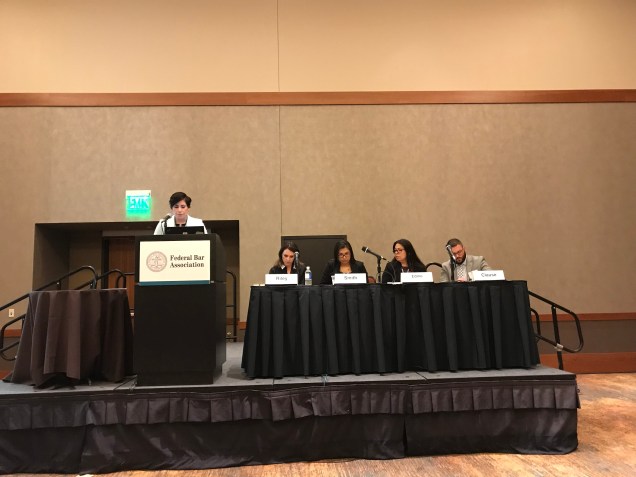
FBA Indian Law Conference ICRA Panel

Karla General, Angela Riley, Terri Smith, Se-ah-dom Edmo, and Josh Clause

380DE011-16CF-4D47-A531-A912F85F7332

Update in Nooksack RICO Suit

Here are the new materials in Rabang v. Kelly (W.D. Wash.):

03-20-18 Letter From Bob Kelly and Notice of Involuntary Disenrollement

144 3-15-18 Kelly Defendants’ Motion for Indicative Ruling Regarding Dismissal

146 3-15-18 Defendant Chief Judge Ray Dodge’s Notice of Joinder of Kelly Defendants’ Motion for Indicative Ruling

147 3-26-18 Plaintiffs’ Response in Opposition to Defendants’ Motion for Indicative Ruling Regarding Dismissal

UPDATE (4/11/18) — motion denied

4-11-18 Order Denying Defendants’ Rule 62.1 Motion For Indicative Ruling Regarding Dismissal

NCAI: “VAWA 2013’s Special Domestic Violence Criminal Jurisdiction (SDVCJ) Five-Year Report”

Here.

Ninth Circuit Briefs in Mitchell v. Tulalip Tribes [challenge to tribal zoning ordinance]

Here:

Mitchell Opening Brief

Tulalip Answer Brief

Reply Brief

Greg Bigler on Traditional Jurisprudence

Judge Gregory Bigler has posted “Traditional Jurisprudence and Protection of Our Society: A Jurisgenerative Tail” on SSRN. Here is the abstract:

This paper is an exercise in self-discipline organizing thoughts from a long period of work and life that explores some of what uniquely guides traditional Euchee and Muscogee society. I use my participation in traditional Euchee ceremonial life as a lens with which to view tribal, federal and human rights law and processes. By so doing I hope to begin articulating a modern traditional Indian jurisprudence and find some source(s) to aid in preservation of native society. In order to truly reform federal Indian law not only must traditional tribal jurisprudence be acknowledged, but the processes used by ceremonial people must be understood, and utilized, in a transformative effort. While I am informed by discussions with friends from other tribes who hold similar beliefs to my Euchee people, however, I write from the perspective of a Polecat Euchee ceremonial stomp ground member. I believe the validity of my observations depends on the discussions being tribal specific, meaning I do not simply refer to “Indian” traditions but rather to Euchee, Muscogee, Shawnee, etc., traditions. Such traditional jurisprudence must be a foundation of the current international indigenous rights efforts regarding sacred sites and artifacts, religious practices and culture if those efforts are to have meaning. If Indian advocates are unable to articulate what we believe and the nature of the society being destroyed it is more difficult to argue for its’ continuity. Perhaps more importantly, we must be able to explain to ourselves what we believe, teaching our own people and incorporating those beliefs into our own tribal institutions thus continuing (or creating) a social-legal system that can carry us into the future. I hope the process I explore herein will also be of interest to my friends and colleagues exploring federal Indian law and international human rights.

HIGHLY RECOMMENDED!

Ninth Circuit Oral Argument Video in Rabang v. Kelly [Nooksack]

Here.

Briefs here.

Jim Diamond on Practicing Indian Law in Federal, State, and Tribal Criminal Courts

James D. Diamond just published “Practicing Indian Law in Federal, State, and Tribal Criminal Courts and an Update on Recent Expansion of Criminal Jurisdiction Over Non-Indians” in the ABA’s Criminal Justice Magazine. PDF SSRN

Eid & Goldtooth on Navajo Juvenile Justice Law

Troy A. Eid and DeAnna Goldtooth have published “’Children Are Sacred’:  Applying Navajo (Dine’) Fundamental Law to Strengthen Juvenile Justice” at 62 The University of South Dakota Law Review 728 (2017). The draft manuscript is here.

Standing Rock Children’s Code RFP

REQUEST FOR PROPOSALS

The Standing Rock Sioux Tribe (Tribe) is now accepting Proposals from qualified individuals, organizations or firms for the development of a Children’s Code for the Standing Rock Sioux Tribe’s Code of Justice.  The Tribe currently has a Children’s Code but the current version is in need of revision to reflect changes in the law and current practices.

The successful Proposal should reflect experience working with Tribes and Tribal Courts. Experience in Code drafting and development, knowledge of the issues facing Children’s Courts, knowledge of the law as it pertains to Abuse and Neglect proceedings, Delinquency, Status offenses, Indian Child Welfare proceedings, Custody, Termination and Adoptions issues/ proceedings and Title IVE requirements.   The Tribe also seeks to implement traditions and customs where applicable or necessary.

Requested Information: A) Cover Letter B) Outline of Experience working with: (1) Abuse & Neglect cases; and, (2) Title IV(e). C) Two (2) years minimum experience in each case type is recommended but not required. D) Whether the Bidder is Tribal or Indian Owned. Copies of tribal identification cards must be included to support the statement. Indian owned is defined as any business that is at least fifty-one percent (51%) owned by an individual who is an enrolled member of a federally recognized tribe; E) detailed breakdown of cost(s) of preparation; and, F) References.

Deadline for submission is January 19, 2018 at 4:00pm CST.  The Tribe reserves the right to select, any bid or no bid. Proposals should be submitted in PDF format via email to: dagard@standingrock.org. Sealed proposals will be received in person at SRST Tribal Court, c/o Melvin White Eagle Building, 101 Agency Avenue, Fort Yates, ND 58538 or mailed to SRST Court, P.O. Box 363 Fort Yates, ND 58538, Attn. D. Agard, Court Administrator.