
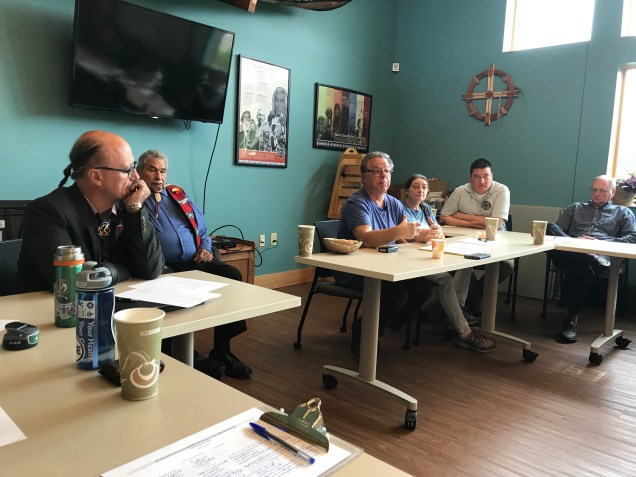

Pokagon Peacemaking Discussion
Here is the brief:
An excerpt:
This brief is submitted in response to the Court’s order inviting the Solicitor General to express the views of the United States. After the petition for a writ of certiorari was filed, amendments to tribal law were proposed that could substantially affect the basis for the decision of the Supreme Court of Alabama in this case. In the view of the United States, if those changes are enacted, the petition should be granted, the judgment vacated, and the case remanded for further proceedings.
Cert stage materials are here.
UPDATE:
Here.
I am an attorney, adjunct professor, and scholar conducting research on tribal responses to #MeToo. If you know of Tribes that have adopted personnel policies or code provisions in response to the #MeToo movement and are able to send me information or links to the relevant provisions, I would greatly appreciate it. You can reach me at ann at anntweedy.com. Thank you in advance!
Here:
Questions presented:
1. Does an Indian Tribe have authority under the second exception of Montana v. United States, 450 U.S. 544 (1981), to forfeit automobiles owned by non Native Americans for violation of tribal drug laws while on tribal land?
2. If so, does the Tribe have authority to seize a motor vehicle off reservation if it has probable cause to believe that the automobile previously contained illegal drugs while on tribal lands?
Lower court materials here.
Here, on SSRN.
The abstract:
The question whether Congress may create legal classifications based on Indian status under the Fifth Amendment’s Due Process Clause is now reaching a critical point. Critics claim the Constitution allows no room to create race or ancestry based legal classifications. The critics are wrong.
When it comes to Indian affairs, the Constitution is not colorblind. Textually, I argue, the Indian Commerce Clause and Indians Not Taxed Clause serve as express authorization for Congress to create legal classifications based on Indian race and ancestry, so long as those classifications are not arbitrary, as the Supreme Court stated a century ago in United States v. Sandoval and more recently in Morton v. Mancari.
Should the Supreme Court reconsider those holdings, I suggest there are significant structural reasons why the judiciary should refrain from applying strict scrutiny review of Congressional legal classifications. The reasons are rooted in the political question doctrine and the institutional incapacity of the judiciary. Who is an Indian is a deeply fraught question to which judges have no special institutional capacity to assess.
Here are the materials in Dallas v. Hill (E.D. Wis.):
Here:
UPDATE:
Question presented:
Does sovereign immunity bar the federal courts’ consideration of a declaratory judgment action to determine whether Respondent Tribes can exercise regulatory/taxing authority over real property owned in fee by Petitioners non-Indians, pursuant to allotments that were authorized by the Tribes’ treaty with the United States?
Lower court materials here.
 Turtle Talk
You must be logged in to post a comment.