Here are the materials in Cross v. Dept. of Interior (D. Ariz.):
tribal constitutions
Fletcher: “Law, Politics, and the Constitution”
Here, on SSRN.
The abstract:
The question whether Congress may create legal classifications based on Indian status under the Fifth Amendment’s Due Process Clause is now reaching a critical point. Critics claim the Constitution allows no room to create race or ancestry based legal classifications. The critics are wrong.
When it comes to Indian affairs, the Constitution is not colorblind. Textually, I argue, the Indian Commerce Clause and Indians Not Taxed Clause serve as express authorization for Congress to create legal classifications based on Indian race and ancestry, so long as those classifications are not arbitrary, as the Supreme Court stated a century ago in United States v. Sandoval and more recently in Morton v. Mancari.
Should the Supreme Court reconsider those holdings, I suggest there are significant structural reasons why the judiciary should refrain from applying strict scrutiny review of Congressional legal classifications. The reasons are rooted in the political question doctrine and the institutional incapacity of the judiciary. Who is an Indian is a deeply fraught question to which judges have no special institutional capacity to assess.
New Scholarship on IP and Traditional Knowledge in Tribal Codes
Dalindyebo Bafana Shabalala has posted “Intellectual Property, Traditional Knowledge, and Traditional Cultural Expressions in Native American Tribal Codes” on SSRN.
Here is the abstract:
Indigenous peoples and nations have been making demands for protection and promotion of their intellectual property, traditional knowledge, and traditional cultural expressions in domestic and international fora. The power of the basic demand is one that lies in claims of moral duty and human rights. This Article argues that in order for such claims to have power, one of the necessary elements for success is that the demandeurs themselves need to provide such protection within whatever scope of sovereignty that they exercise. In the context of Native American tribes seeking protection for Native American intellectual property under federal law in the broader territory of the United States, this Article argues that a necessary condition for success may be ensuring such protection on their own tribal territory. This Article serves as an early contribution to a broader research agenda aimed at providing more data as a basis for tribal claims for protection of their traditional knowledge and traditional cultural expressions. It presents a survey of the nature and scope of legal and formal protection that tribal legislation in the United States has provided for traditional knowledge and traditional cultural expressions. It further surveys and analyzes the nature and scope of protection provided under federal law and assesses the gap between what tribal codes provide and what federal law provides. It then proposes a series of next steps as a research agenda.
New Scholarship on the Tohono O’odham Legal Systems
Kyle Fields has posted “Tohono O’odham Legal Systems” on SSRN.
Here is the abstract:
This short essay surveys the Tohono O’odham’s legal system through three periods. First, it discusses the traditional O’odham legal system, which relied on himdag (culture or way of life). Second, it reviews how the Spanish, using an inquisitorial system based on Christian religious law, altered the O’odham’s legal system. Third, it analyzes how the secular American adversarial system changed the O’odham’s legal system.
Julia Stinson on Disenrollment as Cruel and Unusual Punishment
Julia M. Stinson has posted “When Tribal Disenrollment Becomes Cruel and Unusual” on SSRN. The article is forthcoming in the Nebraska Law Review. Here is the abstract:
In the past two decades, Native American tribes have disenrolled—permanently removed from tribal citizenship—thousands of tribal members, mainly because of lineage concerns or for political reasons. In these instances, scholars generally decry disenrollment. But there is a growing trend to disenroll tribal citizens for criminal conduct, and scholars (and even tribal members themselves) assume this is proper. This paper argues that tribal disenrollment for criminal conduct violates the Indian Civil Rights Act’s prohibition on cruel and unusual punishment.
The Supreme Court held that denationalization as a result of criminal conduct is cruel and unusual punishment in violation of the Eighth Amendment. Congress applied that same prohibition to Native American tribes in the Indian Civil Rights Act. And traditionally, tribes, who had the inherent power to impose any sanction necessary, focused on restoring harmony rather than punishing offenders; permanent expulsion was almost never imposed. Tribes are nations, and tribal membership is a voluntary compact equivalent in all meaningful respects to United States citizenship—hence, tribes cannot disenroll members for criminal behavior. Yet Congress also severely limited tribes’ ability to punish criminal defendants by capping incarceration at one year, and crime in Indian country is a significant problem. To allow tribes to battle crime and yet protect against cruel and unusual punishment, Congress should remove the limit on incarceration and individual tribal members can decide whether they are willing to submit to their tribe’s inherent power—and greater sentences—or voluntarily renounce their tribal citizenship.
ILADA Blog [McGill Law]: Seasonal Thematic Contributions by Indigenous Legal Scholars
Here:
Season 1: Law Through Language (2018)
Our first season focuses on language as law: within the context of language revitalization, how do Indigenous laws pronounce themselves through language? How can Indigenous laws be strengthened, given the impact of colonialism on Indigenous languages? And can the changes required to revitalize—funds, experts, and the privileging of resources—create additional inequities? This season seeks to answer these questions among others.
This season aims first and foremost to address the crucial relationship between language and law: in particular, the role Indigenous languages play in articulating Indigenous laws. Writing about the Navajo people, Anishinaabe scholar Matthew Fletcher emphasizes, “for many tribal communities, the law is encoded right into the language – and the stories generated from the language.”1 Because most Indigenous communities historically expressed (and continually express) their customs and laws orally, this statement applies to Indigenous groups broadly.2 This season features contributors who explore expressions of law and answer questions about how language deepens and complicates protocols, interpretations and worldviews.
We recognize inherent challenges in this exercise: communities experience “law” in different forms and may not identify practices and behaviours as law in the same way that they are identified in Western legal normativity. What one group claims as “law” may be something entirely different to another; and not everything is translatable into English or French—nor should it be. As John Borrows stated, “context should not be stripped from the practice of Indigenous law.”3 Often, that context is language. Our contributors this season help to tease out how Indigenous languages limit and liberate, stymie and enable, and generally complicate the articulation of Indigenous law.
The State of Canada’s Indigenous Languages by Katsi’tsakwas Ellen Gabriel
Indonaakonigewininaan – Toward an Anishinaabe Common Law by Matthew L.M. Fletcher
Language and Anishinaabe Consultation Law by John Borrows
1 Matthew Fletcher, “Rethinking Customary Law in Tribal Court Jurisprudence” (2007) 13 Mich J Race & L 57 at 21.
2 Ibid at 41, “Indian cultures (often) were and are oral cultures.”
3 Borrows, John, “Foreword: Indigenous Law, Lands, and Literature,” (2016) 33 Windsor YB Access to Just v at ix.
Mildly Interesting SCOTUS Development: Bearcomesout Cert Petition
Here is the petition in Bearscomesout v. United States:
Question presented:
Whether the “separate sovereign” concept actually exists any longer where Congress’s plenary power over Indian tribes and the general erosion of any real tribal sovereignty is amplified by the Northern Cheyenne Tribe’s Constitution in this case such that Petitioner’s prosecutions in both tribal and federal court violate the Double Jeopardy Clause of the Fifth Amendment to the United States Constitution.
The Ninth Circuit’s unpublished opinion is here. We posted briefs in this case because the federal appellate defender characterized this case as a direct challenge to the applicability of the dual sovereign exception to double jeopardy as applied to Indian tribes.
SCOTUSBlog notes this case has been relisted, perhaps because a justice wants to write a dissent from denial of certiorari (Justice Thomas anyone?), but who knows?
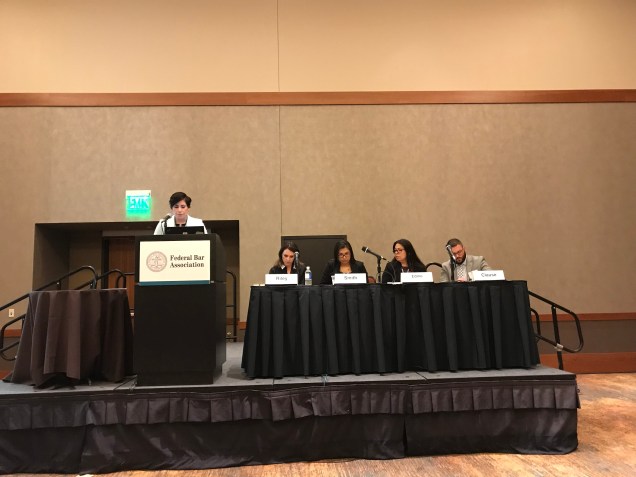
FBA Indian Law Conference ICRA Panel
Karla General, Angela Riley, Terri Smith, Se-ah-dom Edmo, and Josh Clause
NAICJA Save the Date (Oct. 16-19) and Call for Papers (Due April 20)
One of my favorite conferences of the year–and I always offer to do an ICWA/transfer to tribal court case law update!
 RFP for Presentations- 2018 NAICJA Conference – DUE APRIL 20th!
Update in Nooksack RICO Suit
Here are the new materials in Rabang v. Kelly (W.D. Wash.):
03-20-18 Letter From Bob Kelly and Notice of Involuntary Disenrollement
144 3-15-18 Kelly Defendants’ Motion for Indicative Ruling Regarding Dismissal
UPDATE (4/11/18) — motion denied
4-11-18 Order Denying Defendants’ Rule 62.1 Motion For Indicative Ruling Regarding Dismissal
 Turtle Talk
You must be logged in to post a comment.