Journal of Court Innovation Special Issue on Tribal Justice

ARTICLES

Full Faith and Credit and Cooperation Between State and Tribal Courts: Catching Up to the Law
By Paul Stenzel | PDF

Treaties, Tribal Courts, and Jurisdiction: The Treaty of Canandaigua and the Six Nations’ Sovereign Right to Exercise Criminal Jurisdiction
By Carrie E. Garrow | PDF

21st Century Indians: The Dilemma of Healing
By Carey N. Vicenti | PDF

The State of Pretrial Release Decision-Making in Tribal Jurisdictions: Closing the Knowledge Gap By John Clark | PDF

Tribal Probation: An Overview for Tribal Court Judges
By Kimberly A. Cobb and Tracy G. Mullins | PDF

INTERVIEWS

Introduction Reflections on Tribal Justice: Conversations with Native American Judges | PDF

Abby Abinanti, Chief Judge, Yurok Tribal Court, Klamath, California, and California  Superior Court Commissioner | PDF

P.J. Herne, Chief Judge, St. Regis Mohawk Tribal Court, Akwesasne, N.Y. | PDF

B.J. Jones, Tribal Court Judge and Director, Tribal Judicial Institute at the University of North Dakota School of Law | PDF

Continue reading

Navajo SCT Issues In re Saenez Writ of Prohibition — UPDATED

Here is the opinion in In re Saenez: InreSeanezWrit.

An excerpt:

On August 4, 2010, you issued a legal memorandum advising the Speaker of the Navajo Nation Council that the Court in its July 16, 2010 Opinion and Order on Reconsideration, Shirley v. Morgan, No. SC-CV-02-10, exceeded its jurisdiction in a number of holdings, even though the holdings are now settled law, with the time period for reconsideration having passed and no motion for reconsideration having been filed or raised by the party Council. You advised the Navajo Nation Council that it is legal to defy our holdings, and the result was in fact defiance by the Office of the Speaker in its August 4, 2010 memorandum to Office of Navajo Government Development staff. Your legal advice runs counter to Navajo Nation law and is in violation of 7 N.N.C. §206 which imposes upon you, as a  government lawyer, a duty not to obstruct interfere or otherwise influence the functions of the Navajo Nation Courts.

The court ordered Mr. Saenez to appear Friday to show cause why he should not be barred from practice in the Navajo courts.

And here is the Chief Legislative Counsel opinion at issue: Opinion_No._CLC-04-10[1]

Federal Court Dismisses Indian Country Indictment for Reliance Upon Uncounseled Tribal Court Convictions

Here are the materials in United States v. Shavanaux (D. Utah):

DCT Order Dismissing Shavanaux Indictment

Shavanaux Motion to Dismiss

Government Opposition to Shavanaux Motion to Dismiss

Shavanaux Reply

Ninth Circuit Concludes Winnemucca Council Dispute

The court’s unpublished opinion in Bank of America v. Swanson is here.

Here are the materials:

Bills Council Opening Brief

Wasson Council Brief

Bills Council Reply part 1

Bills Council Reply part 2

An excerpt:

Continue reading

Navajo Times: Navajo SCT in Navajo Council’s “Crosshairs”

Additional documents:

NN Pres Press Release onElection of NN Judges

Justice Grant denied appt

Justice Shirley denied appt

From the Navajo Times:

The Navajo Nation Supreme Court is under attack.

Legislation to amend the rules for the Council’s Judiciary Committee governing removal of Supreme Court justices and district court judges is targeting Chief Justice Herb Yazzie, according to a “confidential” memo on the bill.

On Wednesday, the Judiciary Committee voted against the permanent appointment of Associate Justice Louise Grant, although she had resigned Oct. 8 and did not attend the hearing.

A day earlier, the committee voted against permanent appointment of Associate Justice Eleanor Shirley, despite a hearing in which no negative comments or information about her were presented.

According to Navajo law, the president cannot reappoint people to the bench once the Judiciary Committee has voted not to confirm them in a permanent appointment.

Leonard Tsosie (Pueblo Pintado/Torreon/Whitehorse Lake), the only lawyer on the Judiciary Committee, said Tuesday that the committee’s 4-3 vote against Justice Shirley was “revenge” for the Supreme Court’s ruling in favor of President Joe Shirley Jr. (no relation) and against the Council’s position in recent cases.

“The evidence before us didn’t support voting against Justice Shirley,” said Tsosie, one of three committee members who voted to confirm her. “In fact, it was unanimously satisfactory.”

On Wednesday, committee Chairman Kee Allen Begay (May Farms/Round Rock) denied Tsosie’s claim.

“The actions of the committee are not to retaliate against the Supreme Court like honorable Leonard Tsosie claims. The committee acted in the best interest of the Navajo people by upholding trust and being an accountable government,” Begay said. “Honorable Tsosie has a history of instigating arguments if a decision does not benefit his values, belief systems or himself.”

In May, the Supreme Court upheld the lower court’s dismissal of voter Tim Nelson’s complaint seeking to overturn a Dec. 15 election that reduced the 88-member Council to 24.

The high court also ordered the Navajo Election Administration to immediately conduct an election for 24 delegates and not 88, derailing efforts by current Council leaders to postpone the downsizing for four years.

The justices also upheld the lower court decision that the Council illegally placed President Joe Shirley Jr. on leave pending a special prosecutor’s investigation of two business deals that cost the tribe millions.

The high court’s ruling is now being recognized as a landmark decision that addresses the role of Diné Fundamental Law, the encroachment of the Council into the judicial branch, the balance of power between the executive and legislative branches, and the primary role of the Navajo people in shaping their government.

According to Sept. 13, 2010, memo labeled “confidential” and addressed to Chief Legislative Counsel Frank Seanez from Delegate Lorenzo Curley (Houck/Lupton/Nahata Dziil), proposed legislation to amend the Judiciary Committee’s hearing rules is intended “to remove the Navajo Nation Chief Justice.”

Continue reading

Minnesota Public Radio: White Earth Pushes for More Law Enforcement

From Minn. Public Radio:

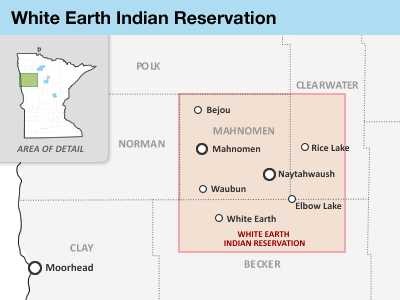
White Earth Indian Reservation, Minn. — Unhappy with the way criminal cases are handled on the White Earth Indian Reservation, tribal officials are seeking more control over law enforcement and the courts.

Tribal officials say local counties don’t prosecute crimes on the reservation aggressively enough.

AN UNEASY RELATIONSHIP

Rape cases particularly are going unpunished on the White Earth reservation, Tribal Attorney Joe Plummer said. Tribal officials want those cases prosecuted to help break the cycle of teen pregnancy and poverty on the reservation.

“These are young girls, 14, 15, 16 years old being impregnated by older men, 21 and older,” Plummer said. “And these are not being prosecuted. I can’t remember when one was prosecuted.”

But county officials strongly disagree. They contend tribal members don’t cooperate with investigators.

The tribe’s dissatisfaction over how criminal cases are handled on the reservation is just one example of the tension between White Earth and Mahnomen County over land, taxes and crime.

“I can’t remember when [a rape case] was prosecuted.”
– Tribal Attorney Joe Plummer

A review of Mahnomen County court records from 2008 to 2009 appears to confirm Plummer’s complaint about the lack of prosecution for criminal sexual conduct cases. But it’s unclear if all of the records from those years are entered in the public database.

When it comes to fighting crime on the White Earth Reservation, counties control the system. The tribe can investigate crimes, but county prosecutors decide who gets charged with a crime.

The two sides often disagree on how cases are handled. It’s one of many areas where the tribe and the county don’t see eye to eye.

COUNTY ATTORNEY: VICTIMS DON’T COOPERATE

Mahnomen County Attorney Julie Bruggeman said she’s not the problem. She said crime victims don’t cooperate with her office.

She also questions whether tribal officials really want justice for all the people accused of a crime. Bruggeman accused tribal officials of wanting to pick and choose who is prosecuted based on tribal connections.

Continue reading

Sault Tribe Members Excluded by State Court Judge from Serving on Jury in Suit against Former Sault Chairman

We’ve been following Sault Ste. Marie Tribe v. Bouschor for many years, and now the claim against Bernard Bouschor may go before a jury next week. But in a very interesting pre-trial order, Judge Johnson (from Emmet County, since the local judge recused himself) ordered that no Sault Tribe members may sit on the jury due to their “financial interest in the litigation.” Order here: Judge Johnson Order Excluding SSM Members from Jury.

Anyone aware of this happening elsewhere in Indian country? I’d imagine it wouldn’t happen often, since there aren’t many of these kinds of claims against former tribal officials in state courts. What I want to know is why the tribe brought suit in state court, when it had a perfectly good tribal court at its disposal. [Now I’m told it was contractual. Now I understand.]

Here is the amended complaint: Amd-Complaint-Fifth[1].

Lower court materials here and here and here.

NAICJA Annual Meeting Agenda — Oct. 26-28, 2010

The 2010 National American Indian Court Judges Association Annual Meeting agenda here: NAICJA Agenda
On-line registration is here.

News Coverage of Shomin v. GTB Election Board

From Indianz:

The tribal court of the Grand Traverse Band of Ottawa and Chippewa Indians of Michigan disqualified a winning candidate from holding public office.

The court said Alvin Pedwaydon violated election law because he sits on a committee that determines the salaries of tribal council members. “I am simply shocked,” told The Leelanau Enterprise in response to the decision.

Pedwaydon was the top vote-getter in the last three elections. He indicated he might pursue an appeal.

Continue reading

Federal Court Rejects Navajo Jurisdiction over Arizona School District — UPDATED

Here is the opinion in Red Mesa USD v. Yellowhair (D. Ariz.): Red Mesa USD Opinion.

Here are the materials:

Red Mesa Motion for Summary Judgment

Navajo Cross-Motion for Summary Judgment

Navajo Response

Red Mesa Reply

Navajo Reply