Here is the opinion in St. Marks v. Chippewa Cree Election Board:
tribal courts
Columbia Law Review Note on Tribal Adjudicatory Jurisdiction
Here is “The Shrinking Sovereign: Tribal Adjudicatory Jurisdiction Over Nonmembers in Civil Cases,” (PDF) published in the Columbia Law Review.
Here is the abstract:
Tribal jurisdiction over nonmembers is limited to two narrow areas: consensual economic relationships between tribes and nonmembers, and nonmember activity that threatens tribal integrity. Even within these two narrow fields, the Supreme Court has stated that tribal adjudicatory power over nonmembers—the authority to decide legal rights of individuals, usually in a trial-like setting—cannot exceed the tribe’s legislative power over nonmembers—the power to regulate nonmember activity through the enactment of legislation and regulation. This raises a question that the Court has acknowledged but never answered: whether a tribe may exercise adjudicatory authority over nonmembers as a result of its legislative power. More simply put, is a tribe’s adjudicatory jurisdiction over nonmembers less than, or equal to, its legislative power?
This Note argues that tribes should have concurrent regulatory and adjudicatory jurisdiction over nonmembers in disputes based on consensual economic relationships, but tribal regulation concerning tribal integrity should be subject to greater federal court oversight. Tribal courts should have presumptive jurisdiction to enforce tribalintegrity regulations; however, proof that the tribal court is unfair or inaccessible to nonmembers should permit federal courts to intervene. By drawing on analogous principles in administrative law, civil procedure, and the law of federal courts, this Note provides a workable solution that is consistent with existing Supreme Court tribal law jurisprudence, that conforms with the normative values shaping jurisdiction in other contexts, and that also respects tribal sovereignty.
WaPo Story on DOJ Taskforce on Violence against Indian Children
Financial Services Company Challenges Sac and Fox Nation’s Tribal Court Jurisdiction
Here are the complaint and tribal court materials in United Planners Financial Services of America LLP v. Sac and Fox Nation (W.D. Okla.):
Pascua Yaqui Tribe Guide to Implementing VAWA’s Tribal Jurisdictional Provisions
Amazing work!
Practical Guide to Implementing VAWA TLOA letter revision 3
Practical Guide VAWA CLE final version
Many thanks for Fred Urbina for sending this around.
Sixth Circuit Briefs in Kelsey v. Pope
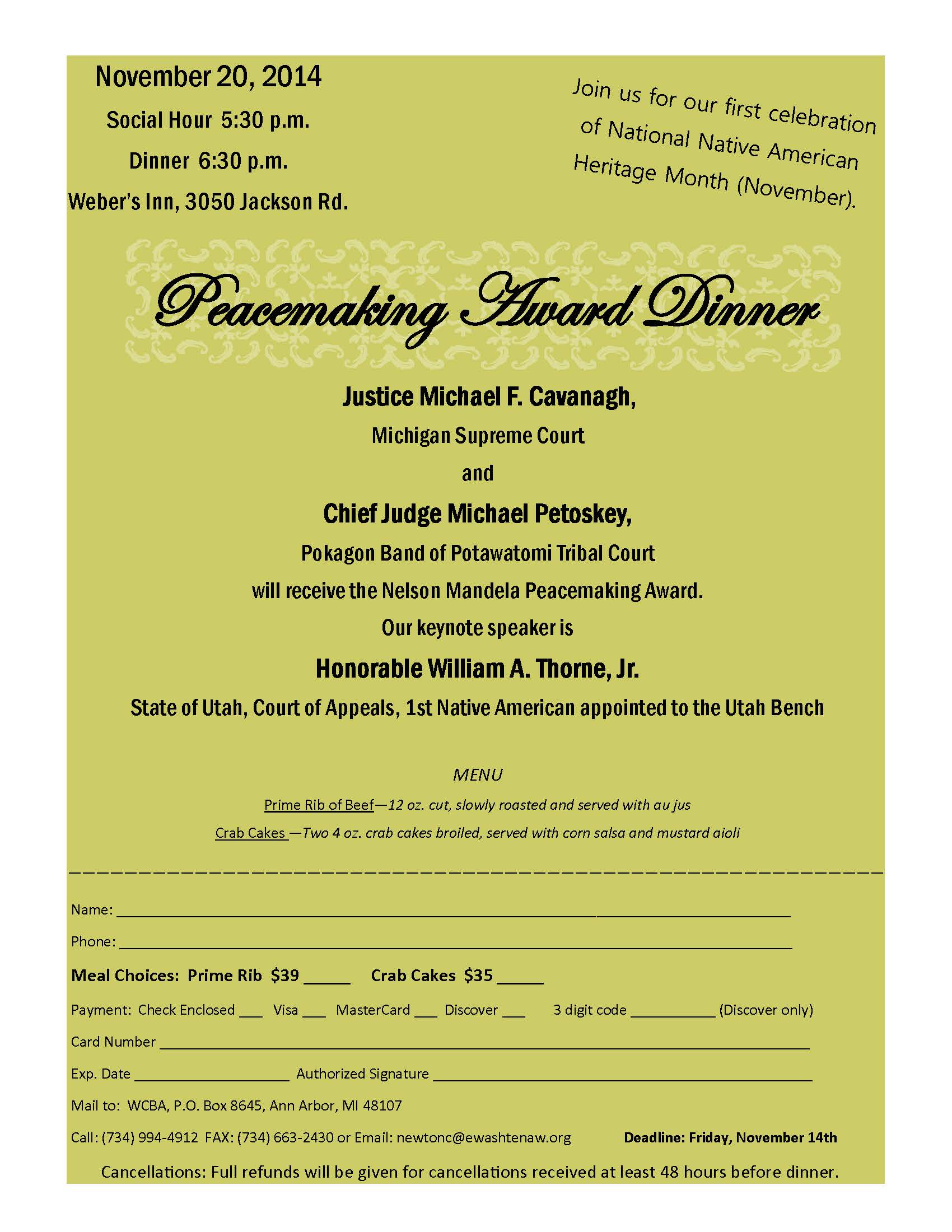
Justice Cavanagh and Chief Judge Petoskey to be Presented with Nelson Mandela Peacemaking Award
Here (PDF):
Gila River Indian Community Court Clerk and Family Drug Court Counselor Job Openings
Here:
And here:
Court clerk
Family Drug Court coordinator
Michigan SCT Justice Mike Cavanagh OpEd: “Inaugural tribal-state court forum addresses child welfare issues”
Justice Cavanagh’s op/ed is available here.
An excerpt:
Our inaugural Tribal State Federal Judicial Forum meeting this week focused on issues of Indian child welfare, on outlining the scope of the Forum’s work, and on organizing our leadership. We examined what forums in other states are doing to find examples of best practices and innovations. Also, we delved into the ICWA as the “gold standard,” as well as the importance of judicial leadership and collaboration.
Because we can’t know where we should be headed if we don’t know where we are now, the Forum also received updates on Michigan Indian child welfare data, and child welfare services and resources from the State Court Administrative Office.
Most importantly, the Forum finalized our Naakonigewin, or Charter, which defines our make-up, appointment process, and governance. The Charter will not only solidify and formalize a valuable, long-standing relationship, but it also will lay the groundwork for future collaborations among the courts. The Charter will guarantee that while the names may change, the mission will continue.
As we opened our meeting with a traditional tribal pipe ceremony and drums, I had the honor of sharing some reflections on my lifelong commitment to improving relations between our sovereign governments and our people. I am also excited to hand over my role as Supreme Court Tribal Liaison Justice to the Forum to Justice Bridget McCormack. I have no doubt she will bring even more passion and dedication to the task.
I am positive that the Forum, under the guidance of Justice McCormack, its tribal and state judge co-chairs, and the participation of many of the state’s and tribes’ most dedicated jurists, will continue to find common ground to accomplish wonderful things for all our children. The measure of our success will be reflected in strong relationships, linking our peoples, learning from the lessons of the past and leading our children to a better future.
Update in Hualapai Ranch Tribal Court Litigation
Here are additional materials in WD at the Canyon v. Hwal’Bay Ba:J Enterprises Inc. (Hualapai Tribal Court):
Order setting telephonic hearing
Respondents’ Supplementary Brief Disclosure
Plaintiffs’ Disclosure Statement
Prior posts are here and here.
 Turtle Talk
You must be logged in to post a comment.