Greg Ablavsky on Structural Federal Indian Law

Gregory Ablavsky has published “Structural Federal Indian Law after Brackeen in the Arizona Law Review. PDF

The abstract:

“You know, when it comes to Indian law, most of the time we’re just making it up,” Justice Scalia once observed. This admission echoed long-standing critiques of the Supreme Court’s jurisprudence in the field, but these anxieties did not trouble the Court—until recently. Over the past two decades, the Court has begun to revisit the field’s foundations, culminating in the Court’s 2023 decision in Haaland v. Brackeen, which upheld the Indian Child Welfare Act against a constitutional challenge. Though the Court upheld the law, the majority pleaded for a “theory for rationalizing this body of law.” Justices Gorsuch and Thomas, each writing separately and at length, offered sharply different visions that would dramatically remake current doctrine.

Rather than providing a single theory, this Article tries to make sense of this current moment of “confusion” in federal Indian law, in the Brackeen majority’s language, by putting the field in dialogue with structural constitutional law. The fields have much in common: both deal with legal rules governing the distribution of governmental authority, and both confront the frequent absence of textual guidance. But in structural constitutional law—which rarely considers the authority of Native nations—the Court has developed a clearer and more fully articulated methodology for resolving this problem of textual underdetermination.

Extending this approach to federal Indian law, I argue, could produce greater clarity and rigor in the field. In particular, this method yields what I term two answers that the federal government has posited over its history to the interrelated questions of federal, Native, and state authority. I then use this framework to evaluate the visions for federal Indian law announced in Brackeen, all of which elide or submerge the jurisprudential choices that assessing these conflicting answers requires. I conclude by offering some thoughts on how Native nations and their advocates might confront this current moment of uncertainty and debate within the Court’s Indian law jurisprudence.
Lauren van Schilfgaarde on the Continuing Problem of the Vanishing Indian

Lauren van Schilfgaarde has posted “(Un)Vanishing the Tribe,” forthcoming in the Arizona Law Review, on SSRN. Here is the abstract:

The U.S. Supreme Court has revived a century-old rhetoric that frames Tribal sovereignty as vanishing. The logic behind this reasoning is often cloaked behind concerns for states’ equal footing and interests. But once the veneer is removed, the Court’s reliance upon what I term the “vanishing Tribe trope” reveals a lawless foundation, and ultimately harms the legal principles of sovereignty it proports to enforce.

Like nation-state sovereignty, Tribal sovereignty is rooted in international norms reflecting the self-determination rights of peoples to territorial integrity, political unity, and to be free from nonintervention. International legal norms recognize dominant-dependent sovereign relations, like that between the U.S. federal government and Tribes, as negotiated power imbalances between sovereigns that nevertheless preserve their respective sovereignty and thereby preserve sovereignty broadly. Within federal Indian law, Tribal sovereignty has long been a volatile legal doctrine. Nevertheless, federal Indian law’s international roots are reflected in the federal Indian legal principle that Tribal self-government should be persevered unless Congress clearly expresses otherwise.

Such legal principles, however, are only as valuable as courts value Tribes. In the late nineteenth century, despite the fortitude of sovereignty terminology, courts often dismissed Tribal sovereignty because they perceived Tribes as vanishing. Tribes would soon be gone, so the thinking went, and so courts need only give passing concern to threats to Tribal sovereignty as those threats would soon be moot. In short, Tribal sovereignty was “temporary and precarious.” But Tribes did not vanish. Rather, Tribes are thriving, and their sovereignty is now framed in their perpetual rights to self-determination. So why then, did the U.S. Supreme Court in Oklahoma v. Castro-Huerta, hold that Tribal sovereignty had once again been implicitly divested? In citing to historically fraught late nineteenth century cases, the Court has revived antiquated views of Tribes as inferior, and inevitably vanishing. Tribes’ vanishing status permits the Court to abandon judicial restraint and imply unauthorized intrusions into Tribal sovereignty. The Court was disturbingly out-of-step with contemporary understandings of Tribal sovereignty, and consequently threatens any legal foundations on which to rely and plan for a future.

To anticipate a future that includes Tribes necessitates contending with the Court’s new embrace of the vanishing Tribe legal doctrine in Castro-Huerta and its company—doctrine that envisions a Tribe-less future. Castro-Huerta frames the Tribal-federal sovereign-to-sovereign framework as crumbling pillars limply bracing a precarious and temporary Tribal sovereignty. Anticipating Tribal futures must dismiss these crumbling pillars and will require not just contending with the vanishing Tribe trope, but with the need to build an entirely new sovereign-to-sovereign framework.

Bill Wood on the Potential History of Indian Gaming

William Wood has published “The (Potential) Legal History of Indian Gaming” in the Arizona Law Review. PDF

Here is the abstract:

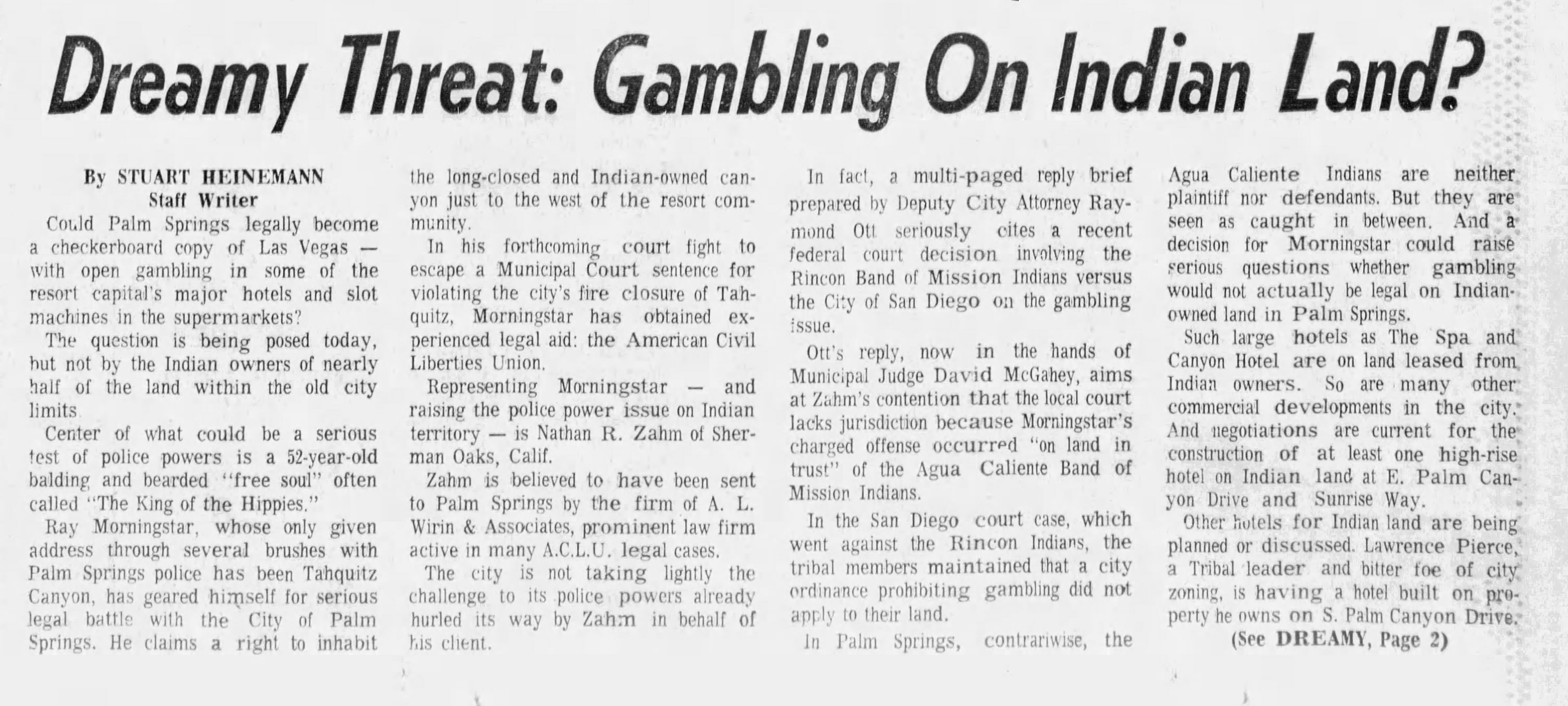
Indian gaming—casinos owned, operated, and regulated by Indian tribes—has been a transformative force for many Indigenous nations over the past few decades. The conventional narrative is that Indian gaming began when the Seminole Tribe of Florida opened a bingo hall in 1979, other tribes began operating bingo, litigation ensued across the continent, and the U.S. Supreme Court recognized tribes’ rights to operate casinos on their reservations in 1987, in California v. Cabazon Band of Mission Indians. Congress then passed the Indian Gaming Regulatory Act in 1988, ushering in the modern Indian gaming era.

This Article provides a heretofore-untold account of the early Indian gaming jurisprudence and related developments. Judges in the earliest Indian gaming cases, which have gone unnoticed, ruled against tribes. Then a series of cases involving the applicability of state law to mobile homes and cigarette and fireworks sales on Indian reservations produced a test under which states could exercise jurisdiction on reservations over activities they prohibit off-reservation but lack jurisdiction over activities they do not prohibit but only regulate. The Supreme Court used this test in Cabazon to hold that state laws did not apply to tribes’ bingo halls and cardrooms.

This Article details the development of the legal doctrine around Indian gaming and how the people involved—legal services attorneys working with legal scholars at the behest and on behalf of Indigenous peoples asserting their sovereignty against state pushback—changed the course of the jurisprudence, providing the framework that yielded the result in Cabazon and Indian gaming as it exists today.

Highly entertaining and recommended.

Palm Springs Desert Sun, March 31, 1971

New Scholarship from Michalyn Steele on Indigenous Resilience

Here, from SSRN:

Indigenous Resilience

Arizona Law Review (Forthcoming), BYU Law Research Paper No. 19-08

Cultivating Professional Identity and Resilience Through the Study of Federal Indian Law

2018 Brigham Young University Law Review 1429, BYU Law Research Paper No. 19-07

Judith Royster on Treaty Rights and Tribal Civil Jurisdiction

Judith Royster has posted “Revisiting Montana: Indian Treaty Rights and Tribal Authority Over Nonmembers on Trust Lands,” published in the Arizona Law Review. PDF SSRN

Here is the abstract:

In a series of cases beginning with its 1981 decision in Montana v. United States, the U.S. Supreme Court has diminished the civil authority of Indian tribal governments over nonmembers within the tribes’ territories. Initially, the Court confined itself to hobbling tribes’ inherent sovereign authority over non-tribal members only on non-Indian (“fee”) lands within reservations. In 2001, however, the Court ruled for the first time that a tribe did not possess inherent jurisdiction over a lawsuit against state officers that arose on Indian (“trust”) lands. What that decision, Nevada v. Hicks, means for general tribal authority over nonmembers on Indian lands is not clear, however, and lower federal courts are struggling to interpret it. The primary issue is whether Hicksintended the Montana approach to extend to all nonmembers on trust lands or whether the decision in Hicks is confined to its particular set of facts. That uncertainty could lead to further inroads on the inherent sovereign authority of tribes.

The Court in Montana, however, recognized a second approach to tribal authority over nonmembers on trust land: the tribal treaty right of use and occupation. Although the Court held that those treaty rights are extinguished on fee lands, it agreed that the rights survive on trust lands. This Article argues that the treaty rights argument—that Indian tribes have rights to govern nonmembers on trust lands recognized by treaty and treaty-equivalent—must be resurrected. If inherent tribal authority over nonmembers on trust lands is under increasing judicial attack, tribes may assert their treaty right to govern as a path to ensure their sovereignty on Indian lands.

New Scholarship on Tribal Disenrollments

Arizona Law Review announces its publication of Galanda and Dreveskracht’s piece entitled Curing the Tribal Disenrollment Epidemic: In Search of a Remedy, which has been described as “a must read for all of Indian country” by Indian law scholar Robert A. Williams, Jr. Please see the press release for additional information.

New Scholarship on the HEARTH Act

Elizabeth Kronk Warner has posted “Tribal Renewable Energy Development Under the Hearth Act: An Independently Rational, But Collectively Deficient Option,” forthcoming in the Arizona Law Review, on SSRN.

The abstract:

Increased domestic energy production is of enhanced importance to the United States. Given the growing focus on domestic energy development, many, including tribal governments, have increasingly looked to Indian country for potential energy development opportunities. Such attention is warranted, as abundant alternative and renewable energy sources exist within Indian country. Many tribes are increasingly exploring possible opportunities related to alternative and renewable energy development. Despite this interest, large alternative and renewable energy projects are virtually absent from Indian country. This article explores why, despite the great potential for alternative and renewable energy development in Indian country and strong tribal interest in such development, such little development is occurring.

Congress enacted the Helping Expedite and Advance Responsible Tribal Homeownership Act (HEARTH Act) in July 2012 to address one of the obstacles to alternative and renewable energy development in Indian country — federal approval for leases of tribal lands. In brief, the HEARTH Act allows tribes with tribal leasing provisions pre-approved by the Secretary of the Interior to lease tribal land without Secretarial approval required for each individual lease.

To fully understand the potential implications of the HEARTH Act, this Article explores obstacles to effective energy development in Indian country, what the HEARTH Act is and how it supposedly addresses those obstacles, and some significant problems associated with enactment of the HEARTH Act — specifically, the mandatory environmental review provisions and waiver of federal liability, and the impact of the liability waiver on the federal government’s trust responsibility to federally recognized tribes. The article ends with some concluding thoughts on how the HEARTH Act and potential future reforms to the existing federal regulatory scheme applicable to energy development in Indian country might better address tribal sovereignty and the federal trust responsibility to Indian country.

“Factbound and Splitless” Available Online

Here and here (Factbound and Splitless):

Factbound and Splitless: The Certiorari Process as Barrier to Justice for Indian Tribes

Matthew L.M. Fletcher

The Supreme Court’s certiorari process does more than help the Court parse through thousands of “uncertworthy” claims—the Court’s process creates an affirmative barrier to justice for parties like Indian tribes and individual Indians. The Court has long maintained that the certiorari process is a neutral and objective means of eliminating patently frivolous petitions from consideration. But this empirical study of 163 preliminary memoranda, recently made available when Justice Blackmun’s papers were opened, demonstrates that the Court’s certiorari process is neither objective nor neutral. The research, reflecting certiorari petitions filed during October Term 1986 through 1993, demonstrates that statistically, there is a near zero chance the Supreme Court will grant a certiorari petition filed by tribal interests. At the same time, the Court grants certiorari to far more petitions filed by opponents of tribal sovereignty.

Barbara Atwood (Arizona) on ICWA

Barbara Atwood has just posted, “The Voice of the Indian Child: Enhancing the Indian Child Welfare Act through Children’s Participation” on SSRN.

From the abstract:

This essay explores the promise and challenge of giving more prominence to the child’s voice in ICWA proceedings in state courts. I identify legal sources of the child’s right of participation in statutory provisions, constitutional law, the UN Convention on the Rights of the Child, and tribal law. The Essay also explores the considerable challenges facing representatives for children who are the subect of ICWA proceedings. Using selected cases for illustration, I argue that incorporating children’s views in the ICWA calculus would move ICWA litigation toward a culture of respect for the dignity of each child and would enrich the decision-making of state court judges.