Navajo Nation Requests Relief Groups Follow Curfew Orders

An NGO (Navajo & Hopi Families COVID-19 Relief Fund) working at Navajo Nation has repeatedly requested to be an exception to the Nation’s curfew rule, and has started a petition regarding it. Here is the Nation’s response:

Letter from NN AG

Letter from NN Department of Health

Navajo Nation orders are available on their website

The Official Navajo Nation relief fund site is here

Tribal Suit over Paycheck Protection Program of CARES Act

Here are the materials (so far) in Flandreau Santee Sioux Tribe v. Carranza (D.S.D.):

4 Motion for TRO

9 First Amended Complaint

New Research on COVID-19 Infection Rates in Indian Country

American Indian Reservations and COVID-19: Correlates of Early Infection Rates in the Pandemic

April 25, 2020 

The SARS-CoV-2 virus is causing widespread devastation as rates of coronavirus disease 2019 (COVID-19) grow across the world. The United States is experiencing one of the largest outbreaks with over half a million confirmed cases as of mid-April 2020. However, outbreaks on tribal lands are largely ignored by the federal government, mainstream media, and case tracking web sites. To reverse this erasure, Indian Country Today has collected cases for the Indian health system. As of April 10, the ICT database contained 861 COVID-19 cases in 287 tribal communities. Infections are growing across Indian Country, but very little is known about the relationship betweencommunity and household characteristics and the rate of COVID-19 spread on tribal lands. This is the question that ateam of Indigenous researchers at UCLA and the University of Arizona are actively working to answer.

This interdisciplinary team includes social demographer Desi Rodriguez-Lonebear, health services researcher Nicolás E.Barceló, economist Randall Akee, and public health researcher Stephanie R. Carroll. Merging the ICT data with the 2018 American Community Survey 5-Year records, they conducted multivariate analyses to identify relationships between the rates of COVID-19 cases per 1000 population and average reservation (or homelands) characteristics. 

The results show that by April 10, 2020, the rate of COVID-19 cases per 1000 people was more than four times higher for the populations residing on reservations than for the U.S. as a whole. COVID-19 cases were more likely to occur in tribal communities with a higher proportion of homes lacking indoor plumbing. COVID-19 cases were less likely to occur in tribal communities where households spoke English-only.

This research finds that failure to account for the lack of complete indoor plumbing and access to running water in a pandemic may be an important determinant of increased incidence of COVID-19 cases in tribal communities. Access to relevant information in Indigenous languages may play a key role in the spread of COVID-19 in some tribal communities. Previous studies have identified household plumbing, overcrowding, and language barriers as potential pandemic and disease infection risk factors. These risk factors persist. Specific actions must be taken now to provide potable water, and culturally-relevant information via community preferred media.Urgent funding to strengthen tribal public health and household infrastructure, as delineated in treaties and other agreements, isnecessary to protect American Indian communities from COVID-19 and future pandemics. This research has been accepted for publication at the Journal of Public Health Management and Practice.

Media Contact Information – Dr. Randall Akee (rakee@ucla.edu)
Federal Reserve Bank (Minneapolis): “COVID-19 and Indian Country: Early snapshot reveals disproportionate economic exposure and uncertainty”

Here.

Updates to COVID-19 Tribal Documents Page

National Indian Gaming Commission:

NIGC Budgetary Impacts from Coronavirus Pandemic

Letters to the White House:

4-20-2020 – Tribal Letter to the White House re 100% waiver of FEMA cost and reimbusement adjustment

Oglala Sioux Tribe written comments on the Coronavirus Relief Funds

Oglala Sioux Tribe Second Comments on CRF (Rev. 1)


See COVID-19 Tribal Documents updates.


News Coverage of Efforts by Tribes to Self-Isolate in the Face of Pressure of Nonmembers to Enter Indian Lands

Al Jazeera: “As Native peoples self-isolate, outsiders are still demanding in

CBS: “Longstanding issues put Native American communities at high COVID-19 risk

Parker Pioneer: “A look at Montana v. U.S., the court case in CRIT’s ‘stay-at-home’ order“//”CRIT says Governor’s order doesn’t apply in Town of Parker, Tribal Council’s resolution does

Parker Live: “CRIT Attorney General hits back at Town of Parker over COVID-19 orders

ABC: “Isolated indigenous tribes risk extinction from coronavirus, experts say

More ammo for the paper on the pandemic and Montana 2….

Underscore News Profile of Pandemic Epidemic on Oregon Tribes

Here is “Oregon tribes’ primary engines – casinos – stalled by COVID-19.”

Fletcher on the Pandemic and Tribal Powers over Nonmembers

I posted a draft paper, “Indian Lives Matter: Pandemics and Inherent Tribal Powers,” on SSRN.

Here is the introduction to the paper:

America’s reaction to the COVID-19 pandemic of 2020 is a microcosm of how Americans see the nation. It is a story of rugged individualism versus community needs. Many Americans insist on freedom to do as they please, rigorously pushing back on government. But in an environment where small numbers of individuals can easily transmit a deadly infection to others, creating the exponential increase in infections, rugged individualism is a terrible threat. Pandemics, luckily for humans, do not seem to occur all that frequently, but when they do occur, they can dramatically alter human history.

Indian people know all too well the impact of pandemics on human populations, having barely survived smallpox outbreaks and other diseases transmitted during the generations of early contact between themselves and Europeans. Indian people also suffered disproportionately from the last pandemic to hit the United States about a century ago. Some things have changed for the better for Indian people, namely tribal self-governance, but many things are not much better, including the public health situation of many Indian people.

Modern tribal governments navigate a tricky legal and political environment. While tribal governments have power to govern their own citizens, nonmembers are everywhere in Indian country, and the courts are skeptical of tribal authority over nonmembers. For example, after the Navajo Nation announced a 57-hour curfew for the weekend of April 10-13, 2020 (Easter weekend for many), the sheriff’s offices of Cibola and McKinley counties sent letters to the tribe insisting that the tribe refrain from citing nonmembers during the curfew, further insisting that nonmembers are governed more “fully” by the Governor of the State of New Mexico. Further, the fact that it is the county sheriff’s offices – and not counsel for the nonmembers – sending the letters is a deeply consequential signal to the tribal government. Of course, allowing nonmembers freedom to flout the tribe’s curfew defeats the purpose of the curfew. During a pandemic, the limitations on powers of tribal government could lead to tragedy.

This short essay is designed to lay down the argument favoring tribal regulatory powers over nonmembers in Indian country during a pandemic. It should be an easy argument, but federal Indian law makes it more complicated than it should be.

Here are some of the primary source documents noted in the paper:

Cibola county letter

McKinley County Sheriff Letter

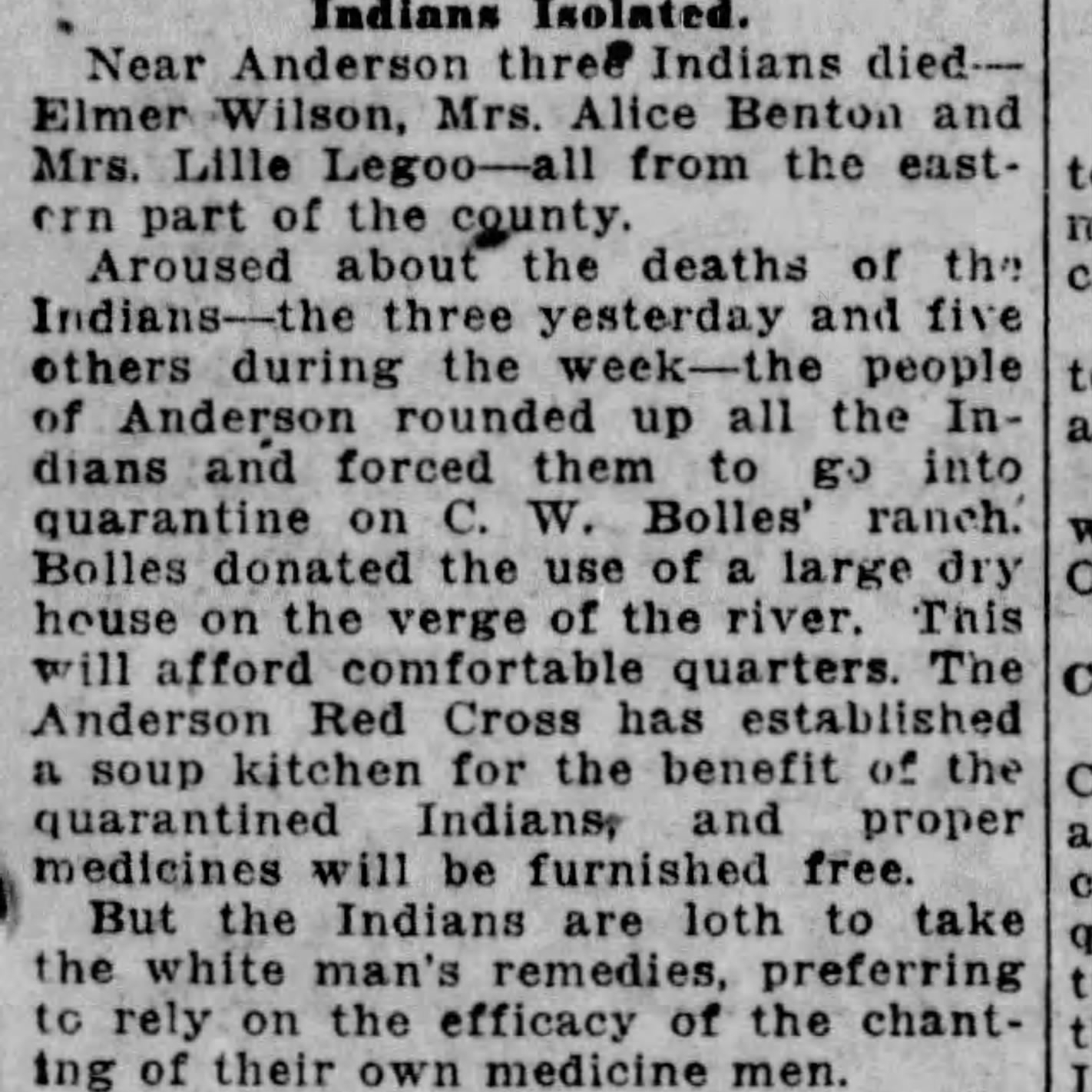
The_Sacramento_Bee_Mon__Oct_28__1918_

Continue reading