Native America Calling: The Battle for Baby Veronica (feat. Kate Fort)

Here:

Tuesday, April 9, 2013 – The Battle for Baby Veronica (listen)
The United States Supreme Court will hear arguments in the case Adoptive Couple v. Baby Girl next week. The case could have long term effects on future adoptions of Native children. The child, a member of the Cherokee Nation, was given up for adoption by her non-Native mother without the consent of the father. At the heart of the Supreme Court case is the Indian Child Welfare Act (ICWA), which regulates adoptions of Native children outside of their tribe. We’re taking a closer look at this case and what it means for Native America. How might the outcome of the case impact families or tribes? What’s the role of tribes in the adoption process? Guests include Chrissi Nimmo (Cherokee) Assistant Attorney General for the Cherokee Nation.

Marcia Zug on the Adoptive Couple Case

Marcia Zug has published “Adoptive Couple v. Baby Girl: Two-and-a-Half-Ways to Destroy Indian Law” in Michigan Law Review’s First Impressions.

The synopsis:

In December 2011, Judge Malphrus of the South Carolina family court ordered Matt and Melanie Capobianco to relinquish custody of Veronica, their two-year-old, adopted daughter, to her biological father, Dusten Brown. A federal statute known as the Indian Child Welfare Act (“ICWA”) mandated Veronica’s return.  However, the court’s decision to return Veronica pursuant to this law incited national outrage and strident calls for the Act’s repeal. While this outrage was misplaced, it may nonetheless have influenced the U.S. Supreme Court’s decision to hear the appeal. The case of Adoptive Couple v. Baby Girl is emotionally complicated, but it is not legally complex. Therefore, the Court’s interest is surprising and likely means that this case will determine more than the fate of a single child.

The court returned Veronica Capobianco to her biological father because the termination of his parental rights and the subsequent adoption attempt did not comply with the requirements of ICWA. South Carolina law would have permitted the involuntary termination of Brown’s parental rights, but ICWA supersedes state law and forbids such involuntary terminations. Consequently, because Brown never relinquished his rights, the family court held that Veronica was not eligible for adoption and that she must be returned to Brown. The South Carolina Supreme Court subsequently affirmed this decision. The court agreed that under the clear language of the Act, Brown qualified as a “parent” and that the termination of his parental rights must comply with ICWA.

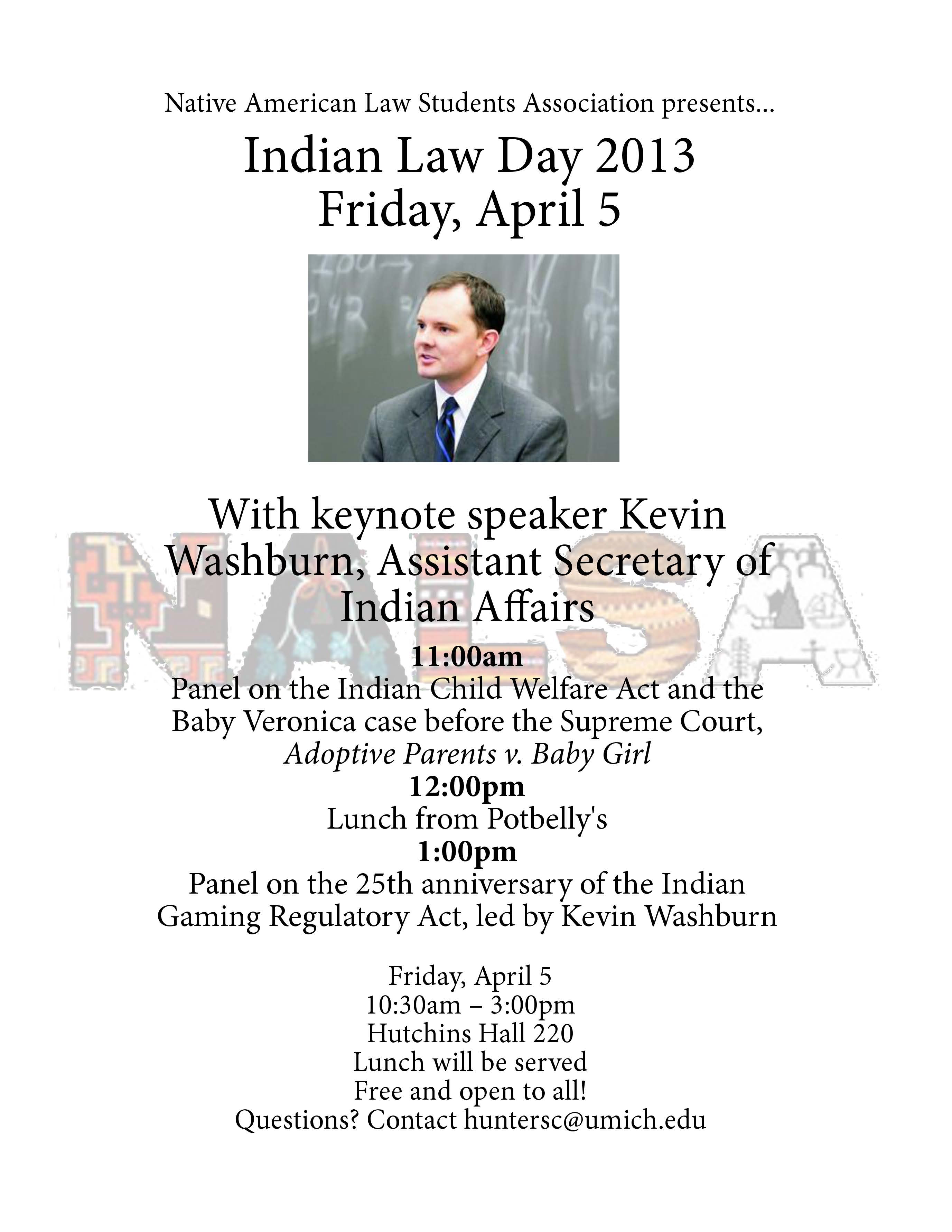
2013 Michigan Indian Law Day — This Friday — UM Law School

ILD2-1

Here:

ILD2-1

Adoptive Couple v. Baby Girl/Cherokee Nation Oral Argument Time Splits

From today’s SCT order:

Upon consideration of the motions for leave participate in oral argument as amicus curiae and the motions for divided argument, the time is to be divided as follows: 20 minutes for petitioners, 10 minutes for respondent Guardian ad Litem, 20 minutes for respondent Birth Father, and 10 minutes for the Solicitor General.

Presumably that means:

20 minutes for petitioners — Lisa Blatt

10 minutes for respondent Guardian ad Litem — Paul Clement

20 minutes for respondent Birth Father — Charles Rothfield

10 minutes for the Solicitor General.

Another monster Indian law argument before the Supremes.


Adoptive Couple v. Baby Girl Amicus Briefs Supporting Respondents — UPDATED 3/29/13

Here:

11-399 bsac The Seminole Nation of Oklahoma

12-399 bsac 63 California Indian Tribes

12-399 bsac American Civil Liberties Union

12-399 bsac Arizona et al

12-399 bsac CurrentandFormerMembersofCongress

12-399 bsac Family Law Professors

12-399 bsac Friends Committee on National Legislation et al.

12-399 bsac Hamline Univ Sch of Law Child Advocacy Clinic

12-399 bsac Lower Sioux Indian Community

12-399 bsac Nat’l Lat Psych Assoc

12-399 bsac Navajo Nation

12-399 bsac Seminole Tribe of Florida et al

12-399 bsac Tanana Chiefs Conference, et al

12-399 bsac The Honorable Abby Abinanti Chief Justice of the Yurok Tribal Court (2)

12-399 bsac Wisconsin Tribes

12-399 Professors of Indian Law Amicus

12-399 bsac Adult Pre-ICWA Indian Adoptees

12-399 bsac Associationon American Indian Affairs

12-399 bsac CaseyFamilyPrograms

12-399 bsac Inter Tribal Council of AZ

12-399 bsac MN DHS

12-399 bsac Nat’l Native American Bar Assoc

12-399 bsac Oklahoma Indian Child Welfare Assoc

ACLU Amicus Brief in Adoptive Couple v. Baby Girl

Here:

12-399bsacAmericanCivilLibertiesUnion

Tribal Amicus Brief on Constituitionality of Indian Child Welfare Act

Here:

12-399 bsacSeminoleTribeofFloridaetal


NARF/Casey Foundation Blog on Indian Child Welfare Developments

Welcome to ICWA INFO, described as:

In early 2013 Casey Family Programs partnered with the Native American Rights Fund to create an online resource that would focus solely on Indian child welfare issues.  Thus, began the ICWA INFO blog.  It was envisioned that this site would provide the public with information and timely updates about all things related to Indian child welfare and the Indian Child Welfare Act (ICWA).  This would include:

  • news about lawsuits related to ICWA in tribal, state, and federal courts,
  • related training and conferences,
  • legal analysis and research resources,
  • federal and state regulations,
  • information about relevant groups and agencies,
  • and job postings.

To see our most recent additions and edits, visit our home page.  To see past materials, you can use our search box or review materials by category, date posted, or topic from the links at the right.

We hope that you find this resource useful and we invite you to submit materials for this website at the contact page.

Highly recommended.

Adoptive Couple v. Baby Girl & Cherokee Nation Respondents’ Briefs

Here:

12-399 Birth Father

12-399 CherokeeNation

ACLU Announcement on Oglala Sioux Tribe v. Van Hunnik

Here.

An excerpt:

Three Indian parents, the Oglala Sioux Tribe, and the Rosebud Sioux Tribe filed a class-action lawsuit to challenge the continued removal of Indian children in Pennington County, South Dakota from their homes based on insufficient evidence and without proper hearings, in violation of the Indian Child Welfare Act of 1978 and the constitutional right to due process.

Congress enacted ICWA to put in place federal safeguards for the removal of Indian children from their homes to both protect the interests of Indian children and give Indian tribes a voice in the process, because of an alarming number of Indian children who were removed from their homes and their tribes. Family separation can be particularly difficult for Indian children because not only are children separated from their parents, but because they are often placed with non-Indian families, they also experience separation from their culture.

When children are removed from their parents based on an allegation of neglect or abuse, a substantive hearing should normally be held in order to determine whether their children should continue to be separated from them. Instead, the lawsuit contends, Pennington County officials hold a cursory hearing in 48 hours that sometimes lasts no more than a minute, where all of the documents are kept a secret from the parents and they are not permitted to introduce any evidence, and their children are then removed for a minimum of 60 days and usually 90 days, according to the complaint. Most parents are also unfairly coerced by the court to “work with” the state Department of Social Services (DSS), which essentially authorizes the department to hold the children for at least two months under whatever terms DSS wants. DSS rarely seeks to assist the family.

The ACLU filed the lawsuit along with the ACLU of South Dakota and Dana Hanna of the Hanna Law Office in Rapid City. The lawsuit was filed on behalf of three parents in Pennington County, as well as the Oglala Sioux Tribe and the Rosebud Sioux Tribe, which are federally recognized Indian tribes with reservations in South Dakota.